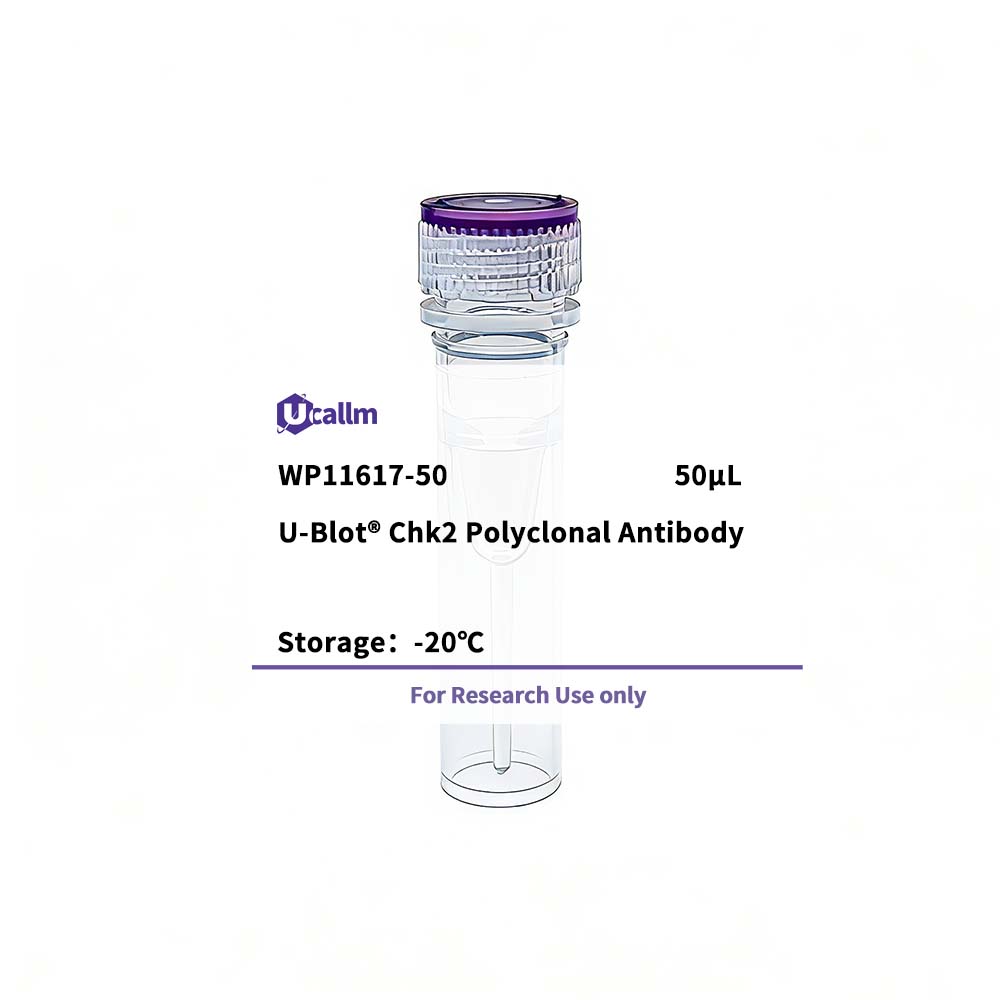
SKU: WP11617 Categories: ,

Chk2 Polyclonal Antibody

Price range: $268.00 through $328.00

SKU: WP11617-100
Enter the quantity you would like, or drag the panel to find the quantity and price that best for you
Bulk QuoteAuthorize OEM & ODM

Product details

Background:

In response to DNA damage and replication blocks, cell cycle progression is halted through the control of critical cell cycle regulators. The protein encoded by this gene is a cell cycle checkpoint regulator and putative tumor suppressor. It contains a forkhead-associated protein interaction domain essential for activation in response to DNA damage and is rapidly phosphorylated in response to replication blocks and DNA damage. When activated, the encoded protein is known to inhibit CDC25C phosphatase, preventing entry into mitosis, and has been shown to stabilize the tumor suppressor protein p53, leading to cell cycle arrest in G1. In addition, this protein interacts with and phosphorylates BRCA1, allowing BRCA1 to restore survival after DNA damage. Mutations in this gene have been linked with Li-Fraumeni syndrome, a highly penetrant familial cancer phenotype usually associated with inherited mutati

Specifications

Size50μL/100μL
TargetChk2
ReactivityHuman, Mouse, Rat
ApplicationsWB, IHC, IF, ELISA
MW(Calculated)
MW(Observed)61kD
Host SpeciesRabbit
IsotypeIgG
Conjugate/ModificationUnmodified
Recommended Dilution RatioWB 1:500-1:2000; IHC 1:100-1:300; ELISA 1:10000; IF 1:50-200 / Note: For IHC, we suggest antigen retrieval with TE buffer pH 9.0 (Cat#WT1004)
FormulationLiquid in PBS containing 50% glycerol, 0.5% BSA and 0.02% sodium azide.
PurificationThe antibody was affinity-purified from rabbit antiserum by affinity-chromatography using epitope-specific immunogen.
Storage-15°C to -25°C/1 year(Do not lower than -25°C)
Concentration1 mg/ml
ClonalityPolyclonal
Clone Number
ImmunogenThe antiserum was produced against synthesized peptide derived from human CHEK2. AA range:35-84
SpecificityChk2 Polyclonal Antibody detects endogenous levels of Chk2 protein.
Gene NameCHEK2
Protein NameSerine/threonine-protein kinase Chk2
Other NameCHEK2; / CDS1; / CHK2; / RAD53; / Serine/threonine-protein kinase Chk2; / CHK2 checkpoint homolog; / Cds1 homolog; / Hucds1; / hCds1; / Checkpoint kinase 2
SpeciesHuman
Gene ID11200
UniprotO96017,
Species.1Mouse
Gene ID.150883
Uniprot.1Q9Z265
Species.2
Gene ID.2
Uniprot.2
Cellular Localization[Isoform 2]: Nucleus. Isoform 10 is present throughout the cell.; [Isoform 4]: Nucleus.; [Isoform 7]: Nucleus.; [Isoform 9]: Nucleus.; [Isoform 12]: Nucleus.; Nucleus, PML body. Nucleus, nucleoplasm. Recruited into PML bodies together with TP53.
Tissue ExpressionHigh expression is found in testis, spleen, colon and peripheral blood leukocytes. Low expression is found in other tissues.
Signaling_pathwayCellular Processes >> Cell growth and death >> Cell cycle;Cellular Processes >> Cell growth and death >> p53 signaling pathway;Cellular Processes >> Cell growth and death >> Cellular senescence
Research Areas>>Cell cycle; / >>p53 signaling pathway; / >>Cellular senescence; / >>Human T-cell leukemia virus 1 infection
FunctionCatalytic activity:ATP + a protein = ADP + a phosphoprotein.,cofactor:Magnesium.,Disease:Defects in CHEK2 are associated with Li-Fraumeni syndrome 2 (LFS2) [MIM:609265]; a highly penetrant familial cancer phenotype usually associated with inherited mutations in p53/TP53.,Disease:Defects in CHEK2 are found in some patients with osteosarcoma (OSRC) [MIM:259500].,Disease:Defects in CHEK2 are found in some patients with prostate cancer (CaP) [MIM:176807].,enzyme regulation:Rapidly phosphorylated on Thr-68 by MLTK in response to DNA damage and to replication block. Kinase activity is also up-regulated by autophosphorylation.,Function:Regulates cell cycle checkpoints and apoptosis in response to DNA damage, particularly to DNA double-strand breaks. Inhibits CDC25C phosphatase by phosphorylation on 'Ser-216', preventing the entry into mitosis. May also play a role in meiosis. Regulates the TP53 tumor suppressor through phosphorylation at 'Thr-18' and 'Ser-20'.,similarity:Belongs to the protein kinase superfamily. CAMK Ser/Thr protein kinase family. CHK2 subfamily.,similarity:Contains 1 FHA domain.,similarity:Contains 1 protein kinase domain.,subcellular location:Isoform 10 is present throughout the cell.,tissue specificity:High expression is found in testis, spleen, colon and peripheral blood leukocytes. Low expression is found in other tissues.,
Please login to post questions
Back to Top
Product has been added to your cart
