SKU: WP11629 Categories: ,

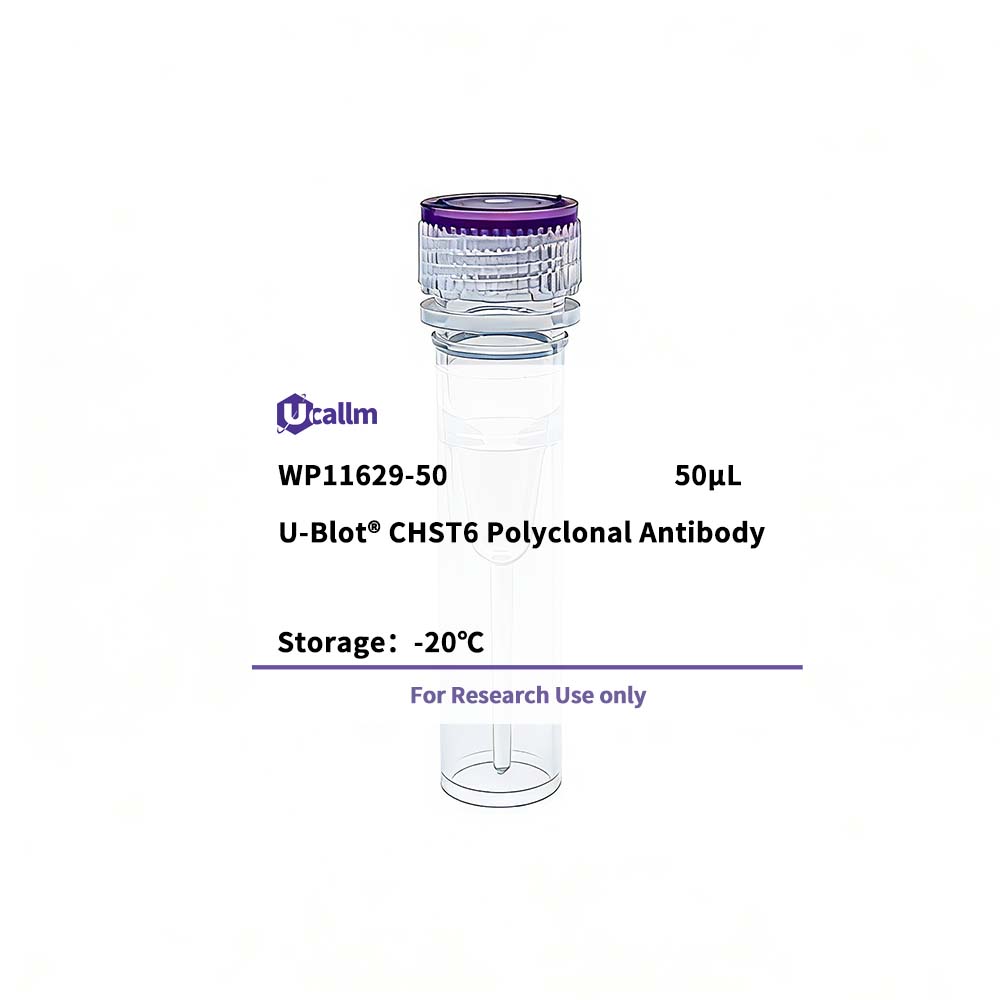
CHST6 Polyclonal Antibody

Price range: $268.00 through $328.00

SKU: WP11629-100
Enter the quantity you would like, or drag the panel to find the quantity and price that best for you
Bulk QuoteAuthorize OEM & ODM

Product details

Background:

The protein encoded by this gene is an enzyme that catalyzes the transfer of a sulfate group to the GlcNAc residues of keratan. Keratan sulfate helps maintain corneal transparency. Defects in this gene are a cause of macular corneal dystrophy (MCD). [provided by RefSeq, Jan 2010],


Specifications

Size50μL/100μL
TargetCHST6
ReactivityHuman
ApplicationsIF, ELISA
MW(Calculated)44kD
MW(Observed)
Host SpeciesRabbit
IsotypeIgG
Conjugate/ModificationUnmodified
Recommended Dilution RatioIF 1:200-1:1000; ELISA 1:20000; Not yet tested in other applications;
FormulationLiquid in PBS containing 50% glycerol, 0.5% BSA and 0.02% sodium azide.
PurificationThe antibody was affinity-purified from rabbit antiserum by affinity-chromatography using epitope-specific immunogen.
Storage-15°C to -25°C/1 year(Do not lower than -25°C)
Concentration1 mg/ml
ClonalityPolyclonal
Clone Number
ImmunogenThe antiserum was produced against synthesized peptide derived from human CHST6. AA range:331-380
SpecificityCHST6 Polyclonal Antibody detects endogenous levels of CHST6 protein.
Gene NameCHST6
Protein NameCarbohydrate sulfotransferase 6
Other NameCHST6; / Carbohydrate sulfotransferase 6; / Corneal N-acetylglucosamine-6-O-sulfotransferase; / C-GlcNAc6ST; / hCGn6ST; / Galactose/N-acetylglucosamine/N-acetylglucosamine 6-O-sulfotransferase 4-beta; / GST4-beta; / N-acetylglucosamine 6-O-sulfotransfera
SpeciesHuman
Gene ID4166
UniprotQ9GZX3
Species.1
Gene ID.1
Uniprot.1
Species.2
Gene ID.2
Uniprot.2
Cellular LocalizationGolgi apparatus membrane; Single-pass type II membrane protein .
Tissue ExpressionExpressed in cornea. Mainly expressed in brain. Also expressed in spinal cord and trachea.
Signaling_pathway
Research Areas>>Glycosaminoglycan biosynthesis - keratan sulfate
FunctionCaution:PubMed:12824236 reported a Gly-204 variant, however according to their results reported in figure 1, it is a Gln-204 variant.,Disease:Defects in CHST6 are the cause of macular corneal dystrophy (MCD) [MIM:217800]. MCD is an autosomal recessive disease characterized by corneal opacities. Onset occurs in the first decade, usually between ages 5 and 9. The disorder is progressive. Minute, gray, punctate opacities develop. Corneal sensitivity is usually reduced. Painful attacks with photophobia, foreign body sensations, and recurrent erosions occur in most patients. There are different types of MCD: MCD type I, in which there is a virtual absence of sulfated keratan sulfate (KS) in the serum and cornea, as determined by KS-specific antibodies; and MCD type II, in which the normal sulfated KS-antibody response is present in cornea and serum. MCD type I patients usually have a homozygous missense mutation, while MCD type II patients show a large deletion and replacement in the upstream region of CHST6. The only missense mutation for type II is Cys-50, which is heterozygous with a replacement in the upstream region on the other allele of CHST6.,Function:Catalyzes the transfer of sulfate to position 6 of non-reducing N-acetylglucosamine (GlcNAc) residues of keratan. Mediates sulfation of keratan in cornea. Keratan sulfate plays a central role in maintaining corneal transparency. Acts on the non-reducing terminal GlcNAc of short and long carbohydrate substrates that have poly-N-acetyllactosamine structures.,online information:GlycoGene database,similarity:Belongs to the sulfotransferase 1 family. Gal/GlcNAc/GalNAc subfamily.,tissue specificity:Expressed in cornea. Mainly expressed in brain. Also expressed in spinal cord and trachea.,
Please login to post questions
Back to Top
Product has been added to your cart