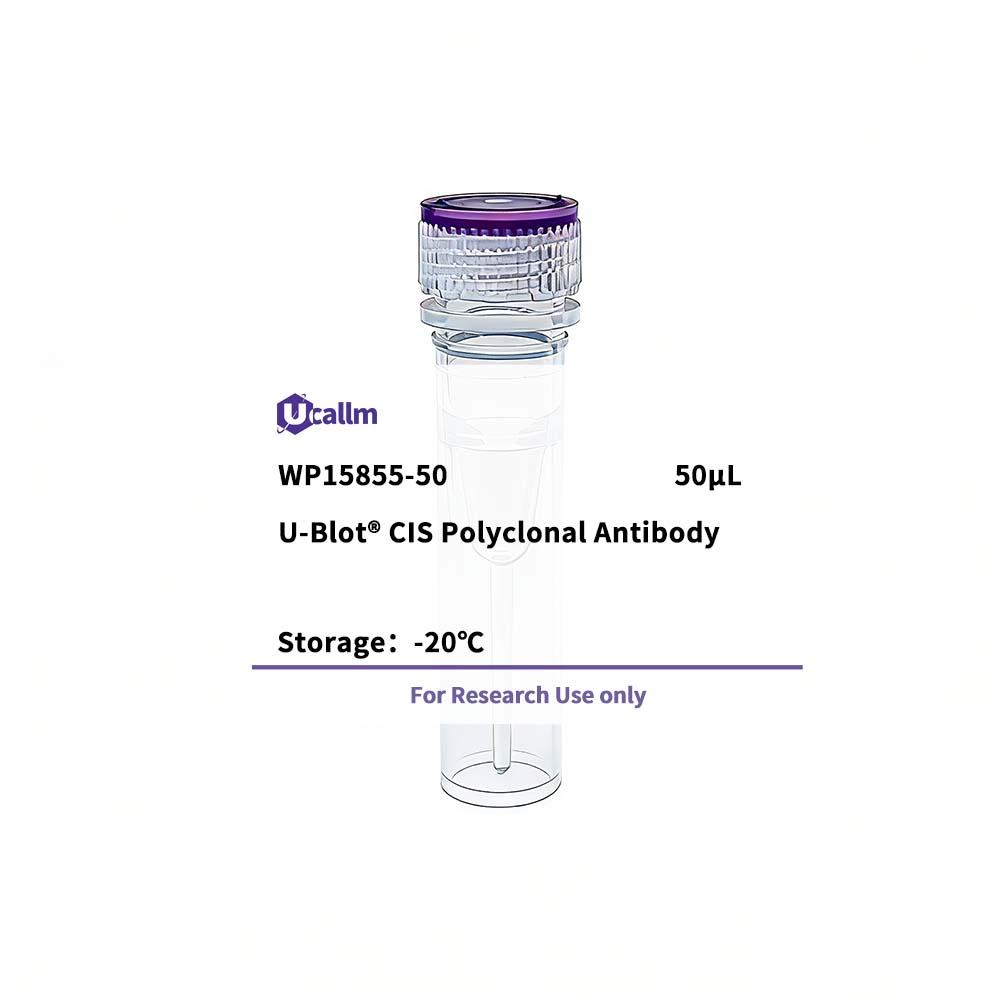
SKU: WP15855 Categories: ,

CIS Polyclonal Antibody

Price range: $268.00 through $328.00

SKU: WP15855-100
Enter the quantity you would like, or drag the panel to find the quantity and price that best for you
Bulk QuoteAuthorize OEM & ODM

Product details

Background:

cytokine inducible SH2 containing protein(CISH) Homo sapiens The protein encoded by this gene contains a SH2 domain and a SOCS box domain. The protein thus belongs to the cytokine-induced STAT inhibitor (CIS), also known as suppressor of cytokine signaling (SOCS) or STAT-induced STAT inhibitor (SSI), protein family. CIS family members are known to be cytokine-inducible negative regulators of cytokine signaling. The expression of this gene can be induced by IL2, IL3, GM-CSF and EPO in hematopoietic cells. Proteasome-mediated degradation of this protein has been shown to be involved in the inactivation of the erythropoietin receptor. Multiple transcript variants encoding different isoforms have been found for this gene. [provided by RefSeq, Aug 2008],

Specifications

Size50μL/100μL
TargetCIS
ReactivityHuman, Mouse, Rat
ApplicationsIHC, IF, ELISA
MW(Calculated)
MW(Observed)
Host SpeciesRabbit
IsotypeIgG
Conjugate/ModificationUnmodified
Recommended Dilution RatioIHC 1:50-200; ELISA 1:10000-20000; IF 1:50-200 / Note: For IHC, we suggest antigen retrieval with TE buffer pH 9.0 (Cat#WT1004)
FormulationLiquid in PBS containing 50% glycerol, 0.5% BSA and 0.02% sodium azide.
PurificationThe antibody was affinity-purified from rabbit antiserum by affinity-chromatography using epitope-specific immunogen.
Storage-15°C to -25°C/1 year(Do not lower than -25°C)
Concentration1 mg/ml
ClonalityPolyclonal
Clone Number
ImmunogenSynthetic peptide from human protein at AA range: 30-90
SpecificityThe antibody detects endogenous CIS
Gene NameCISH G18
Protein NameCytokine-inducible SH2-containing protein (CIS) (CIS-1) (Protein G18) (Suppressor of cytokine signaling) (SOCS)
Other NameCytokine-inducible SH2-containing protein; / CIS; / CIS-1; / Protein G18; / Suppressor of cytokine signaling; / SOCS
SpeciesHuman
Gene ID1154
UniprotQ9NSE2,
Species.1Mouse
Gene ID.112700
Uniprot.1Q62225,
Species.2Rat
Gene ID.2
Uniprot.2O70512
Cellular Localizationcytoplasm,cytosol,plasma membrane,
Tissue ExpressionExpressed in various epithelial tissues. Abundantly expressed in liver and kidney, and to a lesser extent in lung. The tissue distribution of isoforms 1 and 1B is distinct.
Signaling_pathwayOrganismal Systems >> Endocrine system >> Prolactin signaling pathway;Environmental Information Processing >> Signal transduction >> JAK-STAT signaling pathway
Research Areas>>JAK-STAT signaling pathway; / >>Prolactin signaling pathway
FunctionDisease:CISH deletion may be involved in the pathogenesis of renal cell carcinomas and of lung cancer since lung and kidney tumors frequently exhibit 3p21.3 deletions.,Function:SOCS family proteins form part of a classical negative feedback system that regulates cytokine signal transduction. CIS is involved in the negative regulation of cytokines that signal through the JAK-STAT5 pathway such as erythropoietin, prolactin and interleukin 3 (IL3) receptor. Inhibits STAT5 trans-activation by suppressing its tyrosine phosphorylation. May be a substrate-recognition component of a SCF-like ECS (Elongin BC-CUL2/5-SOCS-box protein) E3 ubiquitin-protein ligase complex which mediates the ubiquitination and subsequent proteasomal degradation of target proteins.,induction:By a subset of cytokines including erythropoietin (EPO).,pathway:Protein modification; protein ubiquitination.,PTM:Association with EPOR may target the protein for proteolysis by the ubiquitin-dependent proteasome pathway. CIS is mainly monubiquitinated (37 kDa form) but may also exist in a polyubiquitinated form (45 kDa).,similarity:Contains 1 SH2 domain.,similarity:Contains 1 SOCS box domain.,subunit:Stably associated with the tyrosine-phosphorylated IL3 receptor beta chain and tyrosine-phosphorylated EPO receptor (EPOR).,tissue specificity:Expressed in various epithelial tissues. Abundantly expressed in liver and kidney, and to a lesser extent in lung. The tissue distribution of isoforms 1 and 1B is distinct.,
Please login to post questions
Back to Top
Product has been added to your cart
