

Product details
Background:
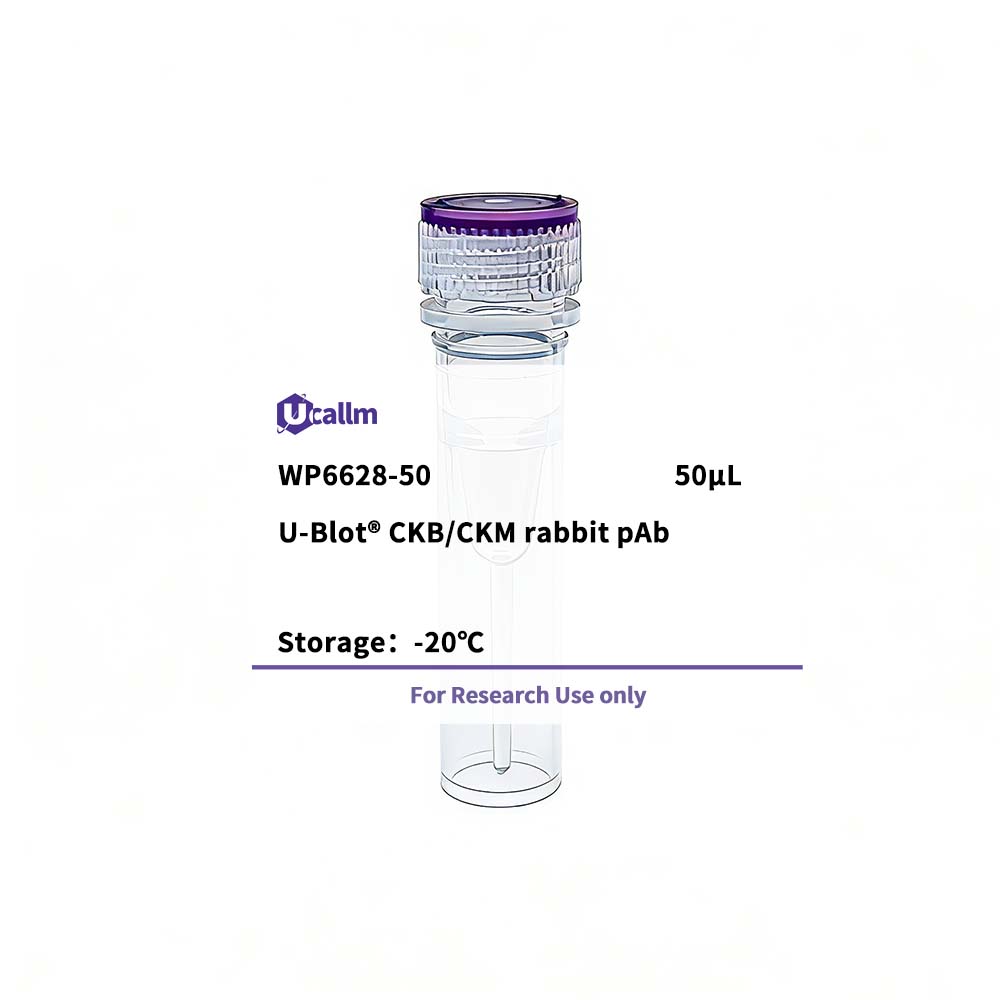
Price range: $268.00 through $328.00
Background:
| Size | 50μL/100μL |
| Target | CKB/CKM |
| Reactivity | Human, Mouse, Rat |
| Applications | WB |
| MW(Calculated) | 42kD |
| MW(Observed) | |
| Host Species | Rabbit |
| Isotype | IgG |
| Conjugate/Modification | Unmodified |
| Recommended Dilution Ratio | WB 1:500-2000 |
| Formulation | Liquid in PBS containing 50% glycerol, 0.5% BSA and 0.02% sodium azide. |
| Purification | The antibody was affinity-purified from rabbit antiserum by affinity-chromatography using epitope-specific immunogen. |
| Storage | -15°C to -25°C/1 year(Do not lower than -25°C) |
| Concentration | 1 mg/ml |
| Clonality | Polyclonal |
| Clone Number | |
| Immunogen | Synthesized peptide derived from human CKB/CKM. AA range:67-167 |
| Specificity | This antibody detects endogenous levels of CKB/CKM at Human, Mouse,Rat |
| Gene Name | CKB CKBB/CKM CKMM |
| Protein Name | Creatine kinase B-type (B-CK) (Creatine kinase B chain)/Creatine phosphokinase M-type (Creatine kinase M chain) |
| Other Name | |
| Species | Human |
| Gene ID | 1152;1158 |
| Uniprot | P12277;P06732, |
| Species.1 | Mouse |
| Gene ID.1 | 12709;12715 |
| Uniprot.1 | Q04447;P07310, |
| Species.2 | Rat |
| Gene ID.2 | 24264;24265 |
| Uniprot.2 | P07335;P00564 |
| Cellular Localization | Cytoplasm, cytosol . Mitochondrion . Localizes to the mitochondria of thermogenic fat cells via the internal MTS-like signal (iMTS-L) region. . |
| Tissue Expression | |
| Signaling_pathway | |
| Research Areas | |
| Function | Reversibly catalyzes the transfer of phosphate between ATP and various phosphogens (e.g. creatine phosphate) . Creatine kinase isoenzymes play a central role in energy transduction in tissues with large, fluctuating energy demands, such as skeletal muscle, heart, brain and spermatozoa (Probable). Acts as a key regulator of adaptive thermogenesis as part of the futile creatine cycle: localizes to the mitochondria of thermogenic fat cells and acts by mediating phosphorylation of creatine to initiate a futile cycle of creatine phosphorylation and dephosphorylation (By similarity). During the futile creatine cycle, creatine and N-phosphocreatine are in a futile cycle, which dissipates the high energy charge of N-phosphocreatine as heat without performing any mechanical or chemical work (By similarity). |




