

Claudin 16 rabbit pAb
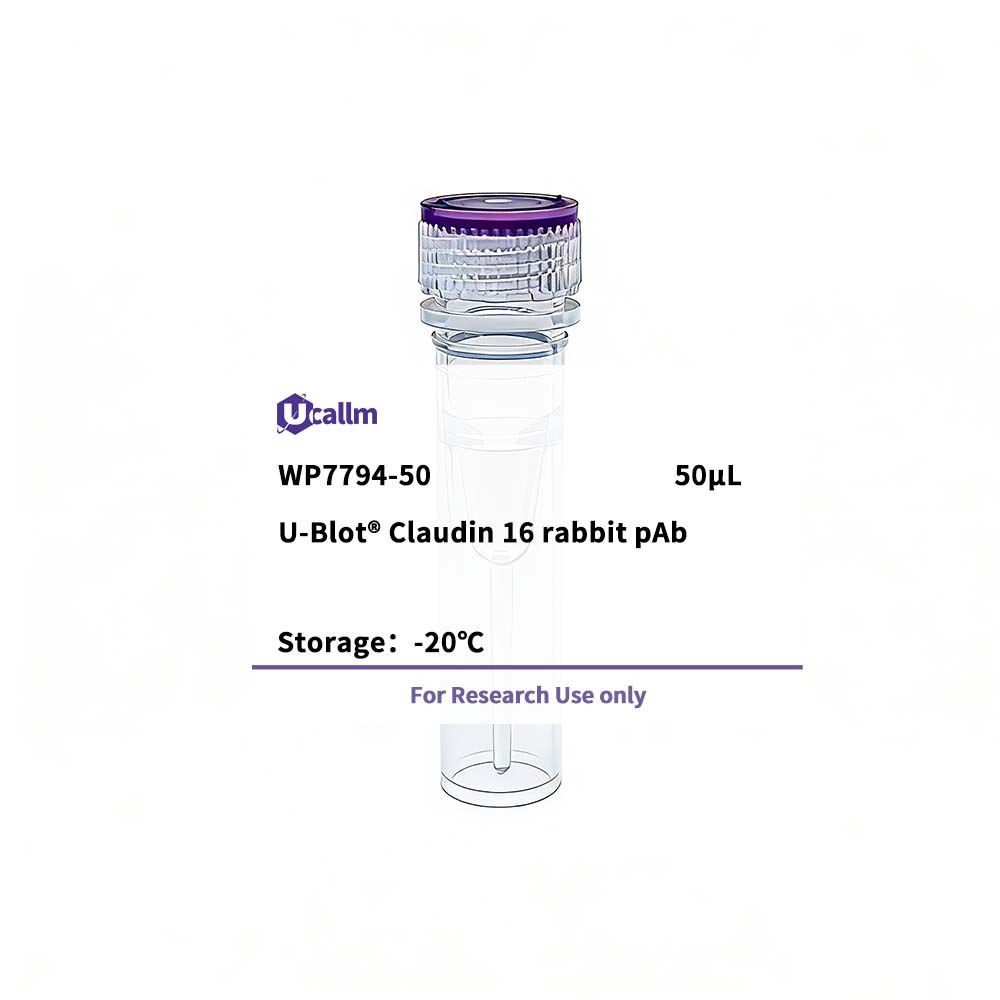
Ucallm_WP7794-50
Price range: $268.00 through $328.00
Product details
Background:
Specifications
| Size | 50μL/100μL |
| Target | CLDN16 |
| Reactivity | Human, Mouse, Rat |
| Applications | WB |
| MW(Calculated) | 26kD |
| MW(Observed) | |
| Host Species | Rabbit |
| Isotype | IgG |
| Conjugate/Modification | Unmodified |
| Recommended Dilution Ratio | WB 1:500-2000 |
| Formulation | Liquid in PBS containing 50% glycerol, 0.5% BSA and 0.02% sodium azide. |
| Purification | The antibody was affinity-purified from rabbit antiserum by affinity-chromatography using epitope-specific immunogen. |
| Storage | -15°C to -25°C/1 year(Do not lower than -25°C) |
| Concentration | 1 mg/ml |
| Clonality | Polyclonal |
| Clone Number | |
| Immunogen | Synthesized peptide derived from human Claudin 16 |
| Specificity | This antibody detects endogenous levels of Claudin 16 at Human, Mouse,Rat |
| Gene Name | CLDN16 PCLN1 |
| Protein Name | Claudin-16 (Paracellin-1) (PCLN-1) |
| Other Name | |
| Species | Human |
| Gene ID | 10686 |
| Uniprot | Q9Y5I7, |
| Species.1 | Mouse |
| Gene ID.1 | 114141 |
| Uniprot.1 | Q925N4, |
| Species.2 | Rat |
| Gene ID.2 | 155268 |
| Uniprot.2 | Q91Y55 |
| Cellular Localization | Cell junction, tight junction. Cell membrane; Multi-pass membrane protein. |
| Tissue Expression | Kidney-specific, including the thick ascending limb of Henle (TAL). |
| Signaling_pathway | Cellular Processes >> Cellular community - eukaryotes >> Tight junction;Organismal Systems >> Immune system >> Leukocyte transendothelial migration;Environmental Information Processing >> Signaling molecules and interaction >> Cell adhesion molecules |
| Research Areas | |
| Function | Plays a major role in tight junction-specific obliteration of the intercellular space, through calcium-independent cell-adhesion activity. Involved in paracellular magnesium reabsorption. Required for a selective paracellular conductance. May form, alone or in partnership with other constituents, an intercellular pore permitting paracellular passage of magnesium and calcium ions down their electrochemical gradients. Alternatively, it could be a sensor of magnesium concentration that could alter paracellular permeability mediated by other factors. |
Please login to post questions
Related products




