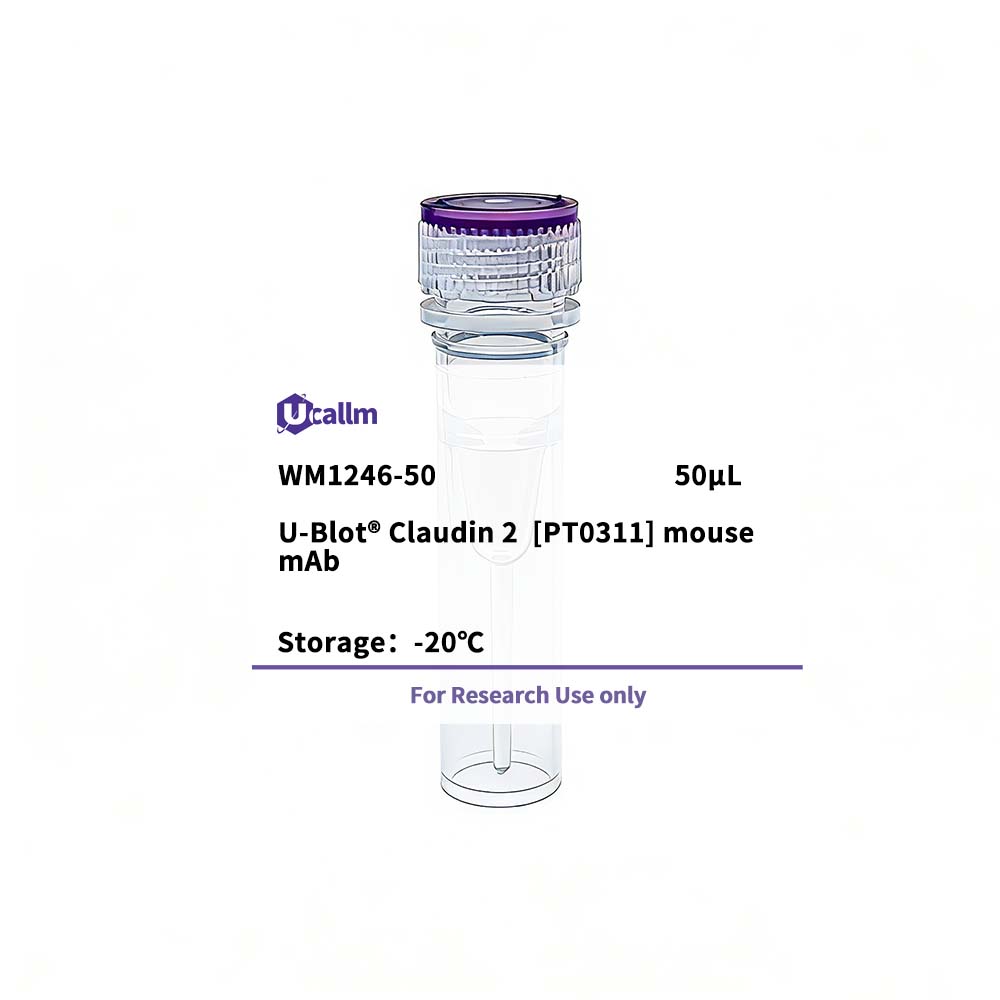
SKU: WM1246 Categories: ,

Claudin 2 [PT0311] mouse mAb

Price range: $268.00 through $328.00

SKU: WM1246-50
Enter the quantity you would like, or drag the panel to find the quantity and price that best for you
Bulk QuoteAuthorize OEM & ODM

Product details

Background:
This gene product belongs to the claudin protein family whose members have been identified as major integral membrane proteins localized exclusively at tight junctions. Claudins are expressed in an organ-specific manner and regulate tissue-specific physiologic properties of tight junctions. This protein is expressed in the intestine. Alternatively spliced transcript variants with different 5' untranslated region have been found for this gene.[provided by RefSeq, Jan 2010],

Specifications

Size50μL/100μL
TargetClaudin-2
ReactivityHuman
ApplicationsIHC, WB, IF, ELISA
MW(Calculated)25kD
MW(Observed)50kD
Host SpeciesMouse
IsotypeIgG2b,Kappa
Conjugate/ModificationUnmodified
Recommended Dilution RatioIHC 1:200-1000; WB 1:500-2000; IF 1:100-500; ELISA 1:1000-5000 / Note: For IHC, we suggest antigen retrieval with TE buffer pH 9.0 (Cat#WT1004)
FormulationPBS, 50% glycerol, 0.05% Proclin 300, 0.05%BSA
PurificationRecombinant Antibody expressed in animal component-free (ACF) media, purified via Protein G affinity chromatography.
Storage-15°C to -25°C/1 year(Do not lower than -25°C)
Concentration
ClonalityMonoclonal
Clone NumberRMM0311
ImmunogenSynthesized peptide derived from human Claudin 2 AA range: 150-230
SpecificityThis antibody detects endogenous levels of Claudin 2 protein.
Gene NameCLDN2 PSEC0059 SP82 UNQ705/PRO1356
Protein NameClaudin 2
Other NameClaudin-2; / SP82
SpeciesHuman
Gene ID9075
UniprotP57739
Species.1
Gene ID.1
Uniprot.1
Species.2
Gene ID.2
Uniprot.2
Cellular LocalizationMembranous
Tissue ExpressionColon,Colon epithelium,Kidney,Skin,Teratocarcinoma,Thalamus,
Signaling_pathwayCellular Processes >> Cellular community - eukaryotes >> Tight junction;Organismal Systems >> Immune system >> Leukocyte transendothelial migration;Environmental Information Processing >> Signaling molecules and interaction >> Cell adhesion molecules
Research Areas>>Cell adhesion molecules; / >>Tight junction; / >>Leukocyte transendothelial migration; / >>Pathogenic Escherichia coli infection; / >>Hepatitis C
FunctionFunction:Plays a major role in tight junction-specific obliteration of the intercellular space, through calcium-independent cell-adhesion activity.,similarity:Belongs to the claudin family.,subunit:Can form homo- and heteropolymers with other CLDN. Homopolymers interact with CLDN3, but not CLDN1, homopolymers. Directly interacts with TJP1/ZO-1, TJP2/ZO-2 and TJP3/ZO-3.,
Please login to post questions
Back to Top
Product has been added to your cart