


Claudin 7 [ABT441] mouse mAb
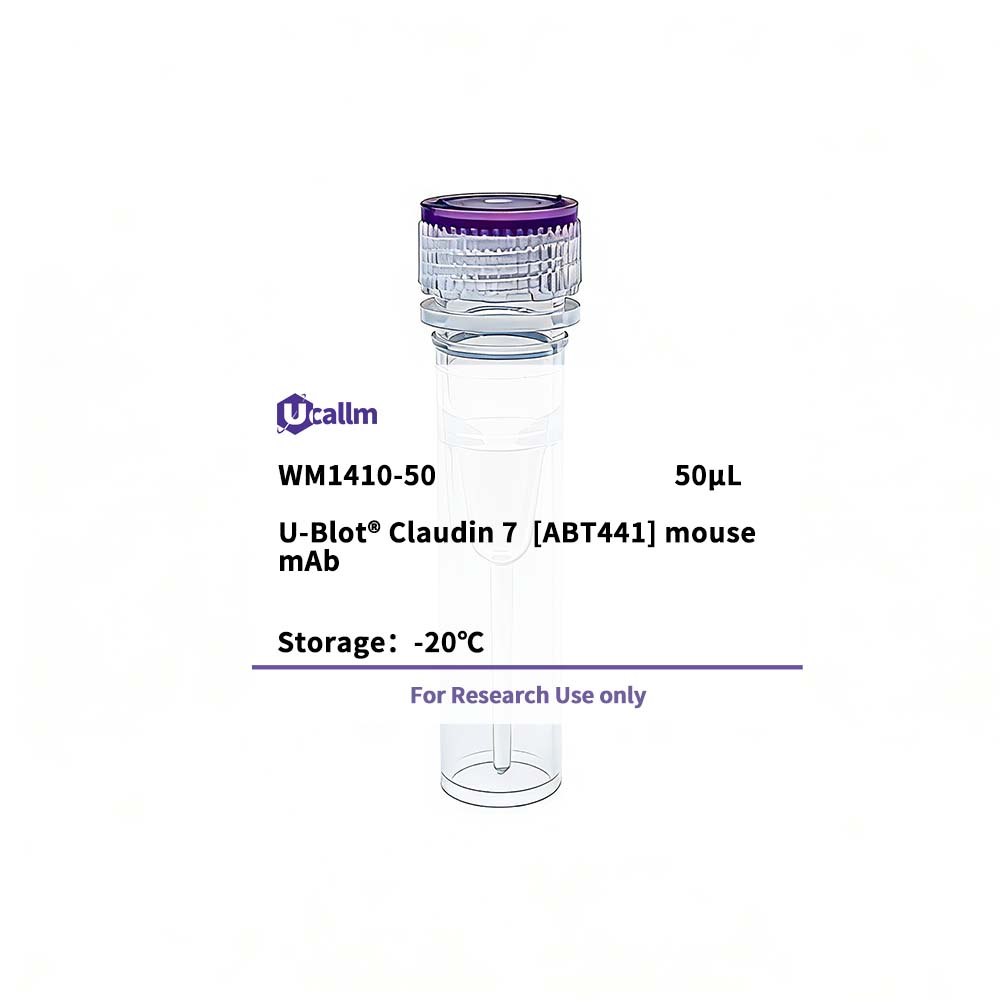
Ucallm_WM1410-50
Price range: $268.00 through $328.00
Product details
Background:
Claudin 7 is a 22 kDa membrane protein, belonging to the tight junction protein family. Claudin family proteins play an important role in cell polarity, signal transduction and the pathogenesis of a variety of malignant tumors. It has been reported that compared with non neoplastic mucosal tissues, the expression of claudin 7 in laryngeal squamous cell carcinoma is down-regulated, and the expression level is related to distant metastasis, which can be used as a potential predictor of poor prognosis. Therefore, claudin 7 may be a useful immunohistochemical marker for the diagnosis, metastasis and prognosis of laryngeal cancer.
Specifications
| Size | 50μL/100μL |
| Target | Claudin 7 |
| Reactivity | Human, Mouse, Rat |
| Applications | IHC, WB, IF, ELISA |
| MW(Calculated) | 22kD |
| MW(Observed) | 22kD |
| Host Species | Mouse |
| Isotype | IgG2b,Kappa |
| Conjugate/Modification | Unmodified |
| Recommended Dilution Ratio | IHC 1:200-1000; WB 1:500-2000; IF 1:100-500; ELISA 1:1000-5000 / Note: For IHC, we suggest antigen retrieval with TE buffer pH 9.0 (Cat#WT1004) |
| Formulation | PBS, 50% glycerol, 0.05% Proclin 300, 0.05%BSA |
| Purification | Recombinant Antibody expressed in animal component-free (ACF) media, purified via Protein G affinity chromatography. |
| Storage | -15°C to -25°C/1 year(Do not lower than -25°C) |
| Concentration | |
| Clonality | Monoclonal |
| Clone Number | RMM441 |
| Immunogen | Synthesized peptide derived from human Claudin 7 AA range: 100-211 |
| Specificity | The antibody can specifically recognize human Claudin 7 protein. In western blotting of LnCap cell lysate, the antibody can label a 22 kDa band corresponding to Claudin 7. |
| Gene Name | CLDN7 CEPTRL2 CPETRL2 |
| Protein Name | Claudin-7 |
| Other Name | CEPTR L2; / CEPTRL 2; / CEPTRL2; / Claudin 1; / Claudin 7; / Claudin 9; / Claudin-7; / Claudin1; / Claudin7; / Claudin9; / CLD7_HUMAN; / CLDN 7; / CLDN-7; / CLDN7; / Clostridium perfringens enterotoxin receptor like 2; / CPETR L2; / CPETRL 2; / CPETRL2; / Hs.84359 |
| Species | Human |
| Gene ID | 1366 |
| Uniprot | O95471, |
| Species.1 | Mouse |
| Gene ID.1 | 53624 |
| Uniprot.1 | Q9Z261, |
| Species.2 | Rat |
| Gene ID.2 | 65132 |
| Uniprot.2 | Q9Z1L1 |
| Cellular Localization | Membranous |
| Tissue Expression | kindey |
| Signaling_pathway | Cellular Processes >> Cellular community - eukaryotes >> Tight junction;Organismal Systems >> Immune system >> Leukocyte transendothelial migration;Environmental Information Processing >> Signaling molecules and interaction >> Cell adhesion molecules |
| Research Areas | >>Cell adhesion molecules; / >>Tight junction; / >>Leukocyte transendothelial migration; / >>Pathogenic Escherichia coli infection; / >>Hepatitis C |
| Function | Function:Plays a major role in tight junction-specific obliteration of the intercellular space.,induction:By androgens.,similarity:Belongs to the claudin family.,subunit:Directly interacts with TJP1/ZO-1, TJP2/ZO-2 and TJP3/ZO-3.,tissue specificity:Expressed in kidney, lung and prostate. Isoform 1 seems to be predominant, except in some normal prostate samples, where isoform 2 is the major form. Down-regulated in breast cancers, including ductal carcinoma in situ (DCIS), lobular carcinoma in situ (LCIS) and invasive ductal carcinoma (IDC) (at protein level), as well as in several cancer cell lines. Loss of expression correlates with histological grade, occurring predominantly in high-grade lesions., |
Please login to post questions
Related products



