

COL13A1 Polyclonal Antibody
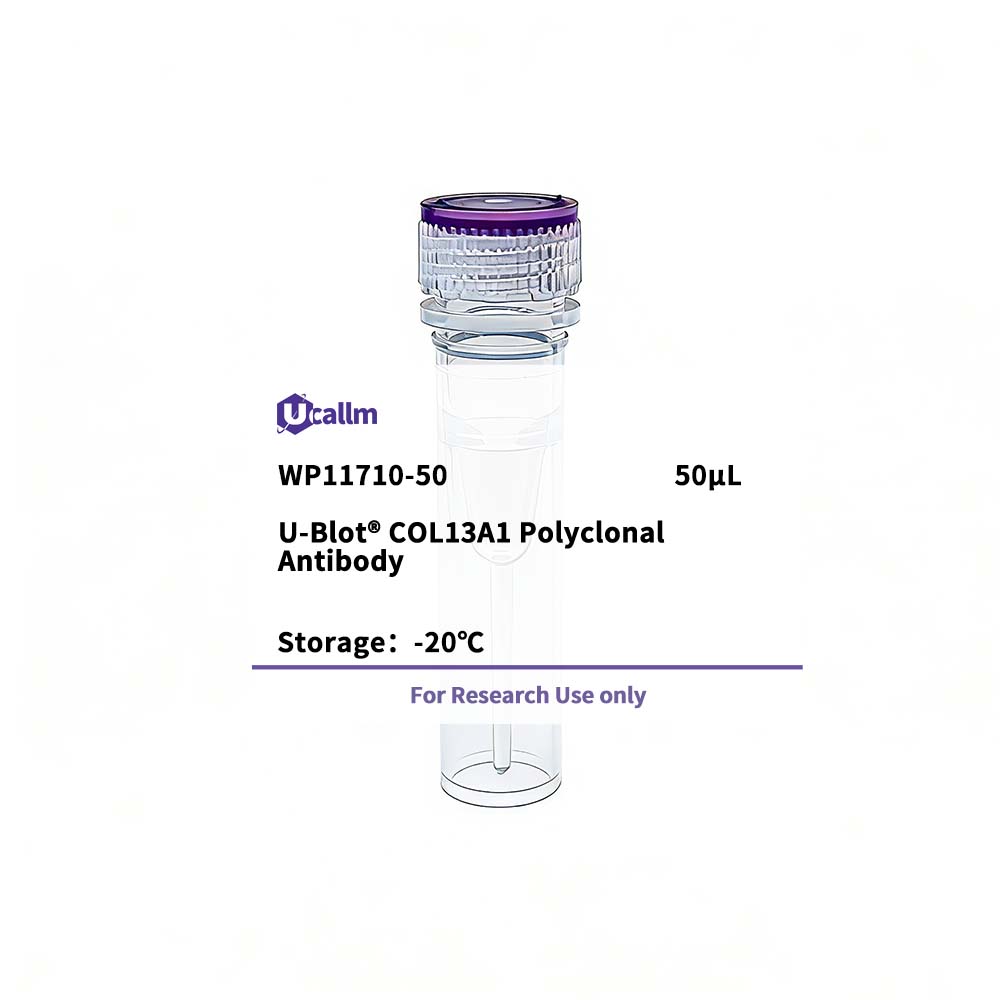
Ucallm_WP11710-50
Price range: $268.00 through $328.00
Product details
Background:
This gene encodes the alpha chain of one of the nonfibrillar collagens. The function of this gene product is not known, however, it has been detected at low levels in all connective tissue-producing cells so it may serve a general function in connective tissues. Unlike most of the collagens, which are secreted into the extracellular matrix, collagen XIII contains a transmembrane domain and the protein has been localized to the plasma membrane. The transcripts for this gene undergo complex and extensive splicing involving at least eight exons. Like other collagens, collagen XIII is a trimer; it is not known whether this trimer is composed of one or more than one alpha chain isomer. A number of alternatively spliced transcript variants have been described, but the full length nature of some of them has not been determined. [provided by RefSeq, Jul 2008],
Specifications
| Size | 50μL/100μL |
| Target | COL13A1 |
| Reactivity | Human, Mouse |
| Applications | WB, IF, ELISA |
| MW(Calculated) | |
| MW(Observed) | 70kD |
| Host Species | Rabbit |
| Isotype | IgG |
| Conjugate/Modification | Unmodified |
| Recommended Dilution Ratio | WB 1:1000-1:5000; IF 1:200-1:1000; ELISA 1:20000; Not yet tested in other applications; |
| Formulation | Liquid in PBS containing 50% glycerol, 0.5% BSA and 0.02% sodium azide. |
| Purification | The antibody was affinity-purified from rabbit antiserum by affinity-chromatography using epitope-specific immunogen. |
| Storage | -15°C to -25°C/1 year(Do not lower than -25°C) |
| Concentration | 1 mg/ml |
| Clonality | Polyclonal |
| Clone Number | |
| Immunogen | The antiserum was produced against synthesized peptide derived from human Collagen XIII alpha1. AA range:641-690 |
| Specificity | COL13A1 Polyclonal Antibody detects endogenous levels of COL13A1 protein. |
| Gene Name | COL13A1 |
| Protein Name | Collagen alpha-1(XIII) chain |
| Other Name | COL13A1; / Collagen alpha-1; / XIII; / chain; / COLXIIIA1 |
| Species | Human |
| Gene ID | 1305 |
| Uniprot | Q5TAT6, |
| Species.1 | Mouse |
| Gene ID.1 | 12817 |
| Uniprot.1 | Q9R1N9 |
| Species.2 | |
| Gene ID.2 | |
| Uniprot.2 | |
| Cellular Localization | Cell membrane; Single-pass type II membrane protein . Cell junction, synapse, postsynaptic cell membrane . |
| Tissue Expression | Widely expressed in both fetal and adult ocular tissues (at protein level). In the eye, expression is accentuated in the ciliary muscle, optic nerve and the neural retina. In early placenta, localized to fibroblastoid stromal cells of the placental villi, to endothelial cells of developing capillaries and to cells of the cytotrophoblastic columns. Also detected in large decidual cells of the decidual membrane and to stromal cells of the gestational endometrium, but not in the epithelial cells in the endometrial glands. Isoform 10: Expressed in muscle (PubMed:26626625). |
| Signaling_pathway | |
| Research Areas | >>Protein digestion and absorption |
| Function | Alternative products:Additional isoforms seem to exist,Function:Involved in cell-matrix and cell-cell adhesion interactions that are required for normal development. May participate in the linkage between muscle fiber and basement membrane. May play a role in endochondral ossification of bone and branching morphogenesis of lung. Binds heparin.,subunit:Homotrimer; disulfide-linked. Nucleation of the type XIII collagen triple helix is likely to occur at the N-terminal region with triple helix formation proceeding from the N- to the C-terminus. Interacts with FN1, perlecan/HSPG2 and NID2.,tissue specificity:Widely expressed in both fetal and adult ocular tissues (at protein level). In the eye, expression is accentuated in the ciliary muscle, optic nerve and the neural retina. In early placenta, localized to fibroblastoid stromal cells of the placental villi, to endothelial cells of developing capillaries and to cells of the cytotrophoblastic columns. Also detected in large decidual cells of the decidual membrane and to stromal cells of the gestational endometrium, but not in the epithelial cells in the endometrial glands., |
Please login to post questions
Related products




