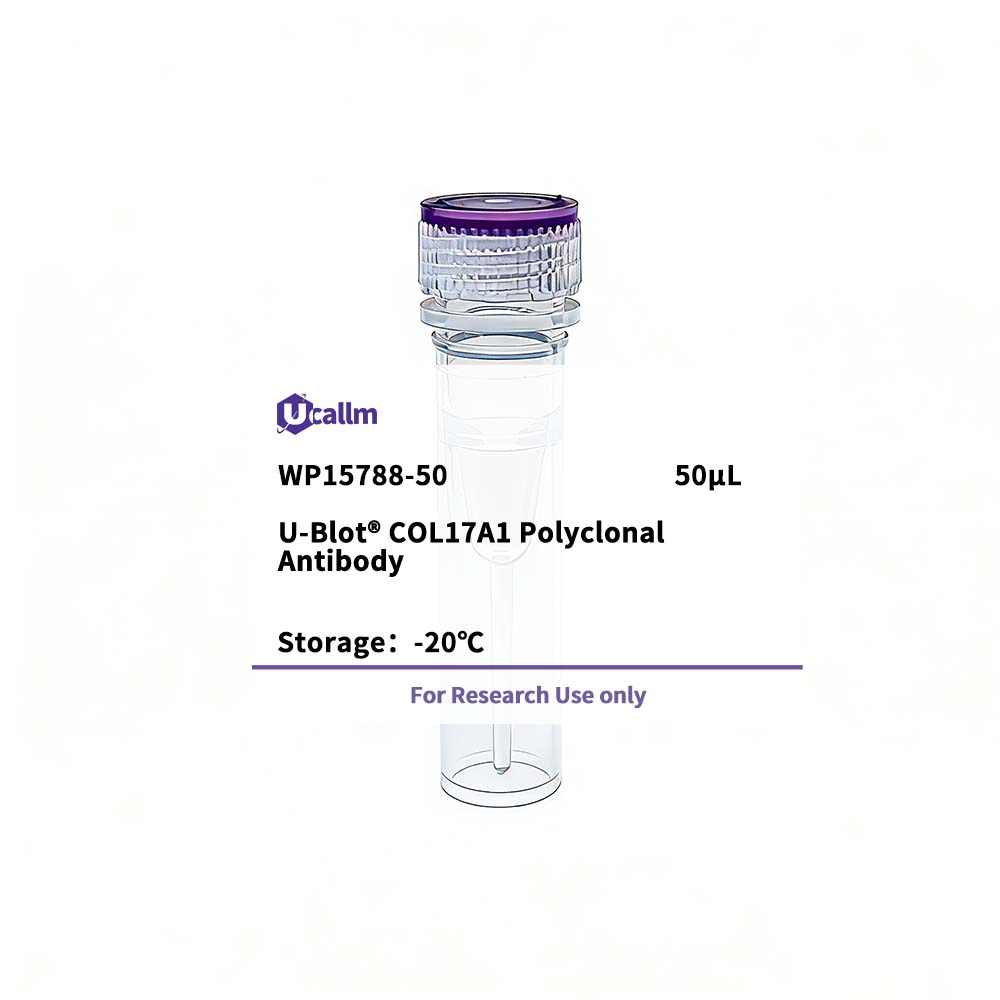
SKU: WP15788 Categories: ,

COL17A1 Polyclonal Antibody

Price range: $268.00 through $328.00

SKU: WP15788-100
Enter the quantity you would like, or drag the panel to find the quantity and price that best for you
Bulk QuoteAuthorize OEM & ODM

Product details

Background:

This gene encodes the alpha chain of type XVII collagen. Unlike most collagens, collagen XVII is a transmembrane protein. Collagen XVII is a structural component of hemidesmosomes, multiprotein complexes at the dermal-epidermal basement membrane zone that mediate adhesion of keratinocytes to the underlying membrane. Mutations in this gene are associated with both generalized atrophic benign and junctional epidermolysis bullosa. Two homotrimeric forms of type XVII collagen exist. The full length form is the transmembrane protein. A soluble form, referred to as either ectodomain or LAD-1, is generated by proteolytic processing of the full length form. [provided by RefSeq, Jul 2008],

Specifications

TargetCOL17A1
ReactivityHuman, Mouse
ApplicationsWB, IHC, IF, ELISA
MW(Calculated)
MW(Observed)150kD
Host SpeciesRabbit
IsotypeIgG
Conjugate/ModificationUnmodified
Modification
Recommended Dilution RatioIHC 1:200-1:1000; WB 1:500-2000; IF 1:100-300; ELISA 1:5000-20000; Not yet tested in other applications. / Note: For IHC, we suggest antigen retrieval with TE buffer pH 9.0 (Cat#YS0004)
FormulationLiquid in PBS containing 50% glycerol, 0.5% BSA and 0.02% sodium azide.
Source
PurificationThe antibody was affinity-purified from rabbit antiserum by affinity-chromatography using epitope-specific immunogen.
Purity
Storage-15°C to -25°C/1 year(Do not lower than -25°C)
Concentration1 mg/ml
ClonalityPolyclonal
Clone Number
ImmunogenThe antiserum was produced against synthesized peptide derived from the Internal region of human COL17A1. AA range:481-530
Sequence
SpecificityThe antibody detects endogenous COL17A1 protein
Gene NameCOL17A1 BP180 BPAG2
Protein Namecollagen, type XVII, alpha 1
Other NameCOL17A1 BP180 BPAG2
SpeciesHuman
Gene ID-11308
UniprotQ9UMD9,
Species.1Mouse
Gene ID-212821
Uniprot.1Q07563
Species.2
Gene ID-3
Uniprot.2
Organism-4
Gene ID-4
SwissProt-4
BackgroundThis gene encodes the alpha chain of type XVII collagen. Unlike most collagens, collagen XVII is a transmembrane protein. Collagen XVII is a structural component of hemidesmosomes, multiprotein complexes at the dermal-epidermal basement membrane zone that mediate adhesion of keratinocytes to the underlying membrane. Mutations in this gene are associated with both generalized atrophic benign and junctional epidermolysis bullosa. Two homotrimeric forms of type XVII collagen exist. The full length form is the transmembrane protein. A soluble form, referred to as either ectodomain or LAD-1, is generated by proteolytic processing of the full length form. [provided by RefSeq, Jul 2008],
Cellular LocalizationCell junction, hemidesmosome. Membrane; Single-pass type II membrane protein. Localized along the plasma membrane of the hemidesmosome.; [120 kDa linear IgA disease antigen]: Secreted, extracellular space, extracellular matrix, basement membrane. Exclusively localized to anchoring filaments. Localized to the epidermal side of split skin.; [97 kDa linear IgA disease antigen]: Secreted, extracellular space, extracellular matrix, basement membrane. Localized in the lamina lucida beneath the hemidesmosomes.
Tissue ExpressionDetected in skin (PubMed:8618013). In the cornea, it is detected in the epithelial basement membrane, the epithelial cells, and at a lower level in stromal cells (at protein level) (PubMed:25676728). Stratified squamous epithelia. Found in hemidesmosomes. Expressed in cornea, oral mucosa, esophagus, intestine, kidney collecting ducts, ureter, bladder, urethra and thymus but is absent in lung, blood vessels, skeletal muscle and nerves.
Signaling_pathway
Research Areas>>Protein digestion and absorption
FunctionDisease:Defects in COL17A1 are a cause of generalized atrophic benign epidermolysis bullosa (GABEB) [MIM:226650]. GABEB is a non-lethal, adult form of junctional epidermolysis bullosa characterized by life-long blistering of the skin, associated with hair and tooth abnormalities.,Function:May play a role in the integrity of hemidesmosome and the attachment of basal keratinocytes to the underlying basement membrane.,Function:The 120 kDa linear IgA disease antigen is an anchoring filament component involved in dermal-epidermal cohesion. Is the target of linear IgA bullous dermatosis autoantibodies.,miscellaneous:Both the 120 kDa linear IgA disease antigen and the 97 kDa linear IgA disease antigen of COL17A1, represent major antigenic targets of autoantibodies in patients with linear IgA disease (LAD). LAD is a subepidermal blistering disorder characterized by tissue-bound and circulating IgA autoantibodies to the dermal-epidermal junction. These IgA autoantibodies preferentially react with 97 and the 120 kDa forms, but not with the full-length COL17A1, suggesting that the cleavage of the ectodomain generates novel autoantigenic epitopes.,PTM:Prolines at the third position of the tripeptide repeating unit (G-X-Y) are hydroxylated in some or all of the chains.,PTM:The ectodomain is shedded from the surface of keratinocytes resulting in a 120-kDa soluble form, also named as 120 kDa linear IgA disease antigen. The shedding is mediated by membrane-bound metalloproteases. This cleavage is inhibited by phosophorylation at Ser-544.,PTM:The intracellular/endo domain is disulfide-linked.,sequence Caution:Contaminating sequence. Potential poly-A sequence.,subcellular location:Exclusively localized to anchoring filaments. Localized to the epidermal side of split skin.,subcellular location:Localized along the plasma membrane of the hemidesmosome.,subcellular location:Localized in the lamina lucida beneath the hemidesmosomes.,subunit:Homotrimers of alpha 1(XVII)chains.,tissue specificity:Stratified squamous epithelia. Found in hemidesmosomes. Expressed in cornea, oral mucosa, esophagus, intestine, kidney collecting ducts, ureter, bladder, urethra and thymus but is absent in lung, blood vessels, skeletal muscle and nerves.,
RRID
Please login to post questions
Back to Top
Product has been added to your cart