SKU: WM1412 Categories: ,

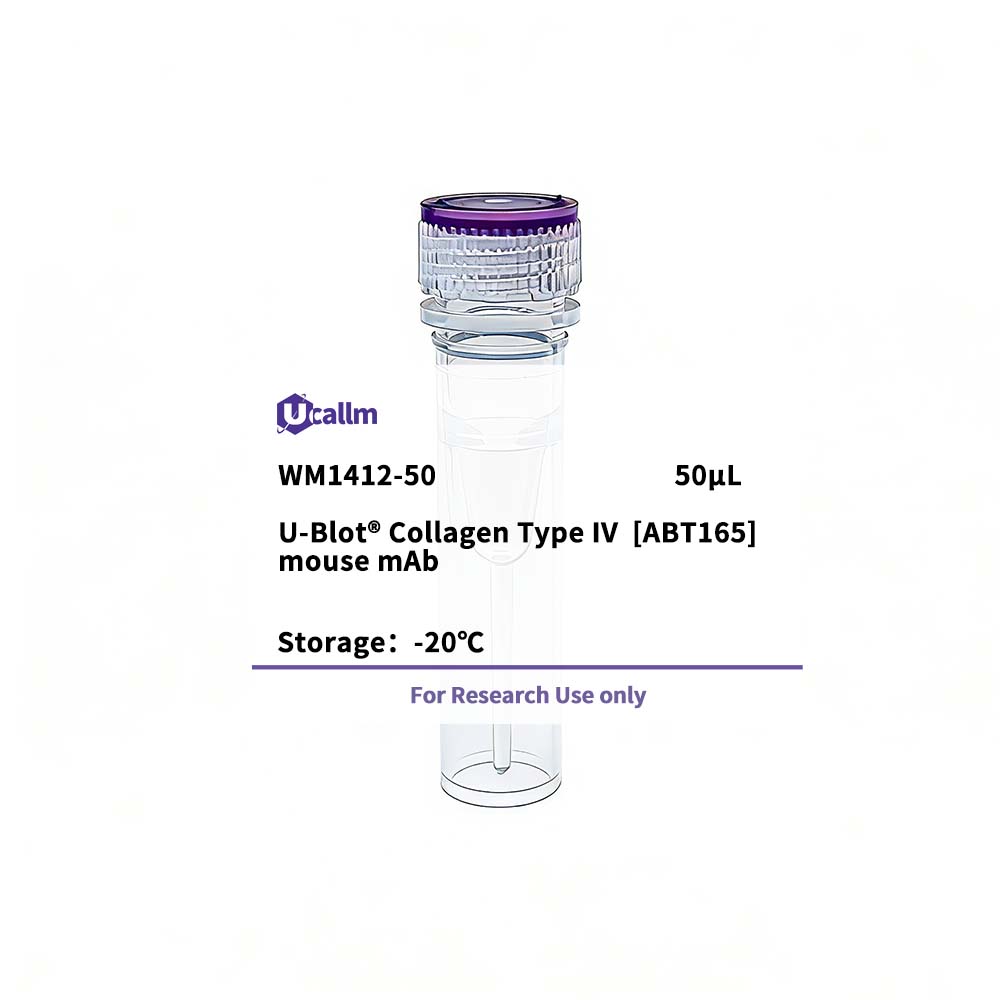
Collagen Type IV [ABT165] mouse mAb

Price range: $268.00 through $328.00

SKU: WM1412-50
Enter the quantity you would like, or drag the panel to find the quantity and price that best for you
Bulk QuoteAuthorize OEM & ODM

Product details

Background:
Type IV collagen is the main component of basement membrane and plays an important role in cell adhesion, migration, differentiation and growth. It exists in the basement membrane of many tissues and organs, such as skin, muscle, spleen, lung, kidney, placenta and lymph nodes, but the basement membrane of corneal epithelium is negative. It is mainly used to study the distribution of basement membrane in various benign and malignant tissues.

Specifications

Size50μL/100μL
TargetCollagen IV
ReactivityHuman, Mouse
ApplicationsIHC, WB, IF, ELISA
MW(Calculated)160kD
MW(Observed)180kD
Host SpeciesMouse
IsotypeIgG2b,Kappa
Conjugate/ModificationUnmodified
Recommended Dilution RatioIHC 1:200-1000; WB 1:500-2000; IF 1:100-500; ELISA 1:1000-5000 / Note: For IHC, we suggest antigen retrieval with TE buffer pH 9.0 (Cat#WT1004)
FormulationPBS, 50% glycerol, 0.05% Proclin 300, 0.05%BSA
PurificationRecombinant Antibody expressed in animal component-free (ACF) media, purified via Protein G affinity chromatography.
Storage-15°C to -25°C/1 year(Do not lower than -25°C)
Concentration
ClonalityMonoclonal
Clone NumberRMM165
ImmunogenSynthesized peptide derived from human Collagen Type IV AA range:1600-1669
SpecificityThe antibody can specifically recognize human Collagen Type IV protein, collagen types I, II, III and V do not respond to the anbody.
Gene NameCOL4A1
Protein NameCollagen Type IV
Other NameArresten; / BSVD; / CO4A1_HUMAN; / COL4A1; / COL4A1 NC1 domain; / COL4A2; / COL4A3; / COL4A4; / COL4A5; / collagen alpha-1; / IV; / chain; / Collagen IV Alpha 1 Polypeptide; / Collagen IV Alpha 2 Polypeptide; / Collagen Of Basement Membrane Alpha 1 Chain; / Collagen Of Basement Membrane Alpha 2 Chain; / Collagen Type IV Alpha 1; / collagen type IV alpha 1 chain; / Collagen Type IV Alpha 2; / Collagen Type IV Alpha 3; / Collagen Type IV Alpha 4; / Collagen Type IV Alpha 5; / RatOR
SpeciesHuman
Gene ID1282
UniprotP02462
Species.1
Gene ID.1
Uniprot.1
Species.2
Gene ID.2
Uniprot.2
Cellular LocalizationCytoplasmic
Tissue ExpressionHighly expressed in placenta.
Signaling_pathwayCellular Processes >> Cellular community - eukaryotes >> Focal adhesion;Organismal Systems >> Endocrine system >> Relaxin signaling pathway;Human Diseases >> Cancer: overview >> Pathways in cancer;Human Diseases >> Cancer: specific types >> Small cell lung cancer;Environmental Information Processing >> Signal transduction >> PI3K-Akt signaling pathway;Environmental Information Processing >> Signaling molecules and interaction >> ECM-receptor interaction
Research Areas>>PI3K-Akt signaling pathway; / >>Focal adhesion; / >>ECM-receptor interaction; / >>Relaxin signaling pathway; / >>AGE-RAGE signaling pathway in diabetic complications; / >>Protein digestion and absorption; / >>Amoebiasis; / >>Human papillomavirus infection; / >>Pathways in cancer; / >>Small cell lung cancer
FunctionDisease:Defects in COL4A1 are a cause of brain small vessel disease with hemorrhage [MIM:607595]. Brain small vessel diseases underlie 20 to 30 percent of ischemic strokes and a larger proportion of intracerebral hemorrhages. Inheritance is autosomal dominant.,Disease:Defects in COL4A1 are a cause of porencephaly type 1 [MIM:175780]; also known as encephaloclastic porencephaly. Porencephaly is a term used for any cavitation or cerebrospinal fluid-filled cyst in the brain. Porencephaly type 1 is usually unilateral and results from focal destructive lesions such as fetal vascular occlusion or birth trauma. Inheritance is autosomal dominant.,Disease:Defects in COL4A1 are the cause of hereditary angiopathy with nephropathy, aneurysms, and muscle cramps (HANAC) [MIM:611773]. The clinical renal manifestations include hematuria and bilateral large cysts. Histologic analysis revealed complex basement membrane defects in kidney and skin. The systemic angiopathy appears to affect both small vessels and large arteries.,Domain:Alpha chains of type IV collagen have a non-collagenous domain (NC1) at their C-terminus, frequent interruptions of the G-X-Y repeats in the long central triple-helical domain (which may cause flexibility in the triple helix), and a short N-terminal triple-helical 7S domain.,Function:Type IV collagen is the major structural component of glomerular basement membranes (GBM), forming a 'chicken-wire' meshwork together with laminins, proteoglycans and entactin/nidogen. Potently inhibits endothelial cell proliferation and angiogenesis. Inhibits angiogenesis potentially via mechanisms involving cell surface proteoglycans and the alpha and beta integrins of endothelial cells.,PTM:Lysines at the third position of the tripeptide repeating unit (G-X-Y) are hydroxylated in all cases and bind carbohydrates.,PTM:Prolines at the third position of the tripeptide repeating unit (G-X-Y) are hydroxylated in some or all of the chains.,PTM:The trimeric structure of the NC1 domains may be stabilized by covalent bonds between Lys and Met residues.,PTM:Type IV collagens contain numerous cysteine residues which are involved in inter- and intramolecular disulfide bonding. 12 of these, located in the NC1 domain, are conserved in all known type IV collagens.,similarity:Belongs to the type IV collagen family.,similarity:Contains 1 collagen IV NC1 (C-terminal non-collagenous) domain.,subunit:There are six type IV collagen isoforms, alpha 1(IV)-alpha 6(IV), each of which can form a triple helix structure with 2 other chains to generate type IV collagen network.,tissue specificity:Highly expressed in placenta.,
Please login to post questions
Back to Top
Product has been added to your cart
