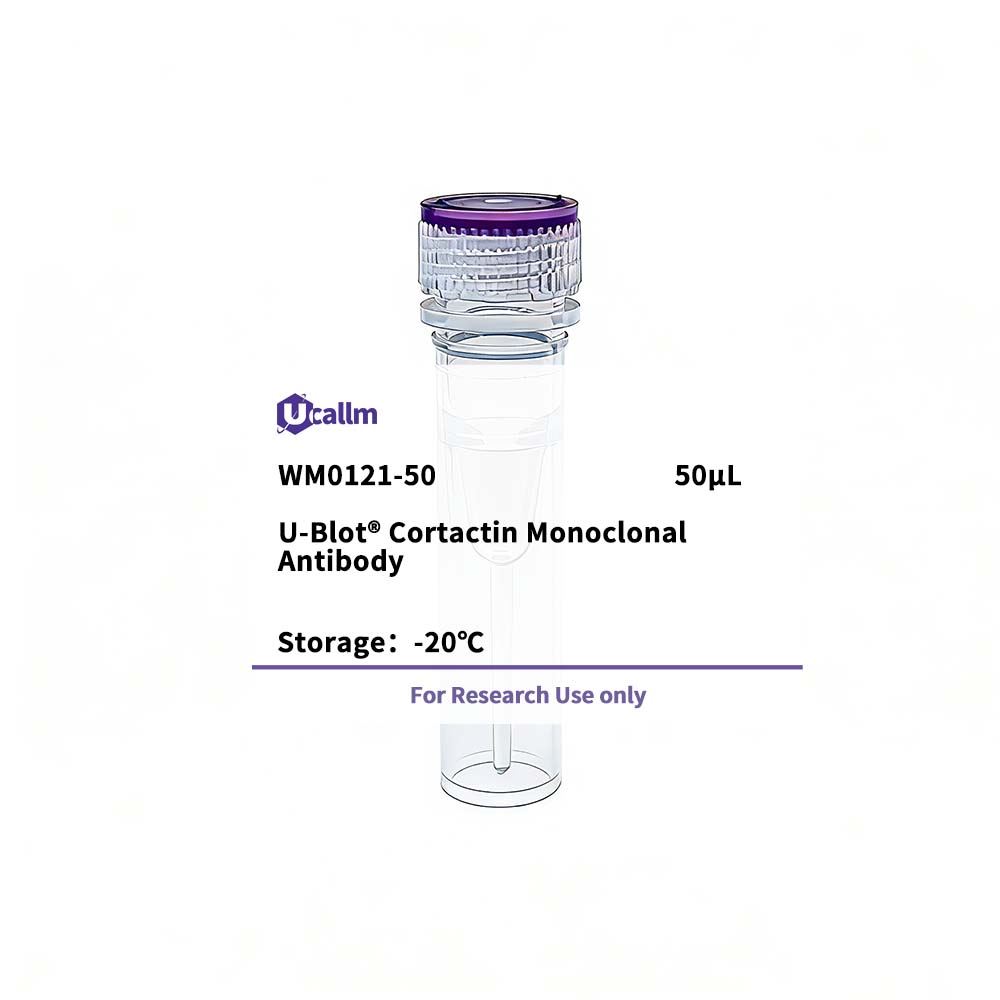
SKU: WM0121 Categories: ,

Cortactin Monoclonal Antibody

Price range: $268.00 through $328.00

SKU: WM0121-50
Enter the quantity you would like, or drag the panel to find the quantity and price that best for you
Bulk QuoteAuthorize OEM & ODM

Product details

Background:
cortactin(CTTN) Homo sapiens This gene is overexpressed in breast cancer and squamous cell carcinomas of the head and neck. The encoded protein is localized in the cytoplasm and in areas of the cell-substratum contacts. This gene has two roles: (1) regulating the interactions between components of adherens-type junctions and (2) organizing the cytoskeleton and cell adhesion structures of epithelia and carcinoma cells. During apoptosis, the encoded protein is degraded in a caspase-dependent manner. The aberrant regulation of this gene contributes to tumor cell invasion and metastasis. Three splice variants that encode different isoforms have been identified for this gene. [provided by RefSeq, May 2010],

Specifications

Size50μL/100μL
TargetCortactin
ReactivityHuman, Mouse
ApplicationsWB, IHC, IF, ELISA
MW(Calculated)62kD
MW(Observed)
Host SpeciesMouse
Isotype
Conjugate/ModificationUnmodified
Recommended Dilution RatioWB 1:500-2000; IHC 1:200-400; IF/ICC1:200-400; ELISA 1:5000-20000 / Note: For IHC, we suggest antigen retrieval with TE buffer pH 9.0 (Cat#WT1004)
FormulationLiquid in PBS containing 50% glycerol, 0.5% BSA and 0.02% sodium azide.
PurificationAffinity purification
Storage-15°C to -25°C/1 year(Do not lower than -25°C)
Concentration
ClonalityMonoclonal
Clone Number13G4
ImmunogenPurified recombinant fragment of human Cortactin expressed in E. Coli.
SpecificityCortactin Monoclonal Antibody detects endogenous levels of Cortactin protein.
Gene NameCTTN
Protein NameSrc substrate cortactin
Other NameCTTN; / EMS1; / Src substrate cortactin; / Amplaxin; / Oncogene EMS1
SpeciesHuman
Gene ID2017
UniprotQ14247,
Species.1Mouse
Gene ID.113043
Uniprot.1Q60598
Species.2
Gene ID.2
Uniprot.2
Cellular LocalizationCytoplasm, cytoskeleton . Cell projection, lamellipodium . Cell projection, ruffle. Cell projection, dendrite . Cell projection . Cell membrane; Peripheral membrane protein; Cytoplasmic side . Cell projection, podosome . Cell junction . Cell junction, focal adhesion . Membrane, clathrin-coated pit . Cell projection, dendritic spine . Cytoplasm, cell cortex . Colocalizes transiently with PTK2/FAK1 at focal adhesions (By similarity). Associated with membrane ruffles and lamellipodia. In the presence of CTTNBP2NL, colocalizes with stress fibers (By similarity). In the presence of CTTNBP2, localizes at the cell cortex (By similarity). In response to neuronal activation by glutamate, redistributes from dendritic spines to the dendritic shaft (By similarity). Colocalizes with DNM2 at the basis of filopodia in hippocampus neuron growth zones (By similarity). .
Tissue ExpressionCoronary artery,Epithelium,Mammary gland,Placenta,Platelet,Testis,
Signaling_pathwayCellular Processes >> Cellular community - eukaryotes >> Tight junction
Research Areas>>Tight junction; / >>Bacterial invasion of epithelial cells; / >>Pathogenic Escherichia coli infection; / >>Shigellosis; / >>Proteoglycans in cancer
FunctionFunction:May contribute to the organization of cell structure. The SH3 motif may function as a binding region to cytoskeleton. Tyrosine phosphorylation in transformed cells may contribute to cellular growth regulation and transformation.,online information:Cortactin entry,similarity:Contains 1 SH3 domain.,similarity:Contains 7 cortactin repeats.,subcellular location:Associated with membrane ruffles and lamellipodia.,subunit:Interacts with SHANK2 and SHANK3 via its SH2 domain. Also interacts with FGD1 (By similarity). Interacts with PLXDC2.,
Please login to post questions
Back to Top
Product has been added to your cart
