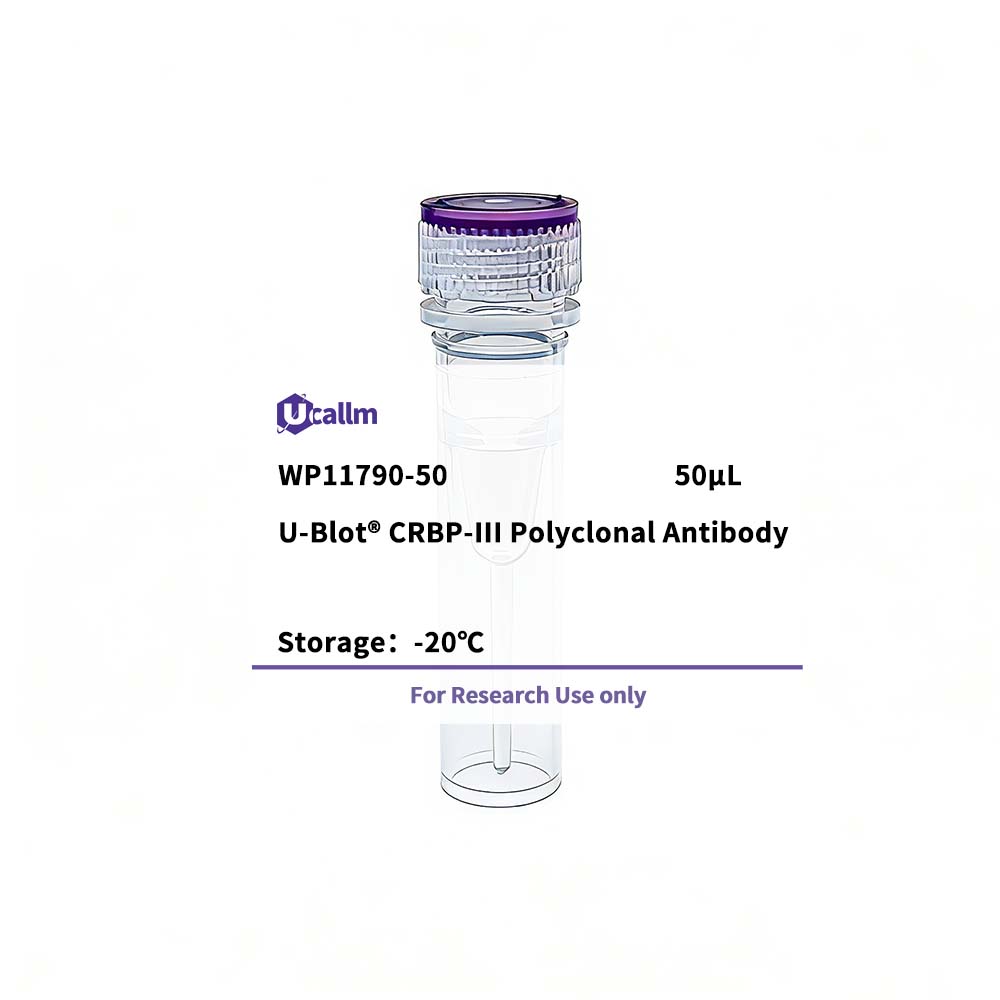
SKU: WP11790 Categories: ,

CRBP-III Polyclonal Antibody

Price range: $268.00 through $328.00

SKU: WP11790-100
Enter the quantity you would like, or drag the panel to find the quantity and price that best for you
Bulk QuoteAuthorize OEM & ODM

Product details

Background:

retinol binding protein 5(RBP5) Homo sapiens The protein encoded by this gene is a cellular retinol-binding protein expressed highly in kidney and liver. Down-regulation of the encoded protein in hepatocellular carcinoma was associated with large tumor size and poor patient survival rates. [provided by RefSeq, Jul 2016],

Specifications

Size50μL/100μL
TargetCRBP-III
ReactivityHuman
ApplicationsIHC, IF, ELISA
MW(Calculated)16kD
MW(Observed)
Host SpeciesRabbit
IsotypeIgG
Conjugate/ModificationUnmodified
Recommended Dilution RatioIHC 1:100-1:300; IF 1:200-1:1000; ELISA 1:20000; Not yet tested in other applications. / Note: For IHC, we suggest antigen retrieval with TE buffer pH 9.0 (Cat#WT1004)
FormulationLiquid in PBS containing 50% glycerol, 0.5% BSA and 0.02% sodium azide.
PurificationThe antibody was affinity-purified from rabbit antiserum by affinity-chromatography using epitope-specific immunogen.
Storage-15°C to -25°C/1 year(Do not lower than -25°C)
Concentration1 mg/ml
ClonalityPolyclonal
Clone Number
ImmunogenThe antiserum was produced against synthesized peptide derived from human CRBP III. AA range:10-59
SpecificityCRBP-III Polyclonal Antibody detects endogenous levels of CRBP-III protein.
Gene NameRBP5
Protein NameRetinol-binding protein 5
Other NameRBP5; / Retinol-binding protein 5; / Cellular retinol-binding protein III; / CRBP-III; / HRBPiso
SpeciesHuman
Gene ID83758
UniprotP82980
Species.1
Gene ID.1
Uniprot.1
Species.2
Gene ID.2
Uniprot.2
Cellular LocalizationCytoplasm .
Tissue ExpressionHigher expression in adult kidney and liver and to a lesser extent in adult and fetal spleen, adult lymph nodes and appendix, and fetal liver and kidney. Strongly decreased in hepatocellular carcinoma tissues (at protein level).
Signaling_pathway
Research Areas
FunctionDomain:Forms a beta-barrel structure that accommodates hydrophobic ligands in its interior.,Function:Intracellular transport of retinol.,similarity:Belongs to the calycin superfamily. Fatty-acid binding protein (FABP) family.,tissue specificity:Higher expression in adult kidney and liver and to a lesser extent in adult and fetal spleen, adult lymph nodes and appendix, and fetal liver and kidney. Strongly decreased in hepatocellular carcinoma tissues (at protein level).,
Please login to post questions
Back to Top
Product has been added to your cart

