SKU: WR4668 Categories: ,

U-Blot® Crk-L Rabbit mAb

Price range: $268.00 through $328.00

SKU: WR4668-50
Enter the quantity you would like, or drag the panel to find the quantity and price that best for you
Bulk QuoteAuthorize OEM & ODM

Product details

Background:This gene encodes a protein kinase containing SH2 and SH3 (src homology) domains which has been shown to activate the RAS and JUN kinase signaling pathways and transform fibroblasts in a RAS-dependent fashion. It is a substrate of the BCR-ABL tyrosine kinase, plays a role in fibroblast transformation by BCR-ABL, and may be oncogenic.[provided by RefSeq, Jan 2009],

Specifications

Size50μL/100μL
TargetCrk-L
ReactivityHuman, Mouse, Rat
ApplicationsWB, IHC, IF, IP, ELISA
MW(Calculated)34kD
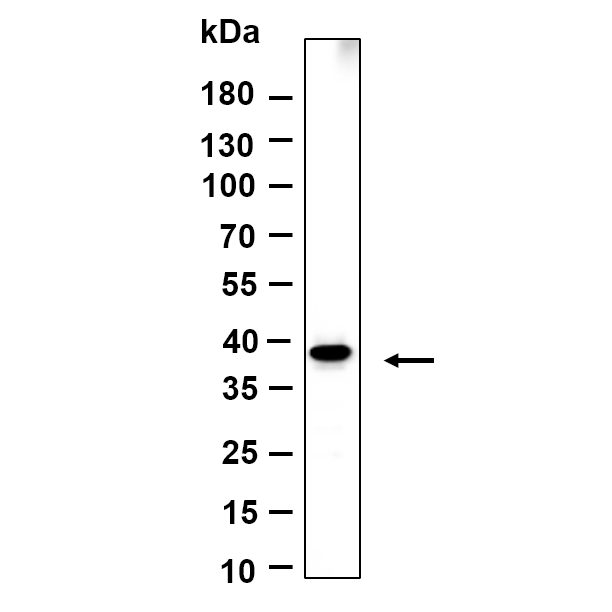
MW(Observed)39kD
Host SpeciesRabbit
IsotypeIgG,Kappa
Conjugate/ModificationUnmodified
Recommended Dilution RatioIHC 1:200-1:1000; WB 1:2000-1:10000; IF 1:200-1:1000; ELISA 1:5000-1:20000; IP 1:50-1:200; / Note: For IHC, we suggest antigen retrieval with TE buffer pH 9.0 (Cat#WT1004)
FormulationPBS, 50% glycerol, 0.05% Proclin 300, 0.05%BSA
PurificationRecombinant Antibody expressed in animal component-free (ACF) media, purified via Protein A affinity chromatography.
Storage-15°C to -25°C/1 year(Do not lower than -25°C)
Concentration
ClonalityMonoclonal
Clone NumberRM0957R
ImmunogenThe specific immunogen used to produce this antibody is proprietary information.
SpecificityEndogenous
Gene NameCRKL
Protein NameCrk-like protein
Other NameCRKL; / Crk-like protein
SpeciesHuman
Gene ID1399
UniprotP46109,
Species.1Mouse
Gene ID.112929
Uniprot.1P47941,
Species.2Rat
Gene ID.2287942
Uniprot.2Q5U2U2
Cellular Localizationendosome,cytosol,cell-cell adherens junction,extracellular exosome,
Tissue ExpressionSkin,Spleen,
Signaling_pathwayCellular Processes >> Cellular community - eukaryotes >> Focal adhesion;Cellular Processes >> Cell motility >> Regulation of actin cytoskeleton;Organismal Systems >> Immune system >> Fc gamma R-mediated phagocytosis;Organismal Systems >> Immune system >> Chemokine signaling pathway;Organismal Systems >> Endocrine system >> Insulin signaling pathway;Organismal Systems >> Endocrine system >> Growth hormone synthesis, secretion and action;Organismal Systems >> Nervous system >> Neurotrophin signaling pathway;Human Diseases >> Cancer: overview >> Pathways in cancer;Human Diseases >> Cancer: overview >> MicroRNAs in cancer;Human Diseases >> Cancer: specific types >> Chronic myeloid leukemia;Human Diseases >> Cancer: specific types >> Renal cell carcinoma;Environmental Information Processing >> Signal transduction >> MAPK signaling pathway;Environmental Information Processing >> Signal transduction >> ErbB signaling pathway;Environmental Information Processing >> Signal transduction >> Rap1 signaling pathway
Research Areas>>MAPK signaling pathway; / >>ErbB signaling pathway; / >>Rap1 signaling pathway; / >>Chemokine signaling pathway; / >>Focal adhesion; / >>Fc gamma R-mediated phagocytosis; / >>Neurotrophin signaling pathway; / >>Regulation of actin cytoskeleton; / >>Insulin signaling pathway; / >>Growth hormone synthesis, secretion and action; / >>Bacterial invasion of epithelial cells; / >>Shigellosis; / >>Yersinia infection; / >>Human cytomegalovirus infection; / >>Human immunodeficiency virus 1 infection; / >>Pathways in cancer; / >>MicroRNAs in cancer; / >>Renal cell carcinoma; / >>Chronic myeloid leukemia
FunctionFunction:May mediate the transduction of intracellular signals.,similarity:Contains 1 SH2 domain.,similarity:Contains 2 SH3 domains.,subunit:Interacts with INPP5D/SHIP1. Interacts with DOCK2 and EPOR. Interacts with phosphorylated CBLB and IRS4.,
Please login to post questions

Back to Top
Product has been added to your cart
