

U-Blot® Cyclophilin F Rabbit mAb
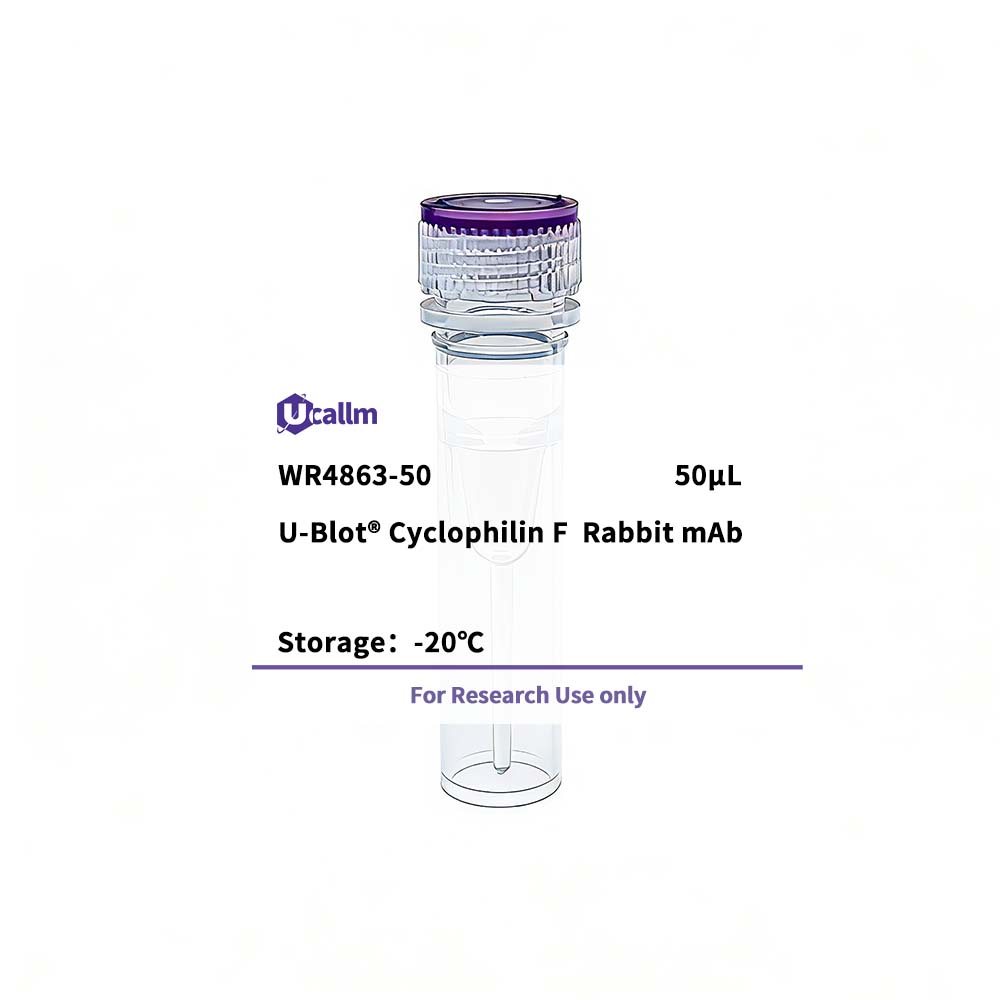
Ucallm_WR4863-50
Price range: $268.00 through $328.00
Product details
Background:The protein encoded by this gene is a member of the peptidyl-prolyl cis-trans isomerase (PPIase) family. PPIases catalyze the cis-trans isomerization of proline imidic peptide bonds in oligopeptides and accelerate the folding of proteins. This protein is part of the mitochondrial permeability transition pore in the inner mitochondrial membrane. Activation of this pore is thought to be involved in the induction of apoptotic and necrotic cell death. [provided by RefSeq, Jul 2008],
Specifications
| Size | 50μL/100μL |
| Target | Cyclophilin F |
| Reactivity | Human, Mouse, Rat |
| Applications | WB, IHC, IF, ELISA |
| MW(Calculated) | 22kD |
| MW(Observed) | 18kD |
| Host Species | Rabbit |
| Isotype | IgG,Kappa |
| Conjugate/Modification | Unmodified |
| Recommended Dilution Ratio | IHC 1:200-1:1000; WB 1:2000-1:10000; IF 1:200-1:1000; ELISA 1:5000-1:20000; / Note: For IHC, we suggest antigen retrieval with TE buffer pH 9.0 (Cat#WT1004) |
| Formulation | PBS, 50% glycerol, 0.05% Proclin 300, 0.05%BSA |
| Purification | Recombinant Antibody expressed in animal component-free (ACF) media, purified via Protein A affinity chromatography. |
| Storage | -15°C to -25°C/1 year(Do not lower than -25°C) |
| Concentration | |
| Clonality | Monoclonal |
| Clone Number | RM1033R |
| Immunogen | The specific immunogen used to produce this antibody is proprietary information. |
| Specificity | Endogenous |
| Gene Name | PPIF |
| Protein Name | Peptidyl-prolyl cis-trans isomerase F mitochondrial |
| Other Name | PPIF; / CYP3; / Peptidyl-prolyl cis-trans isomerase F; / mitochondrial; / PPIase F; / Cyclophilin F; / Rotamase F |
| Species | Human |
| Gene ID | 10105 |
| Uniprot | P30405, |
| Species.1 | Mouse |
| Gene ID.1 | 105675 |
| Uniprot.1 | Q99KR7, |
| Species.2 | Rat |
| Gene ID.2 | 282819 |
| Uniprot.2 | P29117 |
| Cellular Localization | Mitochondrion matrix . |
| Tissue Expression | Blood,Cord blood,Ovary, |
| Signaling_pathway | Organismal Systems >> Immune system >> Neutrophil extracellular trap formation;Human Diseases >> Neurodegenerative disease >> Alzheimer disease;Human Diseases >> Neurodegenerative disease >> Parkinson disease;Human Diseases >> Neurodegenerative disease >> Huntington disease;Human Diseases >> Neurodegenerative disease >> Spinocerebellar ataxia;Human Diseases >> Neurodegenerative disease >> Prion disease;Human Diseases >> Neurodegenerative disease >> Pathways of neurodegeneration - multiple diseases;Environmental Information Processing >> Signal transduction >> Calcium signaling pathway;Environmental Information Processing >> Signal transduction >> cGMP-PKG signaling pathway |
| Research Areas | >>Calcium signaling pathway; / >>cGMP-PKG signaling pathway; / >>Neutrophil extracellular trap formation; / >>Alzheimer disease; / >>Parkinson disease; / >>Huntington disease; / >>Spinocerebellar ataxia; / >>Prion disease; / >>Pathways of neurodegeneration - multiple diseases; / >>Toxoplasmosis; / >>Chemical carcinogenesis - reactive oxygen species; / >>Diabetic cardiomyopathy |
| Function | Catalytic activity:Peptidylproline (omega=180) = peptidylproline (omega=0).,Function:PPIases accelerate the folding of proteins.,Function:PPIases accelerate the folding of proteins. It catalyzes the cis-trans isomerization of proline imidic peptide bonds in oligopeptides.,similarity:Belongs to the cyclophilin-type PPIase family.,similarity:Contains 1 PPIase cyclophilin-type domain., |
Please login to post questions
Related products




