

CYP2C19 Polyclonal Antibody
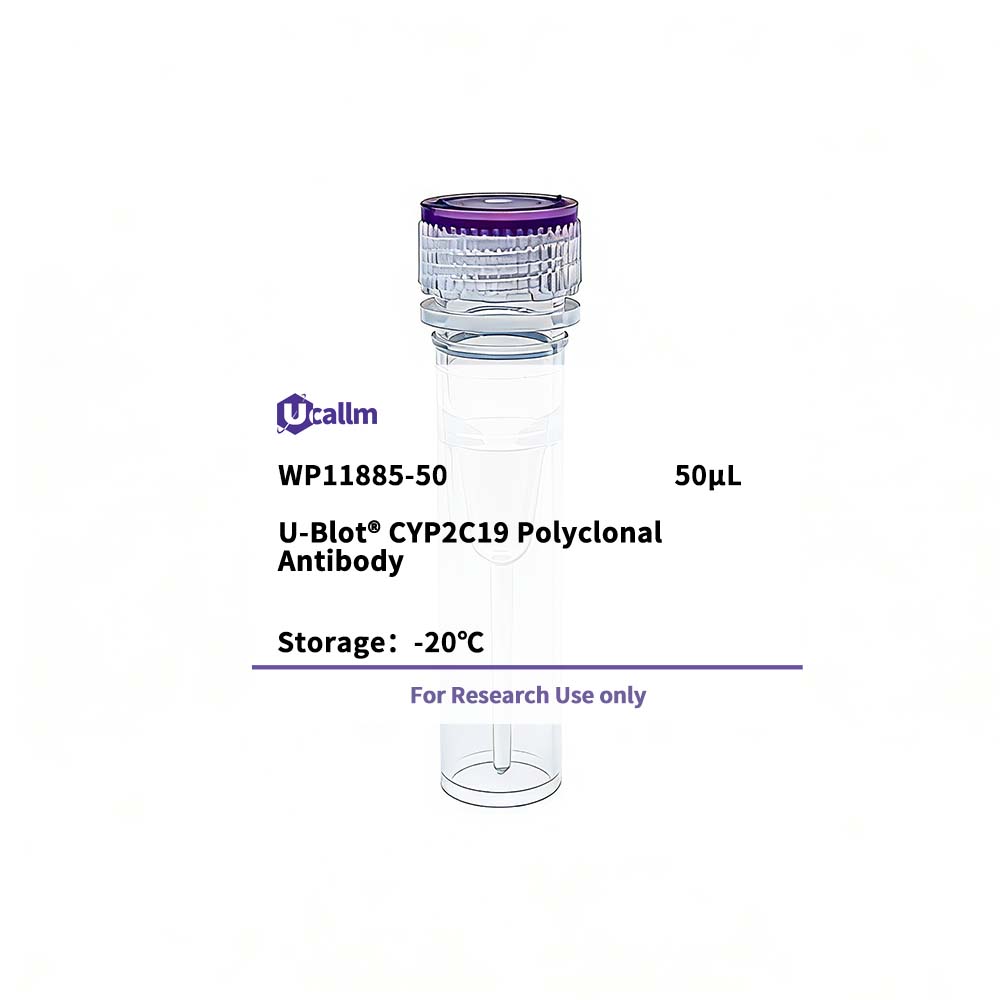
Ucallm_WP11885-50
Price range: $268.00 through $328.00
Product details
Background:
cytochrome P450 family 2 subfamily C member 19(CYP2C19) Homo sapiens This gene encodes a member of the cytochrome P450 superfamily of enzymes. The cytochrome P450 proteins are monooxygenases which catalyze many reactions involved in drug metabolism and synthesis of cholesterol, steroids and other lipids. This protein localizes to the endoplasmic reticulum and is known to metabolize many xenobiotics, including the anticonvulsive drug mephenytoin, omeprazole, diazepam and some barbiturates. Polymorphism within this gene is associated with variable ability to metabolize mephenytoin, known as the poor metabolizer and extensive metabolizer phenotypes. The gene is located within a cluster of cytochrome P450 genes on chromosome 10q24. [provided by RefSeq, Jul 2008],
Specifications
| Size | 50μL/100μL |
| Target | CYP2C19 |
| Reactivity | Human |
| Applications | WB, IHC, IF, ELISA |
| MW(Calculated) | |
| MW(Observed) | 56kD |
| Host Species | Rabbit |
| Isotype | IgG |
| Conjugate/Modification | Unmodified |
| Recommended Dilution Ratio | WB 1:500-1:2000; IHC 1:100-1:300; IF 1:200-1:1000; ELISA 1:5000; Not yet tested in other applications. / Note: For IHC, we suggest antigen retrieval with TE buffer pH 9.0 (Cat#WT1004) |
| Formulation | Liquid in PBS containing 50% glycerol, 0.5% BSA and 0.02% sodium azide. |
| Purification | The antibody was affinity-purified from rabbit antiserum by affinity-chromatography using epitope-specific immunogen. |
| Storage | -15°C to -25°C/1 year(Do not lower than -25°C) |
| Concentration | 1 mg/ml |
| Clonality | Polyclonal |
| Clone Number | |
| Immunogen | The antiserum was produced against synthesized peptide derived from human Cytochrome P450 2C19. AA range:241-290 |
| Specificity | CYP2C19 Polyclonal Antibody detects endogenous levels of CYP2C19 protein. |
| Gene Name | CYP2C19 |
| Protein Name | Cytochrome P450 2C19 |
| Other Name | CYP2C19; / Cytochrome P450 2C19; / R; / -limonene 6-monooxygenase; / S; / -limonene 6-monooxygenase; / S; / -limonene 7-monooxygenase; / CYPIIC17; / CYPIIC19; / Cytochrome P450-11A; / Cytochrome P450-254C; / Mephenytoin 4-hydroxylase |
| Species | Human |
| Gene ID | 1557 |
| Uniprot | P33261 |
| Species.1 | |
| Gene ID.1 | |
| Uniprot.1 | |
| Species.2 | |
| Gene ID.2 | |
| Uniprot.2 | |
| Cellular Localization | Endoplasmic reticulum membrane; Peripheral membrane protein. Microsome membrane; Peripheral membrane protein. |
| Tissue Expression | Liver, |
| Signaling_pathway | |
| Research Areas | >>Arachidonic acid metabolism; / >>Linoleic acid metabolism; / >>Drug metabolism - cytochrome P450; / >>Metabolic pathways; / >>Serotonergic synapse; / >>Chemical carcinogenesis - DNA adducts |
| Function | Catalytic activity:(+)-(R)-limonene + NADPH + O(2) = (+)-trans-carveol + NADP(+) + H(2)O.,Catalytic activity:(-)-(S)-limonene + NADPH + O(2) = (-)-perillyl alcohol + NADP(+) + H(2)O.,Catalytic activity:(-)-(S)-limonene + NADPH + O(2) = (-)-trans-carveol + NADP(+) + H(2)O.,Caution:P450-254C was originally listed as a separate gene (CYP2C17). Resequencing demonstrated that it is not a separate gene, but a chimera. The 5'-portion corresponds to a partial 2C18 clone, and the 3'-portion corresponds to a partial 2C19 clone.,cofactor:Heme group.,Function:Responsible for the metabolism of a number of therapeutic agents such as the anticonvulsant drug S-mephenytoin, omeprazole, proguanil, certain barbiturates, diazepam, propranolol, citalopram and imipramine.,induction:P450 can be induced to high levels in liver and other tissues by various foreign compounds, including drugs, pesticides, and carcinogens.,online information:CYP2C19 alleles,polymorphism:Genetic variation in CYP2C19 is responsible for poor drug metabolism [MIM:609535]. Individuals can be characterized as either extensive metabolizers (EM) or poor metabolizers (PM). The PM phenotype is inherited in an autosomal recessive manner, with the EM phenotype comprising both homozygous dominant and heteroyzgote genotypes. There are marked interracial differences in the frequency of this polymorphism. Poor metabolizers represent 2-5% of Caucasians, 13-23% of Asian populations, and as many as 38-79% of individuals of some of the islands of Polynesia and Micronesia. Different alleles of CYP2C19 are known: CYP2C19*1A CYP2C19*1B, CYP2C19*1C, CYP2C19*2A (CYP2C19m1 or CYP2C19m1A), CYP2C19*2B (CYP2C19m1B), CYP2C19*2C (CYP2C19*21), CYP2C19*3A (CYP2C19m2), CYP2C19*3B (CYP2C19*20), CYP2C19*4 (CYP2C19m3), CYP2C19*5A (CYP2C19m4), CYP2C19*5B, CYP2C19*6, CYP2C19*7, CYP2C19*8, CYP2C19*9, CYP2C19*10, CYP2C19*11 CYP2C19*12, CYP2C19*13, CYP2C19*14 CYP2C19*15, CYP2C19*16, CYP2C19*18, CYP2C19*19. Defective CYP2C19*2 and CYP2C19*3 alleles are characterized by a splice mutation and a stop codon, respectively, and account for most of the PM alleles. The sequence shown is that of allele CYP2C19*1B.,similarity:Belongs to the cytochrome P450 family., |
Please login to post questions
Related products





