

CYP2U1 Polyclonal Antibody
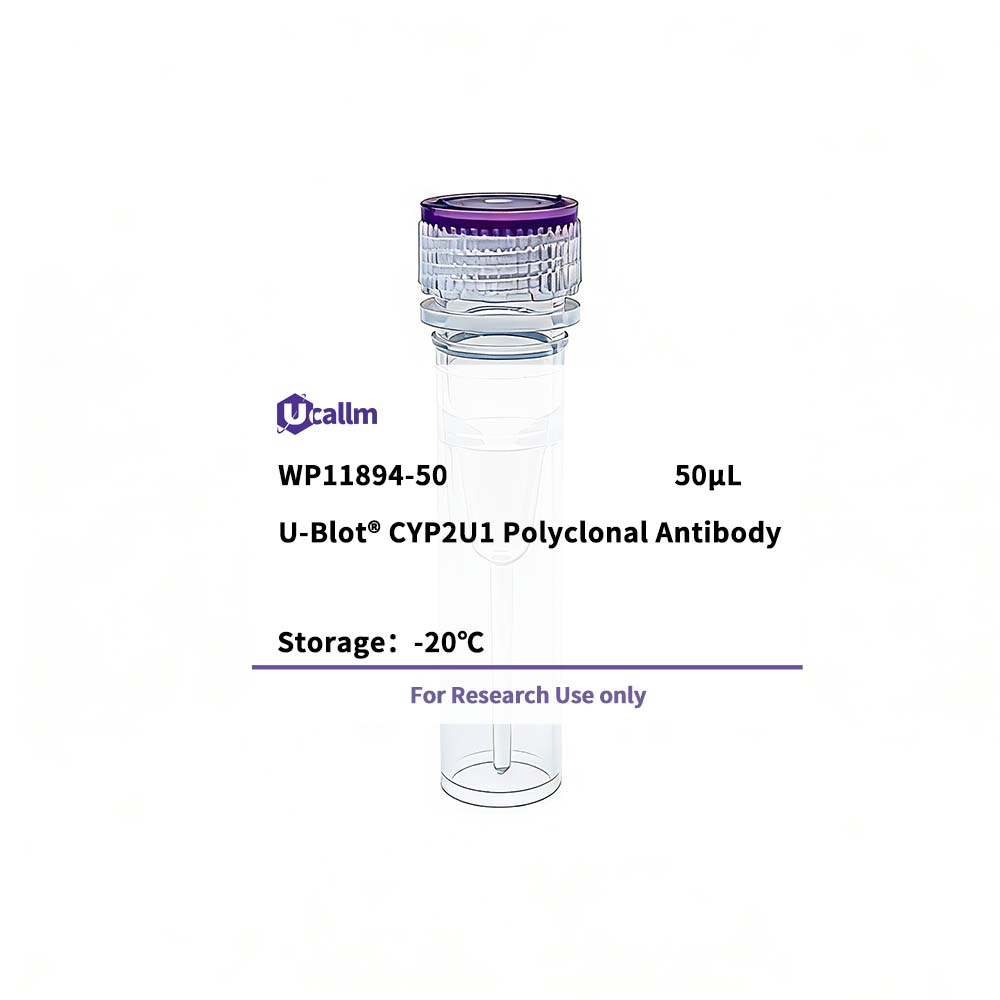
Ucallm_WP11894-50
Price range: $268.00 through $328.00
Product details
Background:
This gene encodes a member of the cytochrome P450 superfamily of enzymes. The cytochrome P450 proteins are monooxygenases which catalyze many reactions involved in drug metabolism and synthesis of cholesterol, steroids and other lipids. This enzyme is a hydroxylase that metabolizes arachidonic acid, docosahexaenoic acid, and other long chain fatty acids. [provided by RefSeq, Jul 2008],
Specifications
| Size | 50μL/100μL |
| Target | CYP2U1 |
| Reactivity | Human, Mouse, Rat |
| Applications | WB, IHC, IF, ELISA |
| MW(Calculated) | |
| MW(Observed) | 61kD |
| Host Species | Rabbit |
| Isotype | IgG |
| Conjugate/Modification | Unmodified |
| Recommended Dilution Ratio | WB 1:500-1:2000; IHC 1:100-1:300; IF 1:200-1:1000; ELISA 1:20000; Not yet tested in other applications. / Note: For IHC, we suggest antigen retrieval with TE buffer pH 9.0 (Cat#WT1004) |
| Formulation | Liquid in PBS containing 50% glycerol, 0.5% BSA and 0.02% sodium azide. |
| Purification | The antibody was affinity-purified from rabbit antiserum by affinity-chromatography using epitope-specific immunogen. |
| Storage | -15°C to -25°C/1 year(Do not lower than -25°C) |
| Concentration | 1 mg/ml |
| Clonality | Polyclonal |
| Clone Number | |
| Immunogen | The antiserum was produced against synthesized peptide derived from human Cytochrome P450 2U1. AA range:281-330 |
| Specificity | CYP2U1 Polyclonal Antibody detects endogenous levels of CYP2U1 protein. |
| Gene Name | CYP2U1 |
| Protein Name | Cytochrome P450 2U1 |
| Other Name | CYP2U1; / Cytochrome P450 2U1 |
| Species | Human |
| Gene ID | 113612 |
| Uniprot | Q7Z449, |
| Species.1 | Mouse |
| Gene ID.1 | 71519 |
| Uniprot.1 | Q9CX98, |
| Species.2 | Rat |
| Gene ID.2 | 310848 |
| Uniprot.2 | Q4V8D1 |
| Cellular Localization | Endoplasmic reticulum membrane; Multi-pass membrane protein . Microsome membrane; Multi-pass membrane protein . Mitochondrion inner membrane; Multi-pass membrane protein . |
| Tissue Expression | Widely expressed with stronger expression in thymus, heart and cerebellum. |
| Signaling_pathway | |
| Research Areas | >>Fatty acid degradation; / >>Arachidonic acid metabolism; / >>Metabolic pathways |
| Function | Catalytic activity:RH + reduced flavoprotein + O(2) = ROH + oxidized flavoprotein + H(2)O.,cofactor:Heme group.,developmental stage:Expressed in fetal thymus.,Function:Catalyzes the hydroxylation of arachidonic acid, docosahexaenoic acid and other long chain fatty acids. May modulate the arachidonic acid signaling pathway and play a role in other fatty acid signaling processes.,similarity:Belongs to the cytochrome P450 family.,tissue specificity:Widely expressed with stronger expression in thymus, heart and cerebellum., |
Please login to post questions
Related products





