

Product details
Background:
CK16 is a cytokeratin with a molecular weight of 48 kDa. It mainly marks keratinized and hyperplastic squamous epithelium and is used for the diagnosis of squamous cell carcinoma.
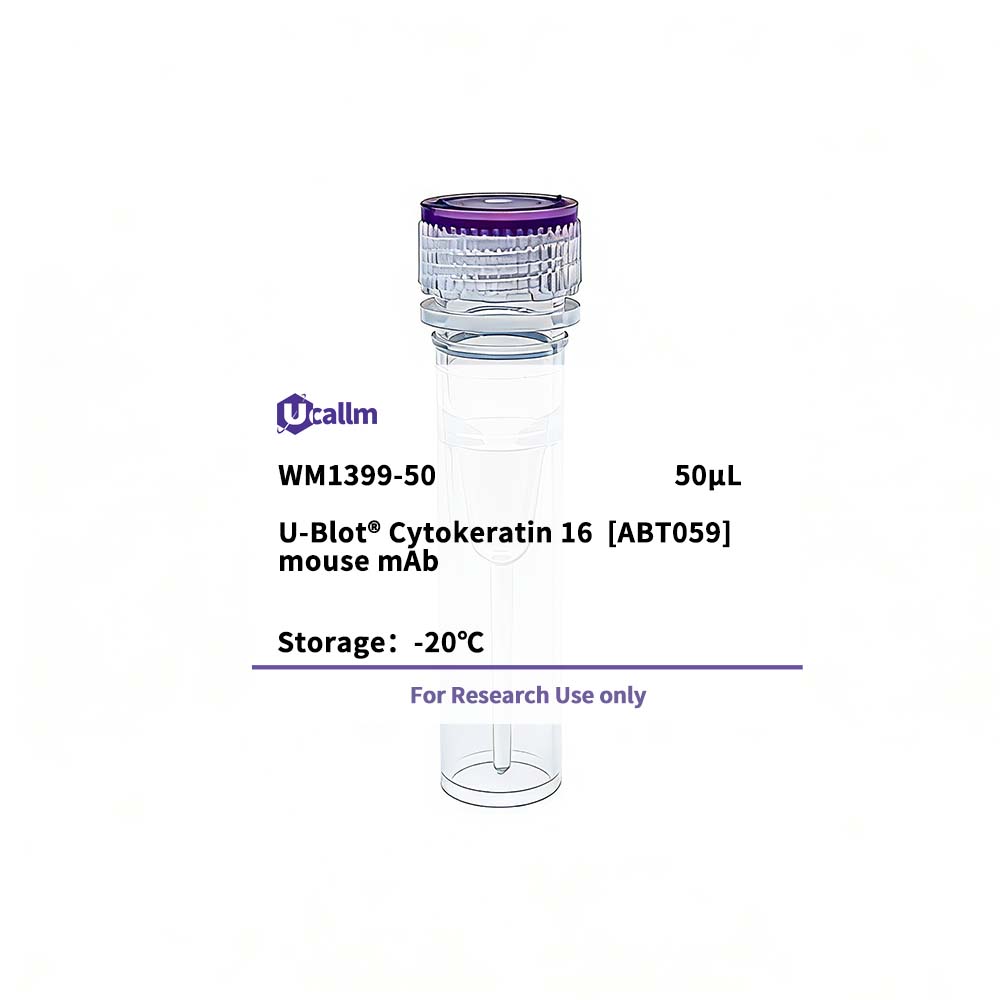
Price range: $268.00 through $328.00
Background:
CK16 is a cytokeratin with a molecular weight of 48 kDa. It mainly marks keratinized and hyperplastic squamous epithelium and is used for the diagnosis of squamous cell carcinoma.
| Size | 50μL/100μL |
| Target | Cytokeratin 16 |
| Reactivity | Human |
| Applications | IHC, WB, IF, ELISA |
| MW(Calculated) | 51kD |
| MW(Observed) | 55kD |
| Host Species | Mouse |
| Isotype | IgG2b,Kappa |
| Conjugate/Modification | Unmodified |
| Recommended Dilution Ratio | IHC 1:200-1000; WB 1:500-2000; IF 1:100-500; ELISA 1:1000-5000 / Note: For IHC, we suggest antigen retrieval with TE buffer pH 9.0 (Cat#WT1004) |
| Formulation | PBS, 50% glycerol, 0.05% Proclin 300, 0.05%BSA |
| Purification | Recombinant Antibody expressed in animal component-free (ACF) media, purified via Protein G affinity chromatography. |
| Storage | -15°C to -25°C/1 year(Do not lower than -25°C) |
| Concentration | |
| Clonality | Monoclonal |
| Clone Number | RMM059 |
| Immunogen | Synthesized peptide derived from human CK16 AA range: 400-473 |
| Specificity | The antibody can specifically recognize human CK16 protein, and shows no cross reaction with CK1, 5, 6, 7, 8, 10, 13, 14, 15, 19, 20. |
| Gene Name | KRT16 KRT16A |
| Protein Name | Cytokeratin-16 |
| Other Name | CK 16; / CK-16; / CK16; / Cytokeratin 16; / CytokeRatin-16; / CytokeRatin16; / FNEPPK; / Focal non epidermolytic palmoplantar keRatoderma; / K 16; / K16; / K1C16_HUMAN; / K1CP; / KeRatin 1 type I; / KeRatin 16; / KeRatin; / KeRatin type I cytoskeletal 16; / KeRatin-16; / KeRatin16; / KRT 16; / Krt16; / KRT16A; / NEPPK; / PC1; / type I cytoskeletal 16 |
| Species | Human |
| Gene ID | 3868 |
| Uniprot | P08779 |
| Species.1 | |
| Gene ID.1 | |
| Uniprot.1 | |
| Species.2 | |
| Gene ID.2 | |
| Uniprot.2 | |
| Cellular Localization | Cytoplasmic, Membranous |
| Tissue Expression | Expressed in the corneal epithelium (at protein level). |
| Signaling_pathway | Organismal Systems >> Endocrine system >> Estrogen signaling pathway |
| Research Areas | >>Estrogen signaling pathway; / >>Staphylococcus aureus infection |
| Function | Disease:Defects in KRT16 are a cause of pachyonychia congenita type 1 (PC1) [MIM:167200]; also known as Jadassohn-Lewandowsky syndrome. PC1 is an autosomal dominant ectodermal dysplasia characterized by hypertrophic nail dystrophy resulting in onchyogryposis (thickening and increase in curvature of the nail), palmoplantar keratoderma, follicular hyperkeratosis, and oral leukokeratosis. Hyperhidrosis of the hands and feet is usually present.,Disease:Defects in KRT16 are a cause of unilateral palmoplantar verrucous nevus (UPVN) [MIM:144200]. UPVN is characterized by a localized thickening of the skin in parts of the right palm and the right sole.,Disease:Defects in KRT16 are the cause of palmoplantar keratoderma non-epidermolytic (NEPPK) [MIM:600962]. NEPKK is a dermatological disorder characterized by focal palmoplantar keratoderma with oral, genital, and follicular lesions.,Disease:KRT16 and KRT17 are coexpressed only in pathological situations such as metaplasias and carcinomas of the uterine cervix and in psoriasis vulgaris.,mass spectrometry: PubMed:11840567,miscellaneous:There are two types of cytoskeletal and microfibrillar keratin, I (acidic) and II (neutral to basic) (40-55 and 56-70 kDa, respectively).,similarity:Belongs to the intermediate filament family.,subunit:Heterodimer of a type I and a type II keratin. KRT16 associates with KRT6 isomers. Interacts with TCHP. Interacts with TRADD.,tissue specificity:Expressed in the hair follicle, nail bed and in mucosal stratified squamous epithelia and, suprabasally, in oral epithelium and palmoplantar epidermis. Also found in luminal cells of sweat and mammary gland ducts., |



