

Cytokeratin 20 [ABT044] mouse mAb
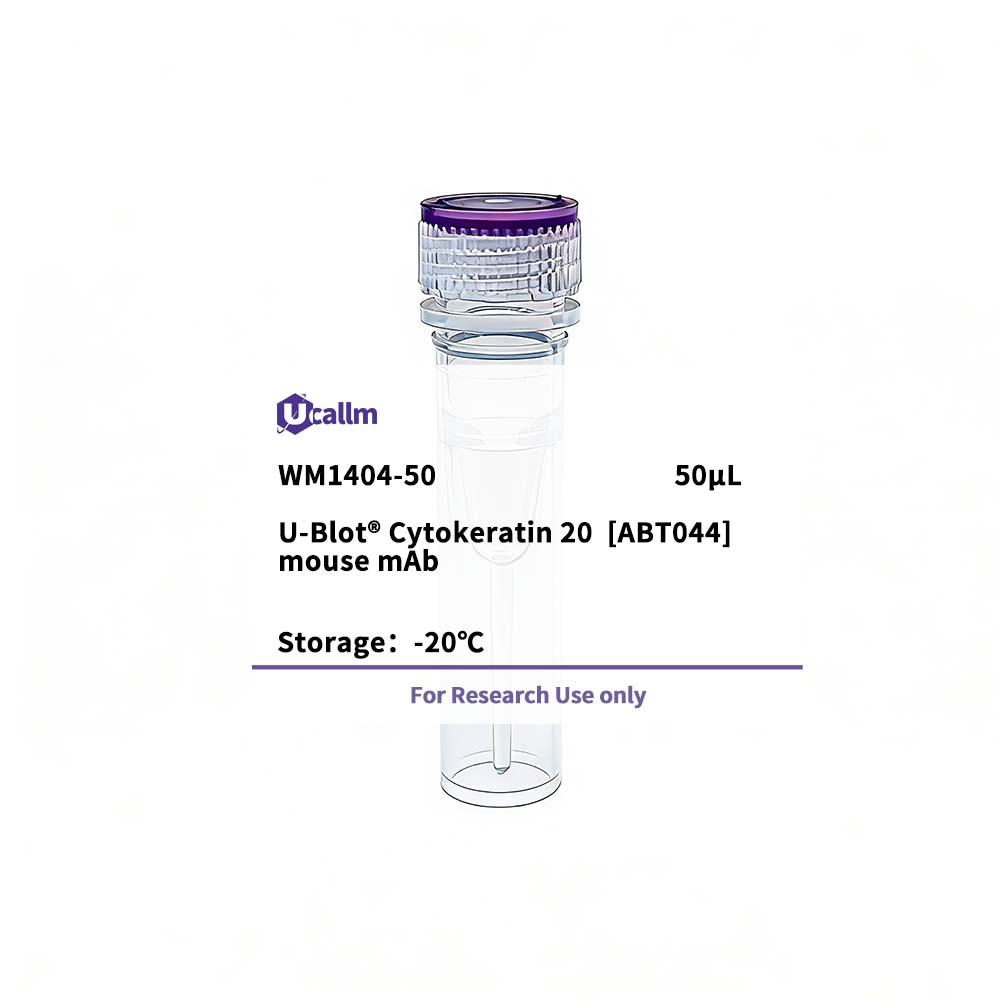
Ucallm_WM1404-50
Price range: $268.00 through $328.00
Product details
Background:
CK20 is a cytokeratin with a molecular weight of 46 kDa, which is mainly expressed in gastrointestinal epithelium, urethral epithelium and Merkel cells. It is mainly used for the diagnosis of gastrointestinal adenocarcinoma, ovarian mucinous tumor, Merkel cell carcinoma and cholangiopancreatic adenocarcinoma. CK20 was negative in squamous cell carcinoma, lung adenocarcinoma, endometrial adenocarcinoma, breast cancer, small cell lung cancer and ovarian non mucinous tumor. It is often used in combination with CK7 and villin to judge the tissue source of adenocarcinoma.
Specifications
| Size | 50μL/100μL |
| Target | Cytokeratin 20 |
| Reactivity | Human, Mouse, Rat |
| Applications | IHC, WB, IF, ELISA |
| MW(Calculated) | 48kD |
| MW(Observed) | 48kD |
| Host Species | Mouse |
| Isotype | IgG2b,Kappa |
| Conjugate/Modification | Unmodified |
| Recommended Dilution Ratio | IHC 1:200-1000; WB 1:500-2000; IF 1:100-500; ELISA 1:1000-5000 / Note: For IHC, we suggest antigen retrieval with TE buffer pH 9.0 (Cat#WT1004) |
| Formulation | PBS, 50% glycerol, 0.05% Proclin 300, 0.05%BSA |
| Purification | Recombinant Antibody expressed in animal component-free (ACF) media, purified via Protein G affinity chromatography. |
| Storage | -15°C to -25°C/1 year(Do not lower than -25°C) |
| Concentration | |
| Clonality | Monoclonal |
| Clone Number | RMM044 |
| Immunogen | Synthesized peptide derived from human CK20 AA range: 300-424 |
| Specificity | The antibody can specifically recognize human CK20 protein, and shows no cross reaction with CK1, 5, 6, 7, 8, 13, 14, 15, 17, 18. |
| Gene Name | KRT20 |
| Protein Name | Cytokeratin-20 |
| Other Name | CD20; / CK 20; / CK-20; / CK20; / CytokeRatin-20; / CytokeRatin20; / K1C20_HUMAN; / K20; / KA20; / KeRatin 20; / keRatin 20, type I; / keRatin 21, Rat, homolog of; / KeRatin; / KeRatin type I cytoskeletal 20; / KeRatin-20; / KeRatin20; / KRT 20; / KRT 21; / KRT20; / KRT21; / MGC35423; / OTTHUMP00000164518; / Protein IT; / type I cytoskeletal 20 |
| Species | Human |
| Gene ID | 54474 |
| Uniprot | P35900 |
| Species.1 | |
| Gene ID.1 | |
| Uniprot.1 | |
| Species.2 | |
| Gene ID.2 | |
| Uniprot.2 | |
| Cellular Localization | Cytoplasmic, Membranous |
| Tissue Expression | Expressed predominantly in the intestinal epithelium. Expressed in luminal cells of colonic mucosa. Also expressed in the Merkel cells of keratinized oral mucosa; specifically at the tips of some rete ridges of the gingival mucosa, in the basal layer of the palatal mucosa and in the taste buds of lingual mucosa. |
| Signaling_pathway | Organismal Systems >> Endocrine system >> Estrogen signaling pathway |
| Research Areas | >>Estrogen signaling pathway; / >>Staphylococcus aureus infection |
| Function | developmental stage:First detected at embryonic week 8 in individual 'converted' simple epithelial cells of the developing intestinal mucosa. In later fetal stages, synthesis extends over most goblet cells and a variable number of villus enterocytes. In the developing gastric and intestinal mucosa, expressed in all enterocytes and goblet cells as well as certain 'low-differentiated' columnar cells, whereas the neuroendocrine and Paneth cells are negative.,Function:Plays a significant role in maintaining keratin filament organization in intestinal epithelia. When phosphorylated, plays a role in the secretion of mucin in the small intestine.,miscellaneous:There are two types of cytoskeletal and microfibrillar keratin: I (acidic; 40-55 kDa) and II (neutral to basic; 56-70 kDa).,PTM:Hyperphosphorylation at Ser-13 occurs during the early stages of apoptosis but becomes less prominent during the later stages. Phosphorylation at Ser-13 also increases in response to stress brought on by cell injury.,PTM:Proteolytically cleaved by caspases during apoptosis. Cleavage occurs at Asp-228.,similarity:Belongs to the intermediate filament family.,subunit:Heterotetramer of two type I and two type II keratins. Associates with KRT8.,tissue specificity:Expressed predominantly in the intestinal epithelium. Expressed in luminal cells of colonic mucosa. Also expressed in the Merkel cells of keratinized oral mucosa; specifically at the tips of some rete ridges of the gingival mucosa, in the basal layer of the palatal mucosa and in the taste buds of lingual mucosa., |
Please login to post questions
Related products




