

Dok-3 Polyclonal Antibody
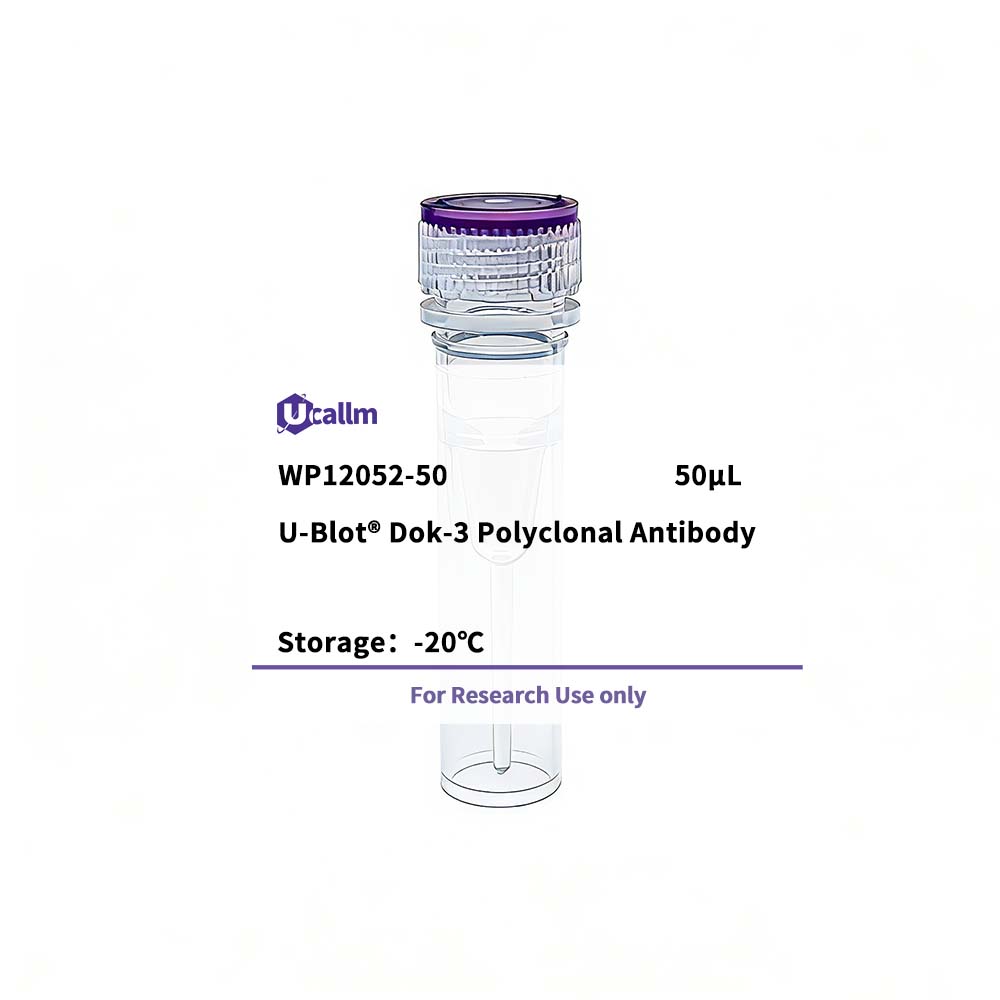
Ucallm_WP12052-50
Price range: $268.00 through $328.00
Product details
Background:
domain:PTB domain mediates receptor interaction., function:DOK proteins are enzymatically inert adaptor or scaffolding proteins. They provide a docking platform for the assembly of multimolecular signaling complexes. DOK3 is a negative regulator of JNK signaling in B-cells through interaction with INPP5D/SHIP1. May modulate ABL function., PTM:Constitutively tyrosine-phosphorylated., PTM:On IL2 stimulation, phosphorylated on C-terminal tyrosine residues possibly by Src kinases. Can also be phosphorylated by ABL kinase., similarity:Belongs to the DOK family. Type A subfamily., similarity:Contains 1 IRS-type PTB domain., similarity:Contains 1 PH domain., subunit:On tyrosine phosphorylation, interacts with CSK and INPP5D/SHIP1 via their SH2 domains. Both Tyr-381 and Tyr-398 are required for interaction with INPP5D. Only Tyr-381 is required for interaction with CSK. Binds ABL through the PTB domain and in a kinase-dependent manner. Does not interact with RasGAP., tissue specificity:Expressed in spleen.,
Specifications
| Size | 50μL/100μL |
| Target | Dok-3 |
| Reactivity | Human, Mouse |
| Applications | WB, IHC, IF, ELISA |
| MW(Calculated) | |
| MW(Observed) | 58kD |
| Host Species | Rabbit |
| Isotype | IgG |
| Conjugate/Modification | Unmodified |
| Recommended Dilution Ratio | WB 1:500-1:2000; IHC 1:100-1:300; IF 1:200-1:1000; ELISA 1:20000; Not yet tested in other applications. / Note: For IHC, we suggest antigen retrieval with TE buffer pH 9.0 (Cat#WT1004) |
| Formulation | Liquid in PBS containing 50% glycerol, 0.5% BSA and 0.02% sodium azide. |
| Purification | The antibody was affinity-purified from rabbit antiserum by affinity-chromatography using epitope-specific immunogen. |
| Storage | -15°C to -25°C/1 year(Do not lower than -25°C) |
| Concentration | 1 mg/ml |
| Clonality | Polyclonal |
| Clone Number | |
| Immunogen | The antiserum was produced against synthesized peptide derived from human DOK3. AA range:101-150 |
| Specificity | Dok-3 Polyclonal Antibody detects endogenous levels of Dok-3 protein. |
| Gene Name | DOK3 |
| Protein Name | Docking protein 3 |
| Other Name | DOK3; / Docking protein 3; / Downstream of tyrosine kinase 3 |
| Species | Human |
| Gene ID | 79930 |
| Uniprot | Q7L591, |
| Species.1 | Mouse |
| Gene ID.1 | 27261 |
| Uniprot.1 | Q9QZK7 |
| Species.2 | |
| Gene ID.2 | |
| Uniprot.2 | |
| Cellular Localization | Cytoplasm . Cell membrane; Peripheral membrane protein; Cytoplasmic side . |
| Tissue Expression | Expressed in spleen. |
| Signaling_pathway | |
| Research Areas | |
| Function | Domain:PTB domain mediates receptor interaction.,Function:DOK proteins are enzymatically inert adaptor or scaffolding proteins. They provide a docking platform for the assembly of multimolecular signaling complexes. DOK3 is a negative regulator of JNK signaling in B-cells through interaction with INPP5D/SHIP1. May modulate ABL function.,PTM:Constitutively tyrosine-phosphorylated.,PTM:On IL2 stimulation, phosphorylated on C-terminal tyrosine residues possibly by Src kinases. Can also be phosphorylated by ABL kinase.,similarity:Belongs to the DOK family. Type A subfamily.,similarity:Contains 1 IRS-type PTB domain.,similarity:Contains 1 PH domain.,subunit:On tyrosine phosphorylation, interacts with CSK and INPP5D/SHIP1 via their SH2 domains. Both Tyr-381 and Tyr-398 are required for interaction with INPP5D. Only Tyr-381 is required for interaction with CSK. Binds ABL through the PTB domain and in a kinase-dependent manner. Does not interact with RasGAP.,tissue specificity:Expressed in spleen., |
Please login to post questions
Related products





