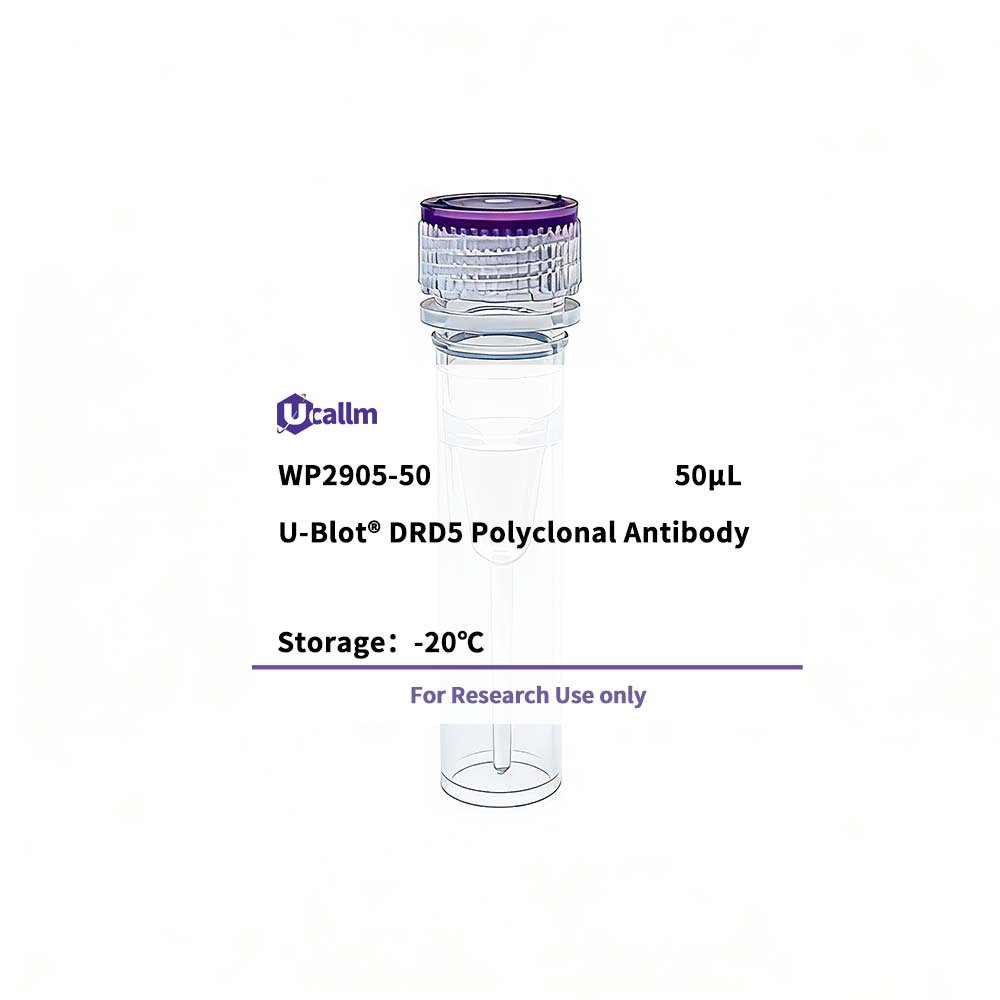
SKU: WP2905 Categories: ,

DRD5 Polyclonal Antibody

Price range: $268.00 through $328.00

SKU: WP2905-100
Enter the quantity you would like, or drag the panel to find the quantity and price that best for you
Bulk QuoteAuthorize OEM & ODM

Product details

Background:

This gene encodes the D5 subtype of the dopamine receptor. The D5 subtype is a G-protein coupled receptor which stimulates adenylyl cyclase. This receptor is expressed in neurons in the limbic regions of the brain. It has a 10-fold higher affinity for dopamine than the D1 subtype. Pseudogenes related to this gene reside on chromosomes 1 and 2. [provided by RefSeq, Jul 2008],

Specifications

Size50μL/100μL
TargetDRD5
ReactivityHuman, Mouse, Rat
ApplicationsWB, ELISA
MW(Calculated)
MW(Observed)52kD
Host SpeciesRabbit
IsotypeIgG
Conjugate/ModificationUnmodified
Recommended Dilution RatioWB 1:500-2000; ELISA 1:5000-20000
FormulationLiquid in PBS containing 50% glycerol,0.5% BSA and 0.02% sodium azide.
PurificationThe antibody was affinity-purified from rabbit antiserum by affinity-chromatography using epitope-specific immunogen.
Storage-15°C to -25°C/1 year(Do not lower than -25°C)
Concentration1 mg/ml
ClonalityPolyclonal
Clone Number
ImmunogenSynthesized peptide derived from human protein . at AA range: 150-230
SpecificityDRD5 Polyclonal Antibody detects endogenous levels of protein.
Gene NameDRD5 DRD1B DRD1L2
Protein NameD(1B) dopamine receptor (D(5) dopamine receptor) (D1beta dopamine receptor) (Dopamine D5 receptor)
Other Name
SpeciesHuman
Gene ID1816
UniprotP21918,
Species.1Mouse
Gene ID.1
Uniprot.1Q8BLD9,
Species.2Rat
Gene ID.2
Uniprot.2P25115
Cellular LocalizationCell membrane; Multi-pass membrane protein.
Tissue ExpressionNeuron-specific, localized primarily within limbic regions of the brain.
Signaling_pathwayOrganismal Systems >> Nervous system >> Dopaminergic synapse;Environmental Information Processing >> Signal transduction >> Calcium signaling pathway;Environmental Information Processing >> Signal transduction >> cAMP signaling pathway
Research Areas>>Calcium signaling pathway; / >>cAMP signaling pathway; / >>Neuroactive ligand-receptor interaction; / >>Dopaminergic synapse
FunctionDisease:Defects in DRD5 are a cause of benign essential blepharospasm (BEB) [MIM:606798]. BEB is a primary focal dystonia affecting the orbicularis oculi muscles. Dystonia is defined by the presence of sustained involuntary muscle contraction, often leading to abnormal postures. BEB usually begins in middle age. Initial symptoms include eye irritation and frequent blinking, progressing to involuntary spasms of eyelid closure. Patients have normal eyes. The visual disturbance is due solely to the forced closure of the eyelids. In severe cases, this can lead to functional blindness.,Disease:Defects in DRD5 may be a cause of schizophrenia, but no proof has yet been found.,Function:This is one of the five types (D1 to D5) of receptors for dopamine. The activity of this receptor is mediated by G proteins which activate adenylyl cyclase.,similarity:Belongs to the G-protein coupled receptor 1 family.,tissue specificity:Neuron-specific, localized primarily within limbic regions of the brain.,
Please login to post questions
Back to Top
Product has been added to your cart

