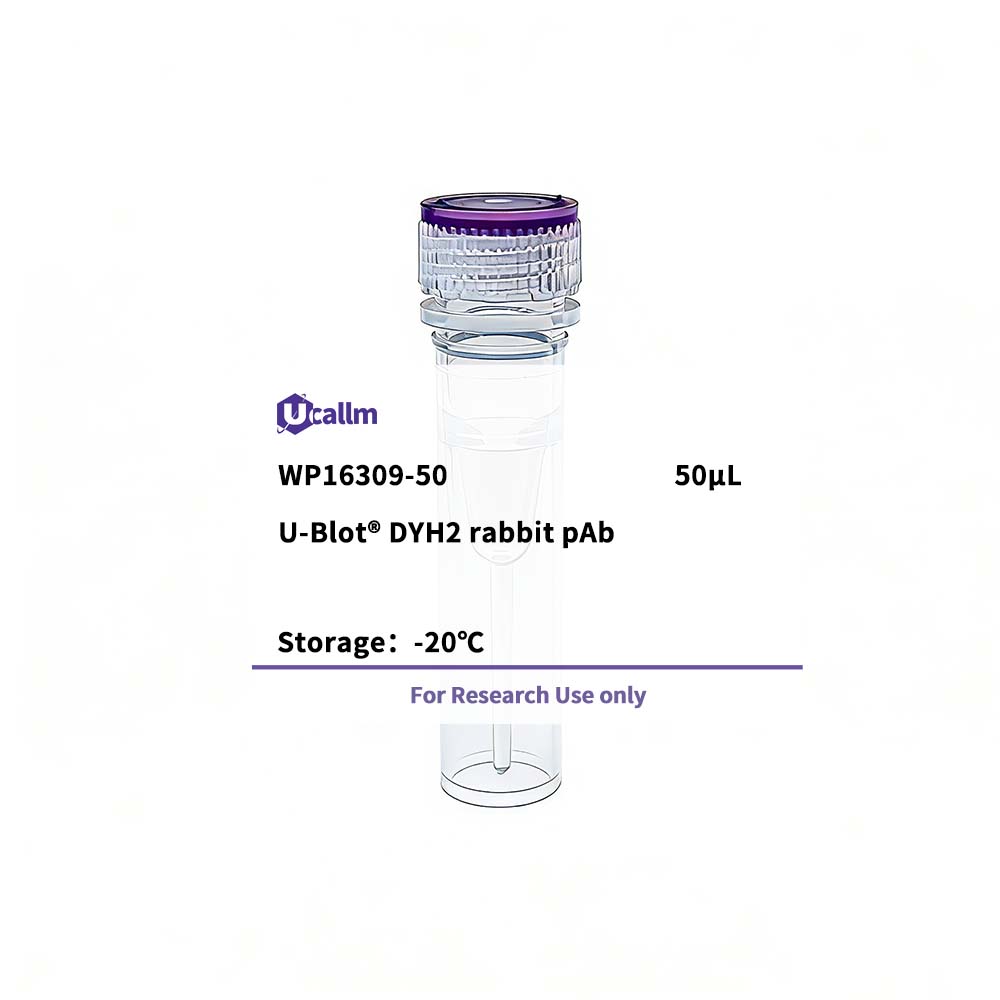
SKU: WP16309 Categories: ,

DYH2 rabbit pAb

Price range: $268.00 through $328.00

SKU: WP16309-100
Enter the quantity you would like, or drag the panel to find the quantity and price that best for you
Bulk QuoteAuthorize OEM & ODM

Product details

Background:

Dyneins are microtubule-associated motor protein complexes composed of several heavy, light, and intermediate chains. The axonemal dyneins, found in cilia and flagella, are components of the outer and inner dynein arms attached to the peripheral microtubule doublets. DNAH2 is an axonemal inner arm dynein heavy chain (Chapelin et al., 1997 [PubMed 9256245]).[supplied by OMIM, Mar 2008],


Specifications

Size50μL/100μL
TargetDYH2
ReactivityHuman, Mouse
ApplicationsIHC, IF
MW(Calculated)487kD
MW(Observed)
Host SpeciesRabbit
IsotypeIgG
Conjugate/ModificationUnmodified
Recommended Dilution RatioIHC 1:50-200; IF 1:50-200 / Note: For IHC, we suggest antigen retrieval with TE buffer pH 9.0 (Cat#WT1004)
FormulationLiquid in PBS containing 50% glycerol, 0.5% BSA and 0.02% sodium azide.
PurificationThe antibody was affinity-purified from rabbit antiserum by affinity-chromatography using epitope-specific immunogen.
Storage-15°C to -25°C/1 year(Do not lower than -25°C)
Concentration1 mg/ml
ClonalityPolyclonal
Clone Number
ImmunogenSynthesized peptide derived from human DYH2 AA range: 329-379
SpecificityThis antibody detects endogenous levels of DYH2 at Human/Mouse
Gene NameDNAH2 DNAHC2 DNHD3 KIAA1503
Protein NameDYH2
Other Name
SpeciesHuman
Gene ID146754
UniprotQ9P225,
Species.1Mouse
Gene ID.1
Uniprot.1P0C6F1
Species.2
Gene ID.2
Uniprot.2
Cellular LocalizationCytoplasm, cytoskeleton, cilium axoneme . Cytoplasm, cytoskeleton, flagellum axoneme .
Tissue ExpressionExpressed primarily in trachea and testis, 2 tissues containing axonemal structures. Also expressed in lung. Expressed in spermatozoa (at protein level) (PubMed:31178125).
Signaling_pathwayHuman Diseases >> Neurodegenerative disease >> Amyotrophic lateral sclerosis;Human Diseases >> Neurodegenerative disease >> Huntington disease;Human Diseases >> Neurodegenerative disease >> Pathways of neurodegeneration - multiple diseases
Research Areas>>Amyotrophic lateral sclerosis; / >>Huntington disease; / >>Pathways of neurodegeneration - multiple diseases
FunctionDomain:Dynein heavy chains probably consist of an N-terminal stem (which binds cargo and interacts with other dynein components), and the head or motor domain. The motor contains six tandemly-linked AAA domains in the head, which form a ring. A stalk-like structure (formed by two of the coiled coil domains) protrudes between AAA 4 and AAA 5 and terminates in a microtubule-binding site. A seventh domain may also contribute to this ring; it is not clear whether the N-terminus or the C-terminus forms this extra domain. There are four well-conserved and two non-conserved ATPase sites, one per AAA domain. Probably only one of these (within AAA 1) actually hydrolyzes ATP, the others may serve a regulatory function.,Function:Force generating protein of respiratory cilia. Produces force towards the minus ends of microtubules. Dynein has ATPase activity; the force-producing power stroke is thought to occur on release of ADP. Involved in sperm motility; implicated in sperm flagellar assembly.,similarity:Belongs to the dynein heavy chain family.,similarity:Contains 5 LRR (leucine-rich) repeats.,similarity:Contains 5 TPR repeats.,subunit:Consists of at least two heavy chains and a number of intermediate and light chains.,tissue specificity:Expressed primarily in trachea and testis, 2 tissues containing axonemal structures. Also expressed in lung.,
Please login to post questions
Back to Top
Product has been added to your cart

