SKU: WP0511 Categories: ,

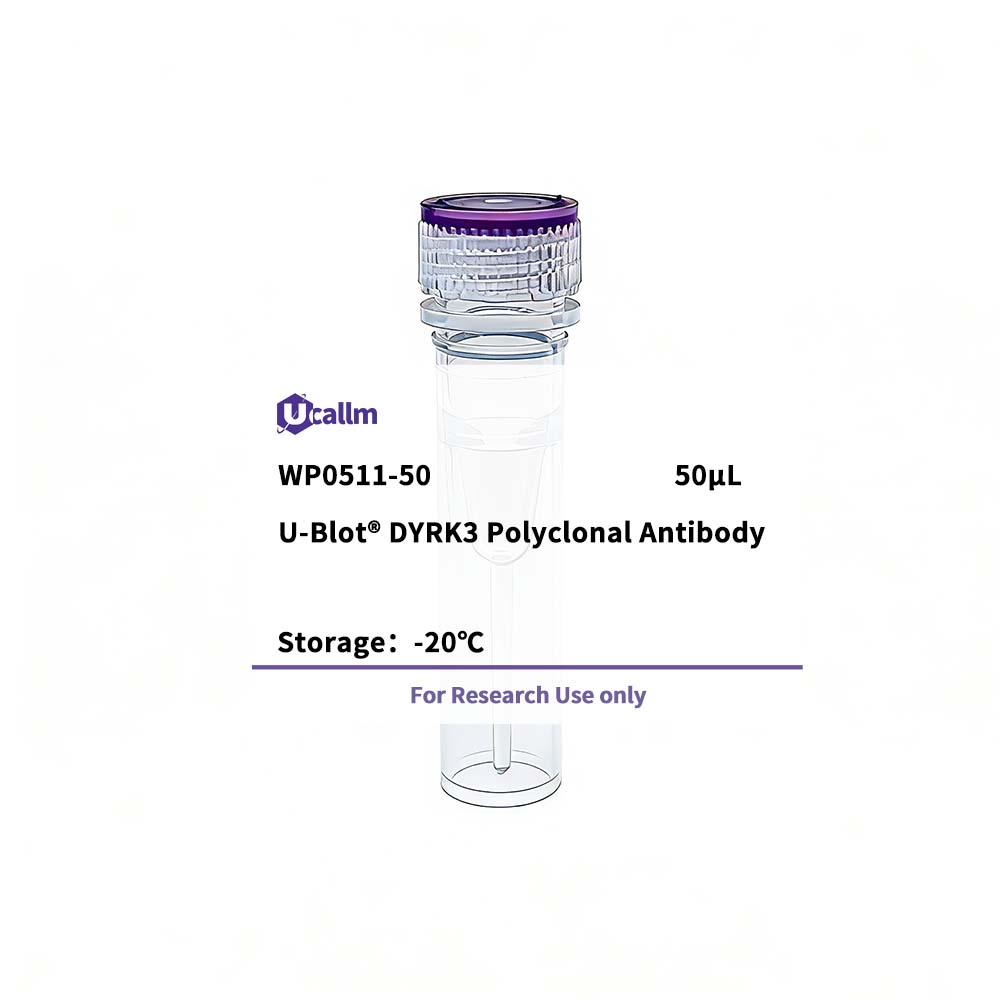
DYRK3 Polyclonal Antibody

Price range: $268.00 through $328.00

SKU: WP0511-100
Enter the quantity you would like, or drag the panel to find the quantity and price that best for you
Bulk QuoteAuthorize OEM & ODM

Product details

Background:

This gene product belongs to the DYRK family of dual-specificity protein kinases that catalyze autophosphorylation on serine/threonine and tyrosine residues. The members of this family share structural similarity, however, differ in their substrate specificity, suggesting their involvement in different cellular functions. The encoded protein has been shown to autophosphorylate on tyrosine residue and catalyze phosphorylation of histones H3 and H2B in vitro. Alternatively spliced transcript variants encoding different isoforms have been identified. [provided by RefSeq, Jul 2008],

Specifications

Size50μL/100μL
TargetDYRK3
ReactivityHuman, Mouse, Rat
ApplicationsWB, ELISA
MW(Calculated)
MW(Observed)64kD
Host SpeciesRabbit
IsotypeIgG
Conjugate/ModificationUnmodified
Recommended Dilution RatioWB 1:500-2000; ELISA 1:5000-20000
FormulationLiquid in PBS containing 50% glycerol,0.5% BSA and 0.02% sodium azide.
PurificationThe antibody was affinity-purified from rabbit antiserum by affinity-chromatography using epitope-specific immunogen.
Storage-15°C to -25°C/1 year(Do not lower than -25°C)
Concentration1 mg/ml
ClonalityPolyclonal
Clone Number
ImmunogenSynthesized peptide derived from human protein . at AA range: 1-80
SpecificityDYRK3 Polyclonal Antibody detects endogenous levels of protein.
Gene NameDYRK3
Protein NameDual specificity tyrosine-phosphorylation-regulated kinase 3 (Regulatory erythroid kinase) (REDK)
Other Name
SpeciesHuman
Gene ID8444
UniprotO43781,
Species.1Mouse
Gene ID.1
Uniprot.1Q922Y0,
Species.2Rat
Gene ID.2
Uniprot.2Q4V8A3
Cellular LocalizationNucleus . Cytoplasm . Nucleus speckle . Cytoplasmic granule . Cytoplasm, cytoskeleton, microtubule organizing center, centrosome . Associates with membraneless organelles in the cytoplasm and nucleus (PubMed:29973724). Shuttles between cytoplasm and stress granules (PubMed:20167603). Localized predominantly on distinct speckles distributed throughout the cytoplasm of the cell (PubMed:20167603). At low concentration, showns a homogeneous distribution throughout the cytoplasm and does not condense in speckles. During oxidative and osmotic stress, localizes to stress granules (PubMed:20167603). .
Tissue ExpressionIsoform 1: Highly expressed in testis and in hematopoietic tissue such as fetal liver, and bone marrow (PubMed:10779429). Isoform 1: Predominant form in fetal liver and bone marrow (PubMed:10779429). Isoform 1: Present at low levels in heart, pancreas, lymph node and thymus (PubMed:10779429). Isoform 2: Highly expressed in testis and in hematopoietic tissue such as fetal liver, and bone marrow (PubMed:10779429). Isoform 2: Predominant form in testis. Isoform 2: Present at low levels in heart, pancreas, lymph node and thymus (PubMed:10779429).
Signaling_pathway
Research Areas
FunctionCatalytic activity:ATP + a protein = ADP + a phosphoprotein.,cofactor:Magnesium.,Function:Negative regulator of EPO-dependent erythropoiesis, may place an upper limit on red cell production during stress erythropoiesis. Inhibits cell death due to cytokine withdrawal in hematopoietic progenitor cells. May act by regulating CREB/CRE signaling.,induction:By erythropoietin.,PTM:Autophosphorylated on tyrosine residues.,similarity:Belongs to the protein kinase superfamily. CMGC Ser/Thr protein kinase family. MNB/DYRK subfamily.,similarity:Contains 1 protein kinase domain.,tissue specificity:Highly expressed in testis where isoform 2 is the predominant form and in hematopoietic tissue such as fetal liver, and bone marrow where isoform 1 predominates. Both isoforms are present at low levels in heart, pancreas, lymph node, and thymus.,
Please login to post questions
Back to Top
Product has been added to your cart

