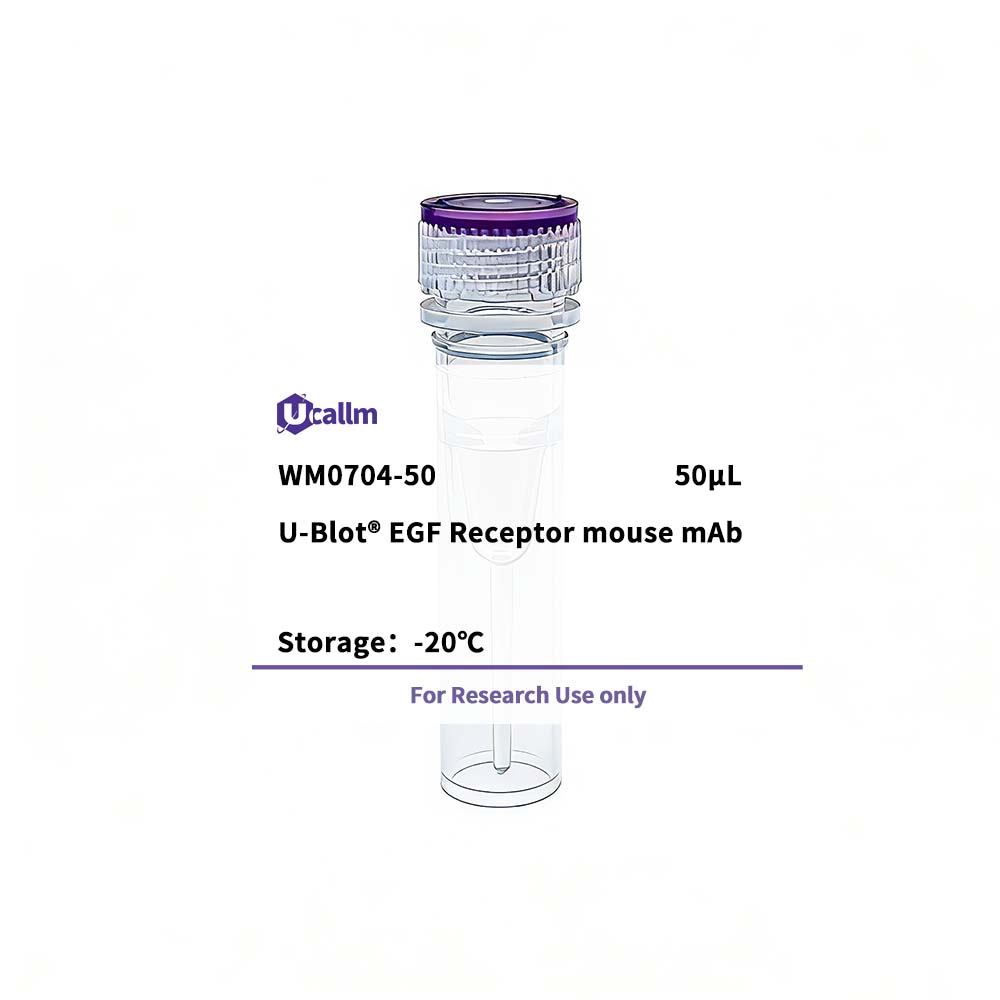
SKU: WM0704 Categories: ,

EGF Receptor mouse mAb

Price range: $268.00 through $328.00

SKU: WM0704-50
Enter the quantity you would like, or drag the panel to find the quantity and price that best for you
Bulk QuoteAuthorize OEM & ODM

Product details

Background:
The protein encoded by this gene is a transmembrane glycoprotein that is a member of the protein kinase superfamily. This protein is a receptor for members of the epidermal growth factor family. EGFR is a cell surface protein that binds to epidermal growth factor. Binding of the protein to a ligand induces receptor dimerization and tyrosine autophosphorylation and leads to cell proliferation. Mutations in this gene are associated with lung cancer. [provided by RefSeq, Jun 2016],

Specifications

Size50μL/100μL
TargetEGFR
ReactivityHuman, Monkey
ApplicationsWB, IHC, ICC, IP
MW(Calculated)
MW(Observed)175kD
Host SpeciesMouse
Isotype
Conjugate/ModificationUnmodified
Recommended Dilution RatioWB 1:500-1:2000; IHC 1:100-1:300; IF 1:200-1:1000; ELISA 1:5000; IP 1:50-100 / Note: For IHC, we suggest antigen retrieval with TE buffer pH 9.0 (Cat#WT1004)
FormulationLiquid in PBS containing 50% glycerol, 0.5% BSA and 0.02% sodium azide.
PurificationThe antibody was affinity-purified from mouse ascites by affinity-chromatography using epitope-specific immunogen.
Storage-15°C to -25°C/1 year(Do not lower than -25°C)
Concentration
ClonalityMonoclonal
Clone Number7D6
ImmunogenPurified recombinant human EGFR protein fragments expressed in E.coli.
SpecificityThe antibody detects endogenous level of total EGFR and does not cross-react with related proteins.
Gene NameEGFR ERBB ERBB1 HER1
Protein NameEpidermal growth factor receptor
Other NameAvian erythroblastic leukemia viral; / v erb b; / oncogene homolog; / Cell growth inhibiting protein 40; / Cell proliferation inducing protein 61; / EGF R; / EGFR; / EGFR_HUMAN; / Epidermal growth factor receptor; / avian erythroblastic leukemia viral; / v erb b; / oncogene homolog; / Epidermal growth factor receptor; / erythroblastic leukemia viral; / v erb b; / oncogene homolog avian; / Epidermal growth factor receptor; / erbb 1; / Erbb; / Erbb1; / ERBB1; / Errp; / HER1; / mENA; / Oncogene ERBB; / PIG61; / Proto-oncogene c-ErbB-1; / Receptor tyrosine protein kinase ErbB 1; / Receptor tyrosine-protein kinase ErbB-1; / Urogastrone; / wa2; / Wa5.
SpeciesHuman
Gene ID1956
UniprotP00533,
Species.1Mouse
Gene ID.113649
Uniprot.1Q01279
Species.2
Gene ID.2
Uniprot.2
Cellular LocalizationCell membrane; Single-pass type I membrane protein . Endoplasmic reticulum membrane; Single-pass type I membrane protein. Golgi apparatus membrane; Single-pass type I membrane protein. Nucleus membrane; Single-pass type I membrane protein. Endosome . Endosome membrane. Nucleus . In response to EGF, translocated from the cell membrane to the nucleus via Golgi and ER (PubMed:20674546, PubMed:17909029). Endocytosed upon activation by ligand (PubMed:2790960, PubMed:17182860, PubMed:27153536, PubMed:17909029). Colocalized with GPER1 in the nucleus of estrogen agonist-induced cancer-associated fibroblasts (CAF) (PubMed:20551055). .; [Isoform 2]: Secreted.
Tissue ExpressionUbiquitously expressed. Isoform 2 is also expressed in ovarian cancers.
Signaling_pathwayCellular Processes >> Cellular community - eukaryotes >> Focal adhesion;Cellular Processes >> Cellular community - eukaryotes >> Adherens junction;Cellular Processes >> Cellular community - eukaryotes >> Gap junction;Cellular Processes >> Cell motility >> Regulation of actin cytoskeleton;Organismal Systems >> Endocrine system >> GnRH signaling pathway;Organismal Systems >> Endocrine system >> Estrogen signaling pathway;Organismal Systems >> Endocrine system >> Oxytocin signaling pathway;Organismal Systems >> Endocrine system >> Relaxin signaling pathway;Human Diseases >> Cancer: overview >> Pathways in cancer;Human Diseases >> Cancer: overview >> MicroRNAs in cancer;Human Diseases >> Cancer: overview >> Central carbon metabolism in cancer;Human Diseases >> Cancer: overview >> PD-L1 expression and PD-1 checkpoint pathway in cancer;Human Diseases >> Cancer: specific types >> Colorectal cancer;Human Diseases >> Cancer: specific types >> Pancreatic cancer;Human Diseases >> Cancer: specific types >> Hepatocellular carcinoma;Human Diseases >> Cancer: specific types >> Gastric cancer;Human Diseases >> Cancer: specific types >> Glioma;Human Diseases >> Cancer: specific types >> Melanoma;Human Diseases >> Cancer: specific types >> Bladder cancer;Human Diseases >> Cancer: specific types >> Prostate cancer;Human Diseases >> Cancer: specific types >> Endometrial cancer;Human Diseases >> Cancer: specific types >> Breast cancer;Human Diseases >> Cancer: specific types >> Non-small cell lung cancer;Environmental Information Processing >> Signal transduction >> MAPK signaling pathway;Environmental Information Processing >> Signal transduction >> ErbB signaling pathway;Environmental Information Processing >> Signal transduction >> Ras signaling pathway;Environmental Information Processing >> Signal transduction >> Rap1 signaling pathway;Environmental Information Processing >> Signal transduction >> JAK-STAT signaling pathway;Environmental Information Processing >> Signal transduction >> HIF-1 signaling pathway;Environmental Information Processing >> Signal transduction >> FoxO signaling pathway;Environmental Information Processing >> Signal transduction >> Calcium signaling pathway;Environmental Information Processing >> Signal transduction >> Phospholipase D signaling pathway;Environmental Information Processing >> Signal transduction >> PI3K-Akt signaling pathway
Research Areas>>EGFR tyrosine kinase inhibitor resistance; / >>Endocrine resistance; / >>MAPK signaling pathway; / >>ErbB signaling pathway; / >>Ras signaling pathway; / >>Rap1 signaling pathway; / >>Calcium signaling pathway; / >>HIF-1 signaling pathway; / >>FoxO signaling pathway; / >>Phospholipase D signaling pathway; / >>Endocytosis; / >>PI3K-Akt signaling pathway; / >>Focal adhesion; / >>Adherens junction; / >>Gap junction; / >>JAK-STAT signaling pathway; / >>Regulation of actin cytoskeleton; / >>GnRH signaling pathway; / >>Estrogen signaling pathway; / >>Oxytocin signaling pathway; / >>Relaxin signaling pathway; / >>Parathyroid hormone synthesis, secretion and action; / >>Cushing syndrome; / >>Epithelial cell signaling in Helicobacter pylori infection; / >>Shigellosis; / >>Hepatitis C; / >>Human cytomegalovirus infection; / >>Human papillomavirus infection; / >>Coronavirus disease - COVID-19; / >>Pathways in cancer; / >>Proteoglycans in cancer; / >>MicroRNAs in cancer; / >>Chemical carcinogenesis - receptor activation; / >>Chemical carcinogenesis - reactive oxygen species; / >>Colorectal cancer; / >>Pancreatic cancer; / >>Endometrial cancer; / >>Glioma; / >>Prostate cancer; / >>Melanoma; / >>Bladder cancer; / >>Non-small cell lung cancer; / >>Breast cancer; / >>Hepatocellular carcinoma; / >>Gastric cancer; / >>Central carbon metabolism in cancer; / >>Choline metabolism in cancer; / >>PD-L1 expression and PD-1 checkpoint pathway in cancer
FunctionCatalytic activity:ATP + a [protein]-L-tyrosine = ADP + a [protein]-L-tyrosine phosphate.,Disease:Defects in EGFR are associated with lung cancer [MIM:211980].,Function:Isoform 2/truncated isoform may act as an antagonist.,Function:Receptor for EGF, but also for other members of the EGF family, as TGF-alpha, amphiregulin, betacellulin, heparin-binding EGF-like growth factor, GP30 and vaccinia virus growth factor. Is involved in the control of cell growth and differentiation. Phosphorylates MUC1 in breast cancer cells and increases the interaction of MUC1 with C-SRC and CTNNB1/beta-catenin.,miscellaneous:Binding of EGF to the receptor leads to dimerization, internalization of the EGF-receptor complex, induction of the tyrosine kinase activity, stimulation of cell DNA synthesis, and cell proliferation.,online information:EGFR entry,PTM:Monoubiquitinated and polyubiquitinated upon EGF stimulation; which does not affect tyrosine kinase activity or signaling capacity but may play a role in lysosomal targeting. Polyubiquitin linkage is mainly through 'Lys-63', but linkage through 'Lys-48', 'Lys-11' and 'Lys-29' also occur.,PTM:Phosphorylation of Ser-695 is partial and occurs only if Thr-693 is phosphorylated.,similarity:Belongs to the protein kinase superfamily. Tyr protein kinase family.,similarity:Belongs to the protein kinase superfamily. Tyr protein kinase family. EGF receptor subfamily.,similarity:Contains 1 protein kinase domain.,subunit:Binds RIPK1. CBL interacts with the autophosphorylated C-terminal tail of the EGF receptor. Part of a complex with ERBB2 and either PIK3C2A or PIK3C2B. The autophosphorylated form interacts with PIK3C2B, maybe indirectly. Interacts with PELP1. Binds MUC1.,tissue specificity:Ubiquitously expressed. Isoform 2 is also expressed in ovarian cancers.,
Please login to post questions
Back to Top
Product has been added to your cart


