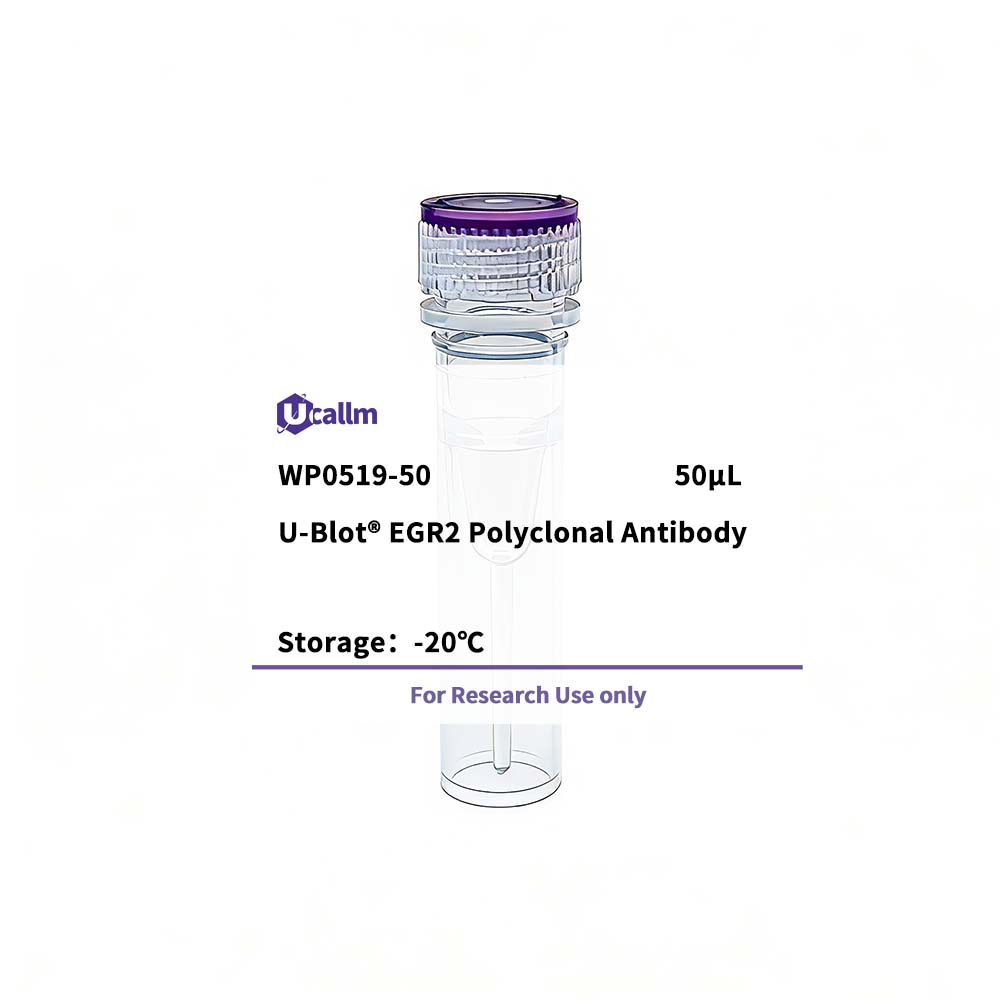
SKU: WP0519 Categories: ,

EGR2 Polyclonal Antibody

Price range: $268.00 through $328.00

SKU: WP0519-100
Enter the quantity you would like, or drag the panel to find the quantity and price that best for you
Bulk QuoteAuthorize OEM & ODM

Product details

Background:

The protein encoded by this gene is a transcription factor with three tandem C2H2-type zinc fingers. Defects in this gene are associated with Charcot-Marie-Tooth disease type 1D (CMT1D), Charcot-Marie-Tooth disease type 4E (CMT4E), and with Dejerine-Sottas syndrome (DSS). Multiple transcript variants encoding two different isoforms have been found for this gene. [provided by RefSeq, Oct 2008],

Specifications

Size50μL/100μL
TargetEGR2
ReactivityHuman, Mouse, Rat
ApplicationsWB, ELISA
MW(Calculated)
MW(Observed)52kD
Host SpeciesRabbit
IsotypeIgG
Conjugate/ModificationUnmodified
Recommended Dilution RatioWB 1:500-2000; ELISA 1:5000-20000
FormulationLiquid in PBS containing 50% glycerol,0.5% BSA and 0.02% sodium azide.
PurificationThe antibody was affinity-purified from rabbit antiserum by affinity-chromatography using epitope-specific immunogen.
Storage-15°C to -25°C/1 year(Do not lower than -25°C)
Concentration1 mg/ml
ClonalityPolyclonal
Clone Number
ImmunogenSynthesized peptide derived from human protein . at AA range: 340-420
SpecificityEGR2 Polyclonal Antibody detects endogenous levels of protein.
Gene NameEGR2 KROX20
Protein NameE3 SUMO-protein ligase EGR2 (AT591) (Early growth response protein 2) (EGR-2) (Zinc finger protein Krox-20)
Other Name
SpeciesHuman
Gene ID1959
UniprotP11161,
Species.1Mouse
Gene ID.1
Uniprot.1P08152,
Species.2Rat
Gene ID.2
Uniprot.2P51774
Cellular LocalizationNucleus .
Tissue ExpressionEndometrium,
Signaling_pathway
Research Areas>>C-type lectin receptor signaling pathway; / >>Hepatitis B; / >>Human T-cell leukemia virus 1 infection; / >>Viral carcinogenesis
FunctionDisease:Defects in EGR2 are a cause of Charcot-Marie-Tooth disease type 1D (CMT1D) [MIM:607678]. CMT1D is a form of Charcot-Marie-Tooth disease, the most common inherited disorder of the peripheral nervous system. Charcot-Marie-Tooth disease is classified in two main groups on the basis of electrophysiologic properties and histopathology: primary peripheral demyelinating neuropathy or CMT1, and primary peripheral axonal neuropathy or CMT2. Neuropathies of the CMT1 group are characterized by severely reduced nerve conduction velocities (less than 38 m/sec), segmental demyelination and remyelination with onion bulb formations on nerve biopsy, slowly progressive distal muscle atrophy and weakness, absent deep tendon reflexes, and hollow feet.,Disease:Defects in EGR2 are a cause of congenital hypomyelination neuropathy (CHN) [MIM:605253]. Inheritance can be autosomal dominant or recessive. Recessive CHN is also known as Charcot-Marie-Tooth disease type 4E (CMT4E). CHN is characterized clinically by early onset of hypotonia, areflexia, distal muscle weakness, and very slow nerve conduction velocities.,Disease:Defects in EGR2 are a cause of Dejerine-Sottas syndrome (DSS) [MIM:145900]; also known as Dejerine-Sottas neuropathy (DSN) or hereditary motor and sensory neuropathy III (HMSN3). DSS is a severe degenerating neuropathy of the demyelinating Charcot-Marie-Tooth disease category, with onset by age 2 years. DSS is characterized by motor and sensory neuropathy with very slow nerve conduction velocities, increased cerebrospinal fluid protein concentrations, hypertrophic nerve changes, delayed age of walking as well as areflexia. There are both autosomal dominant and autosomal recessive forms of Dejerine-Sottas syndrome.,Function:Sequence-specific DNA-binding transcription factor. Binds to two specific DNA sites located in the promoter region of HOXA4.,sequence Caution:Translation N-terminally extended.,similarity:Belongs to the EGR C2H2-type zinc-finger protein family.,similarity:Contains 3 C2H2-type zinc fingers.,subunit:Interacts with HCFC1.,
Please login to post questions
Back to Top
Product has been added to your cart

