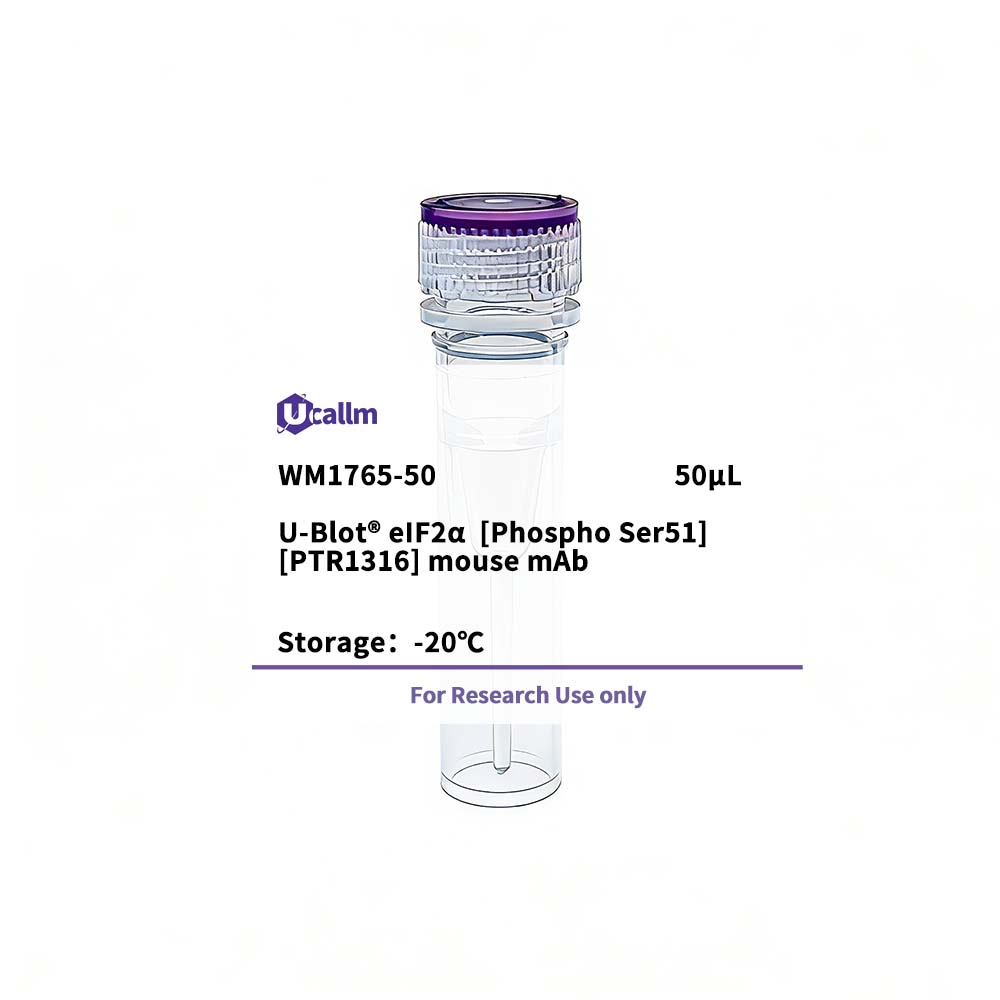
SKU: WM1765 Categories: ,

eIF2α [Phospho Ser51] [PTR1316] mouse mAb

Price range: $288.00 through $368.00

SKU: WM1765-50
Enter the quantity you would like, or drag the panel to find the quantity and price that best for you
Bulk QuoteAuthorize OEM & ODM

Product details

Background:
eukaryotic translation initiation factor 2 subunit alpha(EIF2S1) Homo sapiens The translation initiation factor EIF2 catalyzes the first regulated step of protein synthesis initiation, promoting the binding of the initiator tRNA to 40S ribosomal subunits. Binding occurs as a ternary complex of methionyl-tRNA, EIF2, and GTP. EIF2 is composed of 3 nonidentical subunits, the 36-kD EIF2-alpha subunit (EIF2S1), the 38-kD EIF2-beta subunit (EIF2S2; MIM 603908), and the 52-kD EIF2-gamma subunit (EIF2S3; MIM 300161). The rate of formation of the ternary complex is modulated by the phosphorylation state of EIF2-alpha (Ernst et al., 1987 [PubMed 2948954]).[supplied by OMIM, Feb 2010],

Specifications

Size50μL/100μL
TargeteIF2α Phospho Ser51
ReactivityHuman, Mouse, Rat
ApplicationsWB, IF, ELISA
MW(Calculated)36kD
MW(Observed)40kD,90kD
Host SpeciesMouse
IsotypeIgG2b,Kappa
Conjugate/Modificationphosphate
Recommended Dilution RatioWB 1:500-2000; IF 1:100-500; ELISA 1:1000-5000
FormulationPBS, 50% glycerol, 0.05% Proclin 300, 0.05%BSA
PurificationRecombinant Antibody expressed in animal component-free (ACF) media, purified via Protein G affinity chromatography.
Storage-15°C to -25°C/1 year(Do not lower than -25°C)
Concentration1 mg/ml
ClonalityMonoclonal
Clone NumberRMMR1316
ImmunogenSynthesized peptide derived from human eIF2α AA range: 1-100
SpecificityThis antibody detects endogenous levels of eIF2α (Phospho Ser51) protein.
Gene NameEIF2S1 EIF2A
Protein NameEukaryotic translation initiation factor 2 subunit 1 (Eukaryotic translation initiation factor 2 subunit alpha) (eIF-2-alpha) (eIF-2A) (eIF-2alpha)
Other Name
SpeciesHuman
Gene ID1965
UniprotP05198,
Species.1Mouse
Gene ID.113665
Uniprot.1Q6ZWX6
Species.2
Gene ID.2
Uniprot.2
Cellular Localization
Tissue Expression
Signaling_pathwayCellular Processes >> Transport and catabolism >> Autophagy - animal;Cellular Processes >> Transport and catabolism >> Mitophagy - animal;Cellular Processes >> Cell growth and death >> Apoptosis;Human Diseases >> Neurodegenerative disease >> Alzheimer disease;Human Diseases >> Neurodegenerative disease >> Parkinson disease;Human Diseases >> Neurodegenerative disease >> Amyotrophic lateral sclerosis;Human Diseases >> Neurodegenerative disease >> Prion disease;Human Diseases >> Neurodegenerative disease >> Pathways of neurodegeneration - multiple diseases
Research Areas
FunctionFunctions in the early steps of protein synthesis by forming a ternary complex with GTP and initiator tRNA . This complex binds to a 40S ribosomal subunit, followed by mRNA binding to form a 43S pre-initiation complex . Junction of the 60S ribosomal subunit to form the 80S initiation complex is preceded by hydrolysis of the GTP bound to eIF-2 and release of an eIF-2-GDP binary complex . In order for eIF-2 to recycle and catalyze another round of initiation, the GDP bound to eIF-2 must exchange with GTP by way of a reaction catalyzed by eIF-2B . EIF2S1/eIF-2-alpha is a key component of the integrated stress response (ISR), required for adaptation to various stress: phosphorylation by metabolic-stress sensing protein kinases (EIF2AK1/HRI, EIF2AK2/PKR, EIF2AK3/PERK and EIF2AK4/GCN2) in response to stress converts EIF2S1/eIF-2-alpha in a global protein synthesis inhibitor, leading to an attenuation of cap-dependent translation, while concomitantly initiating the preferential translation of ISR-specific mRNAs, such as the transcriptional activators ATF4 and QRICH1, and hence allowing ATF4- and QRICH1-mediated reprogramming .
Please login to post questions
Back to Top
Product has been added to your cart
