

eIF3ε Polyclonal Antibody
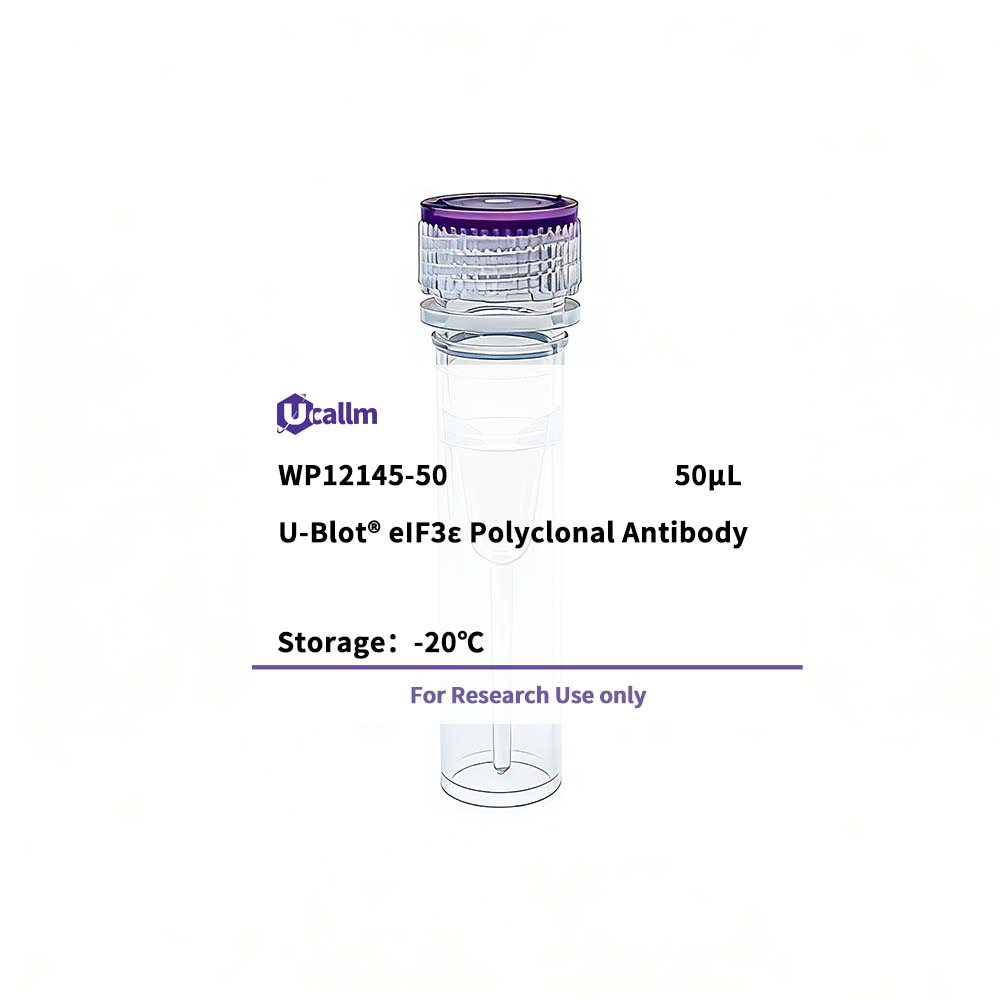
Ucallm_WP12145-50
Price range: $268.00 through $328.00
Product details
Background:
function:Component of the eukaryotic translation initiation factor 3 (eIF-3) complex, which is required for several steps in the initiation of protein synthesis. The eIF-3 complex associates with the 40S ribosome and facilitates the recruitment of eIF-1, eIF-1A, eIF-2:GTP:methionyl-tRNAi and eIF-5 to form the 43S preinitiation complex (43S PIC). The eIF-3 complex stimulates mRNA recruitment to the 43S PIC and scanning of the mRNA for AUG recognition. The eIF-3 complex is also required for disassembly and recycling of posttermination ribosomal complexes and subsequently prevents premature joining of the 40S and 60S ribosomal subunits prior to initiation., mass spectrometry: PubMed:17322308, mass spectrometry: PubMed:18599441, PTM:Phosphorylated. Phosphorylation is enhanced upon serum stimulation., similarity:Belongs to the eIF-3 subunit F family., similarity:Contains 1 MPN (JAB/Mov34) domain., subunit:Component of the eukaryotic translation initiation factor 3 (eIF-3) complex, which is composed of 13 subunits: EIF3A, EIF3B, EIF3C, EIF3D, EIF3E, EIF3F, EIF3G, EIF3H, EIF3I, EIF3J, EIF3K, EIF3L and EIF3M. The eIF-3 complex appears to include 3 stable modules: module A is composed of EIF3A, EIF3B, EIF3G and EIF3I; module B is composed of EIF3F, EIF3H, and EIF3M; and module C is composed of EIF3C, EIF3D, EIF3E, EIF3K and EIF3L. EIF3C of module C binds EIF3B of module A and EIF3H of module B, thereby linking the three modules. EIF3J is a labile subunit that binds to the eIF-3 complex via EIF3B. The eIF-3 complex interacts with RPS6KB1 under conditions of nutrient depletion. Mitogenic stimulation leads to binding and activation of a complex composed of FRAP1 and RAPTOR, leading to phosphorylation and release of RPS6KB1 and binding of EIF4B to eIF-3.,
Specifications
| Size | 50μL/100μL |
| Target | eIF3ε |
| Reactivity | Human, Mouse, Rat |
| Applications | WB, IHC, IF, ELISA |
| MW(Calculated) | |
| MW(Observed) | 38kD |
| Host Species | Rabbit |
| Isotype | IgG |
| Conjugate/Modification | Unmodified |
| Recommended Dilution Ratio | WB 1:500-1:2000; IHC 1:100-1:300; ELISA 1:40000; IF 1:50-200 / Note: For IHC, we suggest antigen retrieval with TE buffer pH 9.0 (Cat#WT1004) |
| Formulation | Liquid in PBS containing 50% glycerol, 0.5% BSA and 0.02% sodium azide. |
| Purification | The antibody was affinity-purified from rabbit antiserum by affinity-chromatography using epitope-specific immunogen. |
| Storage | -15°C to -25°C/1 year(Do not lower than -25°C) |
| Concentration | 1 mg/ml |
| Clonality | Polyclonal |
| Clone Number | |
| Immunogen | The antiserum was produced against synthesized peptide derived from human EIF3F. AA range:81-130 |
| Specificity | eIF3ε Polyclonal Antibody detects endogenous levels of eIF3ε protein. |
| Gene Name | EIF3F |
| Protein Name | Eukaryotic translation initiation factor 3 subunit F |
| Other Name | EIF3F; / EIF3S5; / Eukaryotic translation initiation factor 3 subunit F; / eIF3f; / Deubiquitinating enzyme eIF3f; / Eukaryotic translation initiation factor 3 subunit 5; / eIF-3-epsilon; / eIF3 p47 |
| Species | Human |
| Gene ID | 8665 |
| Uniprot | O00303, |
| Species.1 | Mouse |
| Gene ID.1 | 66085 |
| Uniprot.1 | Q9DCH4 |
| Species.2 | |
| Gene ID.2 | |
| Uniprot.2 | |
| Cellular Localization | Cytoplasm . |
| Tissue Expression | Amygdala,Brain,Liver,Lung, |
| Signaling_pathway | |
| Research Areas | |
| Function | Function:Component of the eukaryotic translation initiation factor 3 (eIF-3) complex, which is required for several steps in the initiation of protein synthesis. The eIF-3 complex associates with the 40S ribosome and facilitates the recruitment of eIF-1, eIF-1A, eIF-2:GTP:methionyl-tRNAi and eIF-5 to form the 43S preinitiation complex (43S PIC). The eIF-3 complex stimulates mRNA recruitment to the 43S PIC and scanning of the mRNA for AUG recognition. The eIF-3 complex is also required for disassembly and recycling of posttermination ribosomal complexes and subsequently prevents premature joining of the 40S and 60S ribosomal subunits prior to initiation.,mass spectrometry: PubMed:17322308,mass spectrometry: PubMed:18599441,PTM:Phosphorylated. Phosphorylation is enhanced upon serum stimulation.,similarity:Belongs to the eIF-3 subunit F family.,similarity:Contains 1 MPN (JAB/Mov34) domain.,subunit:Component of the eukaryotic translation initiation factor 3 (eIF-3) complex, which is composed of 13 subunits: EIF3A, EIF3B, EIF3C, EIF3D, EIF3E, EIF3F, EIF3G, EIF3H, EIF3I, EIF3J, EIF3K, EIF3L and EIF3M. The eIF-3 complex appears to include 3 stable modules: module A is composed of EIF3A, EIF3B, EIF3G and EIF3I; module B is composed of EIF3F, EIF3H, and EIF3M; and module C is composed of EIF3C, EIF3D, EIF3E, EIF3K and EIF3L. EIF3C of module C binds EIF3B of module A and EIF3H of module B, thereby linking the three modules. EIF3J is a labile subunit that binds to the eIF-3 complex via EIF3B. The eIF-3 complex interacts with RPS6KB1 under conditions of nutrient depletion. Mitogenic stimulation leads to binding and activation of a complex composed of FRAP1 and RAPTOR, leading to phosphorylation and release of RPS6KB1 and binding of EIF4B to eIF-3., |
Please login to post questions
Related products





