


Emp Polyclonal Antibody
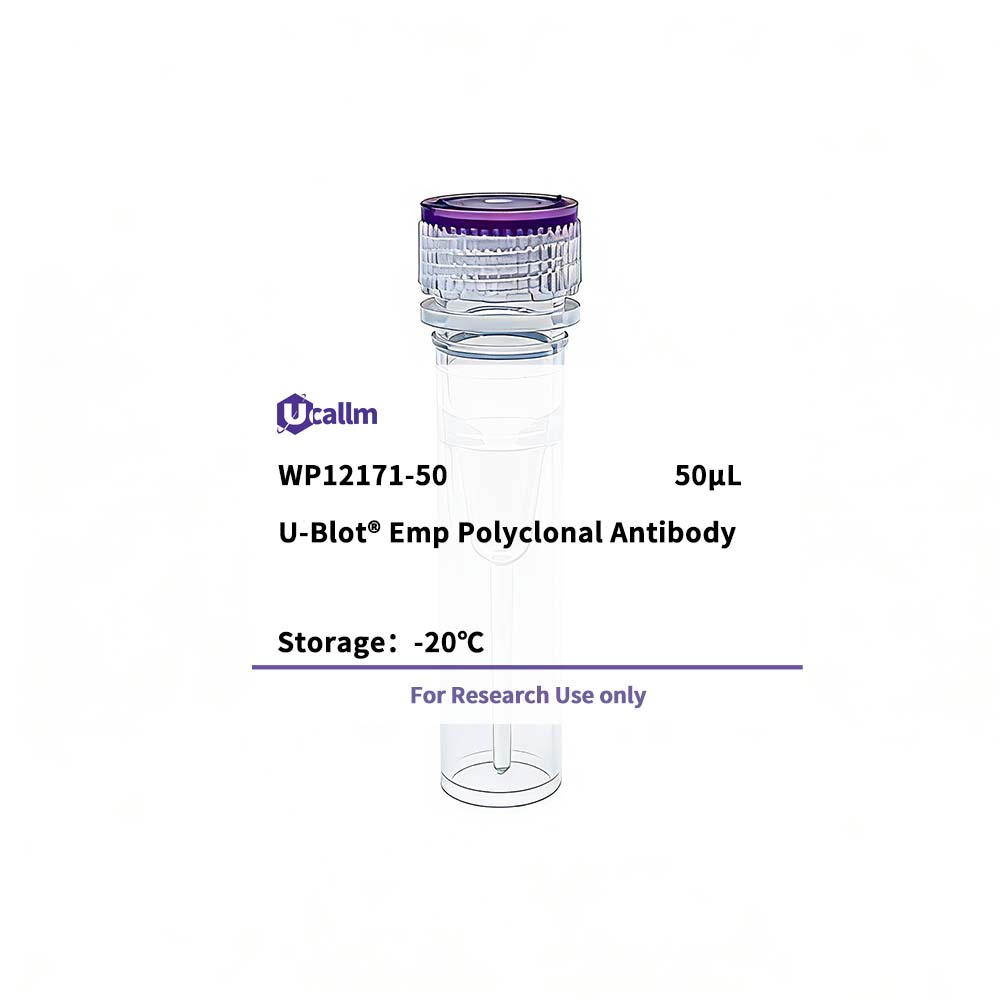
Ucallm_WP12171-50
Price range: $268.00 through $328.00
Product details
Background:
This gene encodes a protein that mediates the attachment of erythroblasts to macrophages. This attachment promotes terminal maturation and enucleation of erythroblasts, presumably by suppressing apoptosis. The encoded protein is an integral membrane protein with the N-terminus on the extracellular side and the C-terminus on the cytoplasmic side of the cell. Alternative splicing results in multiple transcript variants. [provided by RefSeq, Jul 2014],
Specifications
| Size | 50μL/100μL |
| Target | Emp |
| Reactivity | Human, Mouse, Rat |
| Applications | WB, IHC, IF, ELISA |
| MW(Calculated) | |
| MW(Observed) | 45kD |
| Host Species | Rabbit |
| Isotype | IgG |
| Conjugate/Modification | Unmodified |
| Recommended Dilution Ratio | WB 1:500-1:2000; IHC 1:100-1:300; ELISA 1:20000; IF 1:50-200 / Note: For IHC, we suggest antigen retrieval with TE buffer pH 9.0 (Cat#WT1004) |
| Formulation | Liquid in PBS containing 50% glycerol, 0.5% BSA and 0.02% sodium azide. |
| Purification | The antibody was affinity-purified from rabbit antiserum by affinity-chromatography using epitope-specific immunogen. |
| Storage | -15°C to -25°C/1 year(Do not lower than -25°C) |
| Concentration | 1 mg/ml |
| Clonality | Polyclonal |
| Clone Number | |
| Immunogen | The antiserum was produced against synthesized peptide derived from human MAEA. AA range:181-230 |
| Specificity | Emp Polyclonal Antibody detects endogenous levels of Emp protein. |
| Gene Name | MAEA |
| Protein Name | Macrophage erythroblast attacher |
| Other Name | MAEA; / EMP; / HLC10; / PIG5; / Macrophage erythroblast attacher; / Cell proliferation-inducing gene 5 protein; / Erythroblast macrophage protein; / Human lung cancer oncogene 10 protein; / HLC-10 |
| Species | Human |
| Gene ID | 10296 |
| Uniprot | Q7L5Y9, |
| Species.1 | Mouse |
| Gene ID.1 | 59003 |
| Uniprot.1 | Q4VC33, |
| Species.2 | Rat |
| Gene ID.2 | 298982 |
| Uniprot.2 | Q5RKJ1 |
| Cellular Localization | Cytoplasm . Nucleus, nucleoplasm . Nucleus matrix . Cell membrane . Cytoplasm, cytoskeleton . Detected in a nuclear, speckled-like pattern (PubMed:16510120). Localized with condensed chromatin at prophase; Detected in nuclear spindle poles at metaphase and in the contractile ring during telophase and cytokinesis (PubMed:16510120). Present in cytoplasm, nuclear matrix and at the cell surface in macrophages; predominantly nuclear in immature macrophages and predominantly detected at the cell surface in mature macrophages. Colocalizes with F-actin in macrophages (By similarity). . |
| Tissue Expression | Detected at macrophage membranes (at protein level). Ubiquitous. |
| Signaling_pathway | |
| Research Areas | |
| Function | developmental stage:Localized with condensed chromatin at prophase; Detected in nuclear spindle poles at metaphase and in the contractile ring during telophase and cytokinesis.,Function:Play a role in erythroblast enucleation and in the development of the mature macrophages. Mediates the attachment of erythroid cell to mature macrophages, in correlation with the presence of MAEA at cell surface of mature macrophages; This MAEA-mediated contact inhibits erythroid cells apoptosis. Participates to erythroblastic island formation, which is the functional unit of definitive erythropoiesis. Associates with F-actin to regulate actin distribution in erythroblasts and macrophages. May contribute to nuclear architecture and cells division events.,similarity:Contains 1 CTLH domain.,similarity:Contains 1 LisH domain.,subcellular location:Localized as nuclear speckled-like pattern.,subunit:Form a complex with F-actin.,tissue specificity:Ubiquitous., |
Please login to post questions
Related products





