SKU: WR5117 Categories: ,

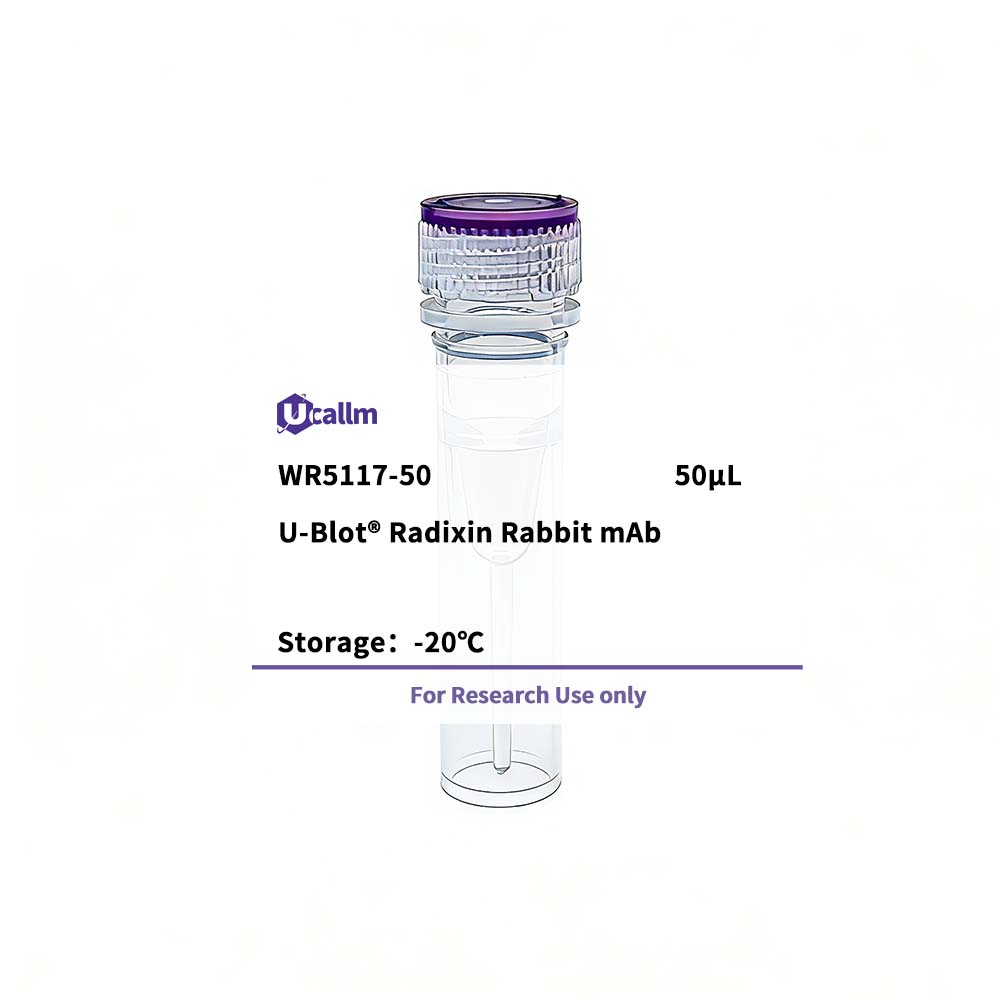
U-Blot® Radixin Rabbit mAb

Price range: $268.00 through $328.00

SKU: WR5117-50
Enter the quantity you would like, or drag the panel to find the quantity and price that best for you
Bulk QuoteAuthorize OEM & ODM

Product details

Background:Radixin is a cytoskeletal protein that may be important in linking actin to the plasma membrane. It is highly similar in sequence to both ezrin and moesin. The radixin gene has been localized by fluorescence in situ hybridization to 11q23. A truncated version representing a pseudogene (RDXP2) was assigned to Xp21.3. Another pseudogene that seemed to lack introns (RDXP1) was mapped to 11p by Southern and PCR analyses. Multiple alternatively spliced transcript variants encoding different isoforms have been found for this gene. [provided by RefSeq, May 2012],

Specifications

Size50μL/100μL
TargetRadixin
ReactivityHuman, Mouse, Rat
ApplicationsWB, IHC, IF, IP, ELISA
MW(Calculated)69kD
MW(Observed)80kD
Host SpeciesRabbit
IsotypeIgG,Kappa
Conjugate/ModificationUnmodified
Recommended Dilution RatioIHC 1:200-1:1000; WB 1:2000-1:10000; IF 1:200-1:1000; ELISA 1:5000-1:20000; IP 1:50-1:200; / Note: For IHC, we suggest antigen retrieval with TE buffer pH 9.0 (Cat#WT1004)
FormulationPBS, 50% glycerol, 0.05% Proclin 300, 0.05%BSA
PurificationRecombinant Antibody expressed in animal component-free (ACF) media, purified via Protein A affinity chromatography.
Storage-15°C to -25°C/1 year(Do not lower than -25°C)
Concentration
ClonalityMonoclonal
Clone NumberRM1325R
ImmunogenThe specific immunogen used to produce this antibody is proprietary information.
SpecificityEndogenous
Gene NameRDX
Protein NameRadixin
Other NameRDX; / Radixin
SpeciesHuman
Gene ID5962
UniprotP35241,
Species.1Mouse
Gene ID.119684
Uniprot.1P26043
Species.2
Gene ID.2
Uniprot.2
Cellular LocalizationCell membrane; Peripheral membrane protein; Cytoplasmic side. Cytoplasm, cytoskeleton. Cleavage furrow. Cell projection, microvillus . Highly concentrated in the undercoat of the cell-to-cell adherens junction and the cleavage furrow in the interphase and mitotic phase, respectively.
Tissue ExpressionBrain,Hippocampus,Liver,Lung,Testis,Uterus,
Signaling_pathwayCellular Processes >> Cellular community - eukaryotes >> Tight junction;Cellular Processes >> Cell motility >> Regulation of actin cytoskeleton;Human Diseases >> Cancer: overview >> MicroRNAs in cancer
Research Areas>>Tight junction; / >>Regulation of actin cytoskeleton; / >>Proteoglycans in cancer; / >>MicroRNAs in cancer
FunctionDisease:Defects in RDX are the cause of non-syndromic sensorineural deafness autosomal recessive type 24 (DFNB24) [MIM:611022]. DFNB24 is a form of sensorineural hearing loss. Sensorineural deafness results from damage to the neural receptors of the inner ear, the nerve pathways to the brain, or the area of the brain that receives sound information.,Domain:The N-terminal domain interacts with the C-terminal domain of LAYN. An interdomain interaction between its N-terminal and C-terminal domains inhibits its ablilty to bind LAYN. In the presence of acidic phospholipids, the interdomain interaction is inhibited and this enhances binding to LAYN.,Function:Probably plays a crucial role in the binding of the barbed end of actin filaments to the plasma membrane.,PTM:Phosphorylated by tyrosine-protein kinases.,similarity:Contains 1 FERM domain.,subcellular location:Highly concentrated in the undercoat of the cell-to-cell adherens junction and the cleavage furrow in the interphase and mitotic phase, respectively.,subunit:Binds SLC9A3R1. Interacts with NHERF1, NHERF2, LAYN, MME/NEP and ICAM2.,
Please login to post questions
Back to Top
Product has been added to your cart

