

ERdj3 Polyclonal Antibody
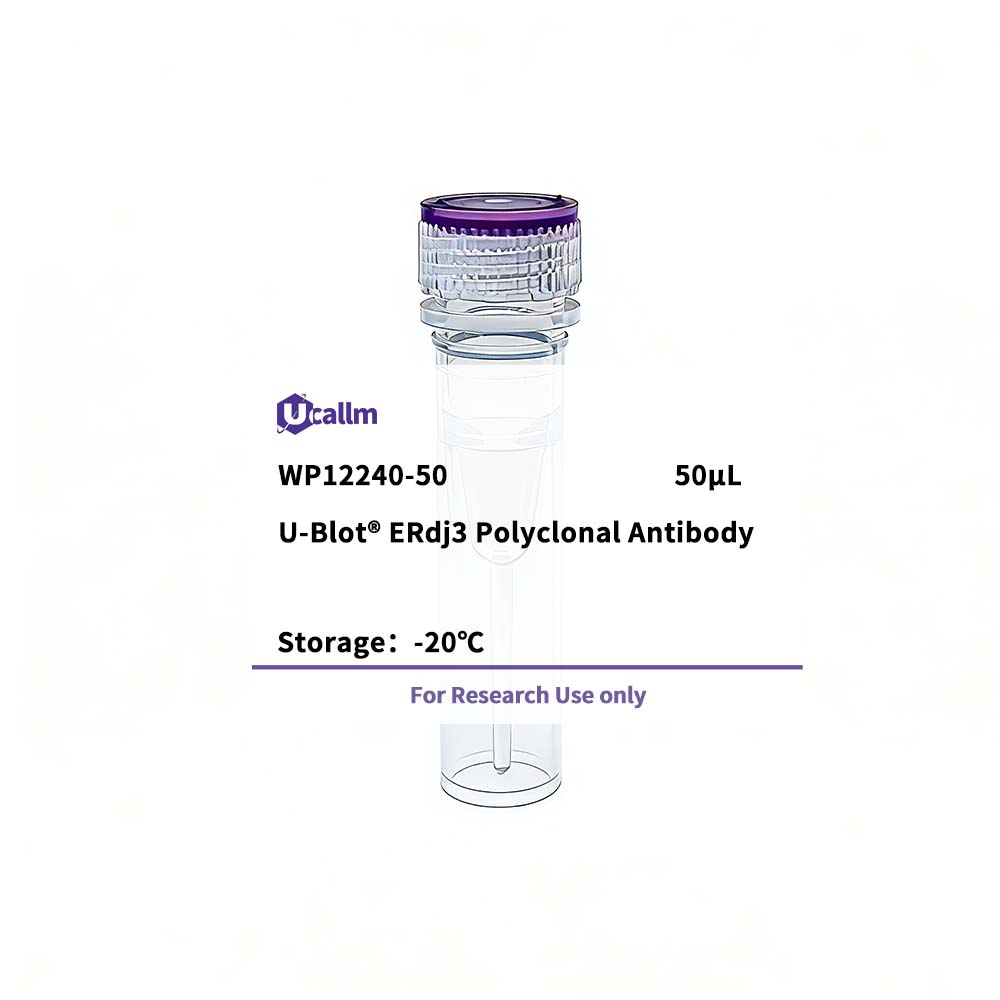
Ucallm_WP12240-50
Price range: $268.00 through $328.00
Product details
Background:
This gene encodes a soluble glycoprotein of the endoplasmic reticulum (ER) lumen that functions as a co-chaperone of binding immunoglobulin protein, a 70 kilodalton heat shock protein chaperone required for the proper folding and assembly of proteins in the ER. The encoded protein contains a highly conserved J domain of about 70 amino acids with a characteristic His-Pro-Asp (HPD) motif and may regulate the activity of binding immunoglobulin protein by stimulating ATPase activity. [provided by RefSeq, Mar 2014],
Specifications
| Size | 50μL/100μL |
| Target | ERdj3 |
| Reactivity | Human, Mouse, Rat |
| Applications | WB, IHC, IF, ELISA |
| MW(Calculated) | |
| MW(Observed) | 40kD |
| Host Species | Rabbit |
| Isotype | IgG |
| Conjugate/Modification | Unmodified |
| Recommended Dilution Ratio | WB 1:500-1:2000; IHC 1:100-1:300; ELISA 1:20000; IF 1:50-200 / Note: For IHC, we suggest antigen retrieval with TE buffer pH 9.0 (Cat#WT1004) |
| Formulation | Liquid in PBS containing 50% glycerol, 0.5% BSA and 0.02% sodium azide. |
| Purification | The antibody was affinity-purified from rabbit antiserum by affinity-chromatography using epitope-specific immunogen. |
| Storage | -15°C to -25°C/1 year(Do not lower than -25°C) |
| Concentration | 1 mg/ml |
| Clonality | Polyclonal |
| Clone Number | |
| Immunogen | The antiserum was produced against synthesized peptide derived from human DNAJB11. AA range:31-80 |
| Specificity | ERdj3 Polyclonal Antibody detects endogenous levels of ERdj3 protein. |
| Gene Name | DNAJB11 |
| Protein Name | DnaJ homolog subfamily B member 11 |
| Other Name | DNAJB11; / EDJ; / ERJ3; / HDJ9; / PSEC0121; / DnaJ homolog subfamily B member 11; / APOBEC1-binding protein 2; / ABBP-2; / DnaJ protein homolog 9; / ER-associated DNAJ; / ER-associated Hsp40 co-chaperone; / ER-associated dnaJ protein 3; / ERdj3; / ERj3p; / HEDJ; / Human |
| Species | Human |
| Gene ID | 51726 |
| Uniprot | Q9UBS4, |
| Species.1 | Mouse |
| Gene ID.1 | 67838 |
| Uniprot.1 | Q99KV1, |
| Species.2 | Rat |
| Gene ID.2 | 360734 |
| Uniprot.2 | Q6TUG0 |
| Cellular Localization | Endoplasmic reticulum lumen . Associated with the ER membrane in a C-terminally epitope-tagged construct. |
| Tissue Expression | Widely expressed. |
| Signaling_pathway | Genetic Information Processing >> Folding, sorting and degradation >> Protein processing in endoplasmic reticulum |
| Research Areas | >>Protein processing in endoplasmic reticulum |
| Function | Caution:PubMed:11584023 reported a cytosolic, as well as nuclear subcellular location. This result was obtained using an N-terminally GFP-tagged construct which most probably affected signal peptide-driven targeting to the ER. As a consequence, the in vivo revelance of the observed interaction with APOBEC1, a nuclear protein, is dubious. This holds true for the interaction with PWP1.,Function:Serves as a co-chaperone for HSPA5. Binds directly to both unfolded proteins that are substrates for ERAD and nascent unfolded peptide chains, but dissociates from the HSPA5-unfolded protein complex before folding is completed. May help recruiting HSPA5 and other chaperones to the substrate. Stimulates HSPA5 ATPase activity.,induction:By ER stress-inducing agents, such as thapsigargin and tunicamycin.,PTM:Contains high-mannose Endo H-sensitive carbohydrates.,PTM:Cys-169, Cys-171, Cys-193 and Cys-196 form intramolecular disulfide bonds. The preferential partner for each Cys is not known.,PTM:Thr-188 was reported (PubMed:17525332) to be phosphorylated upon DNA damage by ATM or ATR; however as this position has been shown to be in the ER lumen, the in vivo relevance is not proven.,similarity:Contains 1 J domain.,subcellular location:Associated with the ER membrane in a C-terminally epitope-tagged construct.,subunit:Part a large chaperone multiprotein complex comprising CABP1, DNAJB11, HSP90B1, HSPA5, HYOU, PDIA2, PDIA4, PPIB, SDF2L1, UGT1A1 and very small amounts of ERP29, but not, or at very low levels, CALR nor CANX. Binds to denatured substrates in an ATP-independent manner. Interacts via the J domain with HSPA5 in an ATP-dependent manner.,tissue specificity:Widely expressed., |
Please login to post questions
Related products





