

ESET Monoclonal Antibody
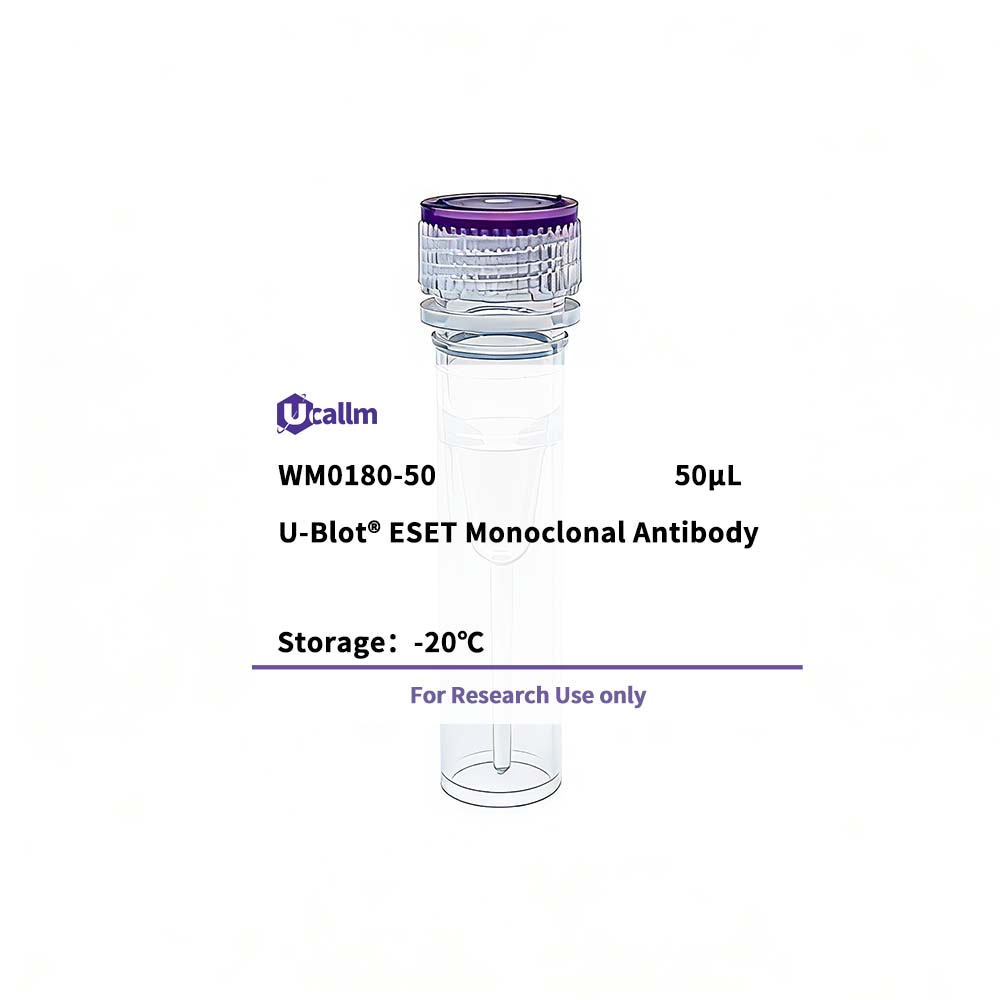
Ucallm_WM0180-50
Price range: $268.00 through $328.00
Product details
Background:
SET domain bifurcated 1(SETDB1) Homo sapiens This gene encodes a histone methyltransferase which regulates histone methylation, gene silencing, and transcriptional repression. This gene has been identified as a target for treatment in Huntington Disease, given that gene silencing and transcription dysfunction likely play a role in the disease pathogenesis. Alternatively spliced transcript variants of this gene have been described.[provided by RefSeq, Jun 2011],
Specifications
| Size | 50μL/100μL |
| Target | ESET |
| Reactivity | Human, Mouse, Monkey |
| Applications | WB, IF, ELISA |
| MW(Calculated) | 143kD |
| MW(Observed) | |
| Host Species | Mouse |
| Isotype | |
| Conjugate/Modification | Unmodified |
| Recommended Dilution Ratio | WB 1:500-1:2000; IF 1:200-1:1000; ELISA 1:10000; Not yet tested in other applications. |
| Formulation | Liquid in PBS containing 50% glycerol, 0.5% BSA and 0.02% sodium azide. |
| Purification | Affinity purification |
| Storage | -15°C to -25°C/1 year(Do not lower than -25°C) |
| Concentration | |
| Clonality | Monoclonal |
| Clone Number | 20E4 |
| Immunogen | Purified recombinant fragment of human ESET expressed in E. Coli. |
| Specificity | ESET Monoclonal Antibody detects endogenous levels of ESET protein. |
| Gene Name | SETDB1 |
| Protein Name | Histone-lysine N-methyltransferase SETDB1 |
| Other Name | SETDB1; / KIAA0067; / KMT1E; / Histone-lysine N-methyltransferase SETDB1; / ERG-associated protein with SET domain; / ESET; / Histone H3-K9 methyltransferase 4; / H3-K9-HMTase 4; / Lysine N-methyltransferase 1E; / SET domain bifurcated 1 |
| Species | Human |
| Gene ID | 9869 |
| Uniprot | Q15047, |
| Species.1 | Mouse |
| Gene ID.1 | |
| Uniprot.1 | O88974 |
| Species.2 | |
| Gene ID.2 | |
| Uniprot.2 | |
| Cellular Localization | Nucleus . Cytoplasm . Chromosome. Associated with non-pericentromeric regions of chromatin. Excluded from nucleoli and islands of condensed chromatin. . |
| Tissue Expression | Widely expressed. High expression in testis. |
| Signaling_pathway | Cellular Processes >> Cellular community - eukaryotes >> Signaling pathways regulating pluripotency of stem cells |
| Research Areas | >>Lysine degradation; / >>Metabolic pathways; / >>Signaling pathways regulating pluripotency of stem cells |
| Function | Catalytic activity:S-adenosyl-L-methionine + histone L-lysine = S-adenosyl-L-homocysteine + histone N(6)-methyl-L-lysine.,Domain:The pre-SET, SET and post-SET domains are all required for methyltransferase activity. The 347-amino-acid insertion in the SET domain has no effect on the catalytic activity.,Function:Histone methyltransferase that specifically trimethylates 'Lys-9' of histone H3. H3 'Lys-9' trimethylation represents a specific tag for epigenetic transcriptional repression by recruiting HP1 (CBX1, CBX3 and/or CBX5) proteins to methylated histones. Mainly functions in euchromatin regions, thereby playing a central role in the silencing of euchromatic genes. H3 'Lys-9' trimethylation is coordinated with DNA methylation. Probably forms a complex with MBD1 and ATF7IP that represses transcription and couples DNA methylation and histone 'Lys-9' trimethylation. Its activity is dependent on MBD1 and is heritably maintained through DNA replication by being recruited by CAF-1. SETDB1 is targeted to histone H3 by TRIM28/TIF1B, a factor recruited by KRAB zinc-finger proteins.,miscellaneous:Highly up-regulated in Huntington disease patients, suggesting that participates in the altered chromatin modulation and transcription dysfunction observed in Huntington disease. Its down-regulation has salubrious effects on patients, suggesting that it may be a promising treatment in Huntington disease patients.,miscellaneous:Isoform 2 lacks all domains required for histone methyltransferase activity.,similarity:Belongs to the histone-lysine methyltransferase family. Suvar3-9 subfamily.,similarity:Contains 1 MBD (methyl-CpG-binding) domain.,similarity:Contains 1 post-SET domain.,similarity:Contains 1 pre-SET domain.,similarity:Contains 1 SET domain.,similarity:Contains 2 Tudor domains.,subcellular location:Associated with non-pericentromeric regions of chromatin. Excluded from nucleoli and islands of condensed chromatin.,subunit:Interacts with MBD1; interaction is abolished when MBD1 is sumoylated. Interacts with ATF7IP and ATF7IP2; the interaction with ATF7IP is required to stimulate histone methyltransferase activity and facilitate the conversion of dimethylated to trimethylated H3 'Lys-9'. During DNA replication, it is recruited by SETDB1 to form a S phase-specific complex that facilitates methylation of H3 'Lys-9' during replication-coupled chromatin assembly and is at least composed of the CAF-1 subunit CHAF1A, MBD1 and SETDB1. Interacts with ERG, TRIM28/TIF1B, CBX1, CBX5, DNMT3A, HDAC1, HDAC2, SIN3A, SIN3B, DNMT3B and SUMO2.,tissue specificity:Widely expressed. High expression in testis., |
Please login to post questions
Related products





