


ETAR Polyclonal Antibody
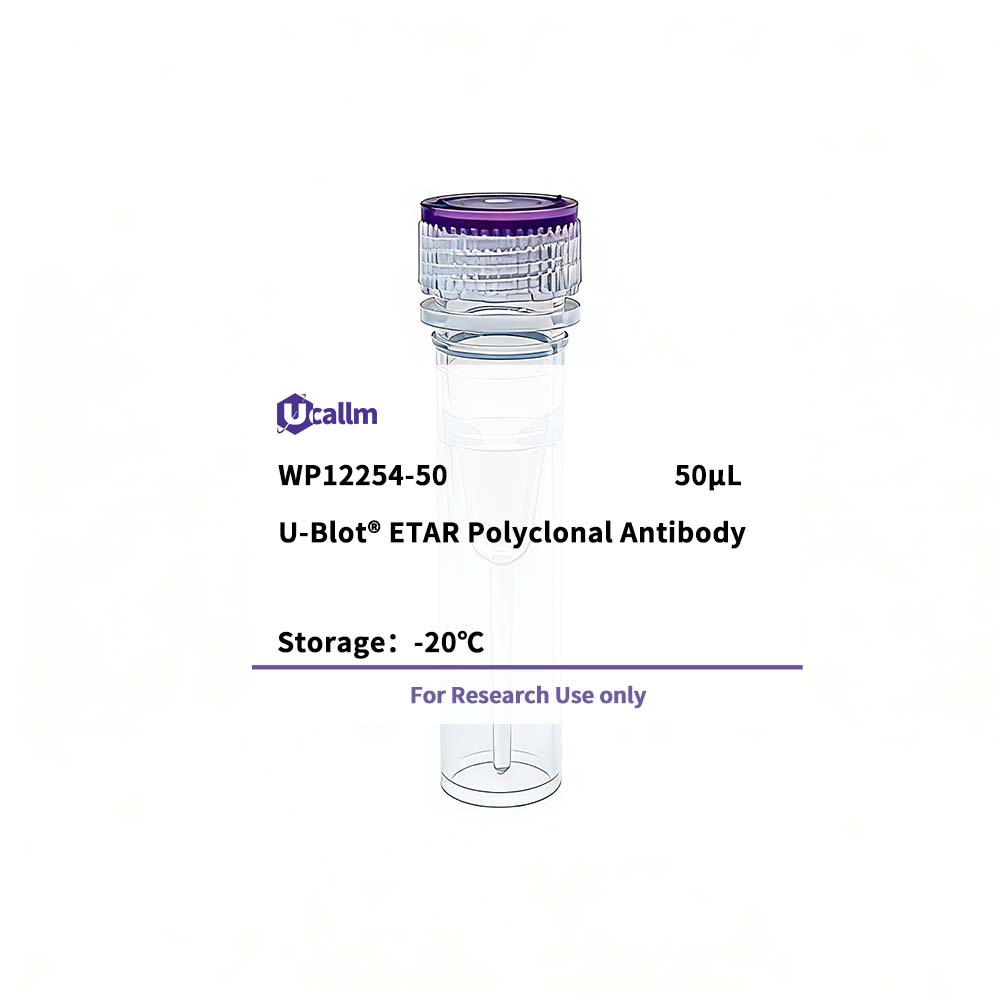
Ucallm_WP12254-50
Price range: $268.00 through $328.00
Product details
Background:
This gene encodes the receptor for endothelin-1, a peptide that plays a role in potent and long-lasting vasoconstriction. This receptor associates with guanine-nucleotide-binding (G) proteins, and this coupling activates a phosphatidylinositol-calcium second messenger system. Polymorphisms in this gene have been linked to migraine headache resistance. Alternative splicing results in multiple transcript variants. [provided by RefSeq, Oct 2009],
Specifications
| Size | 50μL/100μL |
| Target | ETAR |
| Reactivity | Human, Mouse, Monkey |
| Applications | WB, IHC, IF, ELISA |
| MW(Calculated) | |
| MW(Observed) | 48kD |
| Host Species | Rabbit |
| Isotype | IgG |
| Conjugate/Modification | Unmodified |
| Recommended Dilution Ratio | WB 1:500-1:2000; IHC 1:100-1:300; IF 1:200-1:1000; ELISA 1:20000; Not yet tested in other applications. / Note: For IHC, we suggest antigen retrieval with TE buffer pH 9.0 (Cat#WT1004) |
| Formulation | Liquid in PBS containing 50% glycerol, 0.5% BSA and 0.02% sodium azide. |
| Purification | The antibody was affinity-purified from rabbit antiserum by affinity-chromatography using epitope-specific immunogen. |
| Storage | -15°C to -25°C/1 year(Do not lower than -25°C) |
| Concentration | 1 mg/ml |
| Clonality | Polyclonal |
| Clone Number | |
| Immunogen | The antiserum was produced against synthesized peptide derived from human EDNRA. AA range:378-427 |
| Specificity | ETAR Polyclonal Antibody detects endogenous levels of ETAR protein. |
| Gene Name | EDNRA |
| Protein Name | Endothelin-1 receptor |
| Other Name | EDNRA; / ETA; / ETRA; / Endothelin-1 receptor; / Endothelin A receptor; / ET-A; / ETA-R; / hET-AR |
| Species | Human |
| Gene ID | 1909 |
| Uniprot | P25101, |
| Species.1 | Mouse |
| Gene ID.1 | 13617 |
| Uniprot.1 | Q61614 |
| Species.2 | |
| Gene ID.2 | |
| Uniprot.2 | |
| Cellular Localization | Cell membrane; Multi-pass membrane protein. |
| Tissue Expression | Isoform 1, isoform 3 and isoform 4 are expressed in a variety of tissues, with highest levels in the aorta and cerebellum, followed by lung, atrium and cerebral cortex, lower levels in the placenta, kidney, adrenal gland, duodenum, colon, ventricle and liver but no expression in umbilical vein endothelial cells. Within the placenta, isoform 1, isoform 2, isoform 3 and isoform 4 are expressed in the villi and stem villi vessels. |
| Signaling_pathway | Organismal Systems >> Circulatory system >> Vascular smooth muscle contraction;Human Diseases >> Cancer: overview >> Pathways in cancer;Environmental Information Processing >> Signal transduction >> Calcium signaling pathway;Environmental Information Processing >> Signal transduction >> cAMP signaling pathway;Environmental Information Processing >> Signal transduction >> cGMP-PKG signaling pathway |
| Research Areas | >>Calcium signaling pathway; / >>cGMP-PKG signaling pathway; / >>cAMP signaling pathway; / >>Neuroactive ligand-receptor interaction; / >>Vascular smooth muscle contraction; / >>Renin secretion; / >>Pathways in cancer |
| Function | Function:Receptor for endothelin-1. Mediates its action by association with G proteins that activate a phosphatidylinositol-calcium second messenger system. The rank order of binding affinities for ET-A is: ET1 > ET2 >> ET3.,similarity:Belongs to the G-protein coupled receptor 1 family.,subunit:Interacts with HDAC7 and HTATIP.,tissue specificity:Isoform 1, isoform 3 and isoform 4 are expressed in a variety of tissues, with highest levels in the aorta and cerebellum, followed by lung, atrium and cerebral cortex, lower levels in the placenta, kidney, adrenal gland, duodenum, colon, ventricle and liver but no expression in umbilical vein endothelial cells. Within the placenta, isoform 1, isoform 2, isoform 3 and isoform 4 are expressed in the villi and stem villi vessels., |
Please login to post questions
Related products




