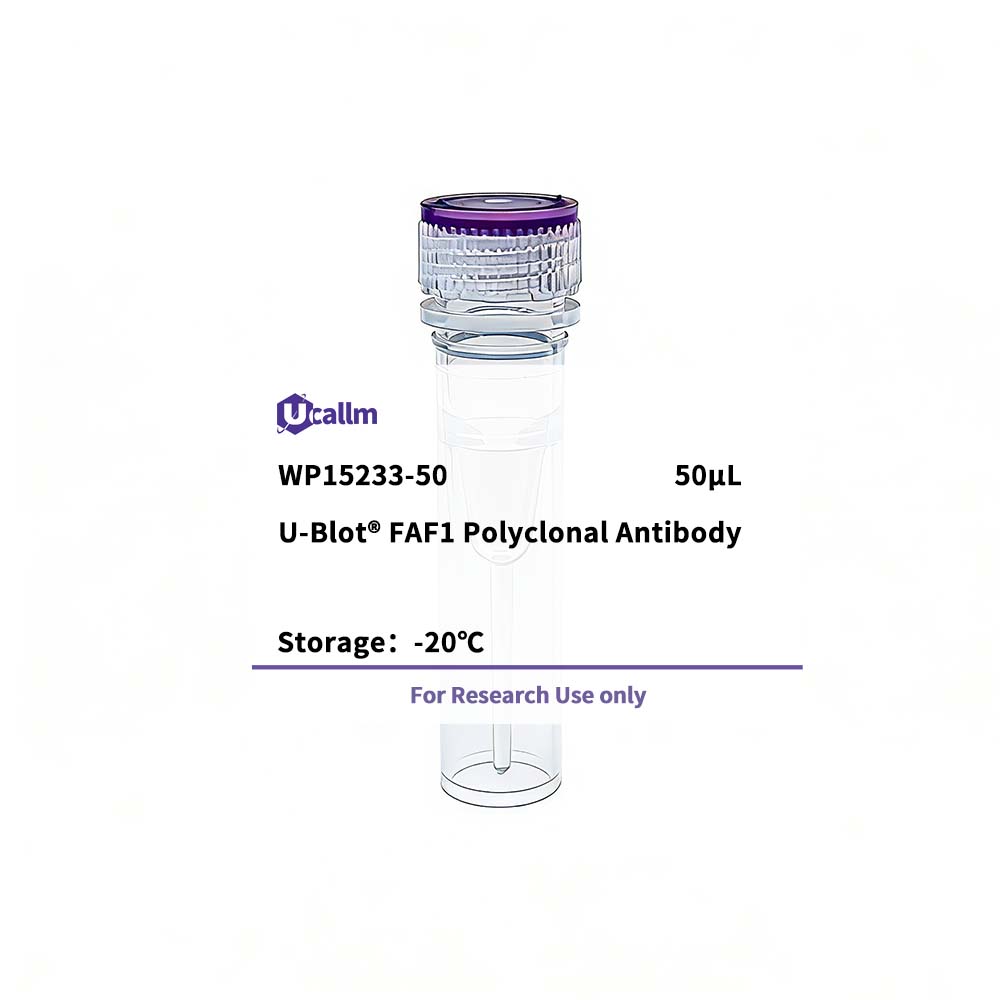
SKU: WP15233 Categories: ,

FAF1 Polyclonal Antibody

Price range: $268.00 through $328.00

SKU: WP15233-100
Enter the quantity you would like, or drag the panel to find the quantity and price that best for you
Bulk QuoteAuthorize OEM & ODM

Product details

Background:

Interaction of Fas ligand (TNFSF6) with the FAS antigen (TNFRSF6) mediates programmed cell death, also called apoptosis, in a number of organ systems. The protein encoded by this gene binds to FAS antigen and can initiate apoptosis or enhance apoptosis initiated through FAS antigen. Initiation of apoptosis by the protein encoded by this gene requires a ubiquitin-like domain but not the FAS-binding domain. [provided by RefSeq, Jul 2008],

Specifications

Size50μL/100μL
TargetFAF1
ReactivityHuman, Mouse, Rat
ApplicationsWB, IHC, IF, ELISA
MW(Calculated)
MW(Observed)75kD
Host SpeciesRabbit
IsotypeIgG
Conjugate/ModificationUnmodified
Recommended Dilution RatioWB 1:500-1:2000; IHC: 1:100-300; ELISA 1:20000; IF 1:50-200 / Note: For IHC, we suggest antigen retrieval with TE buffer pH 9.0 (Cat#WT1004)
FormulationLiquid in PBS containing 50% glycerol, 0.5% BSA and 0.02% sodium azide.
PurificationThe antibody was affinity-purified from rabbit antiserum by affinity-chromatography using epitope-specific immunogen.
Storage-15°C to -25°C/1 year(Do not lower than -25°C)
Concentration1 mg/ml
ClonalityPolyclonal
Clone Number
ImmunogenThe antiserum was produced against synthesized peptide derived from the Internal region of human FAF1. AA range:461-510
SpecificityFAF1 Polyclonal Antibody detects endogenous levels of FAF1 protein.
Gene NameFAF1
Protein NameFAS-associated factor 1
Other NameFAF1; / UBXD12; / UBXN3A; / CGI-03; / FAS-associated factor 1; / hFAF1; / UBX domain-containing protein 12; / UBX domain-containing protein 3A
SpeciesHuman
Gene ID11124
UniprotQ9UNN5,
Species.1Mouse
Gene ID.114084
Uniprot.1P54731,
Species.2Rat
Gene ID.2140657
Uniprot.2Q924K2
Cellular LocalizationNucleus .
Tissue ExpressionMost abundant in testis, slightly less abundant in skeletal muscle and heart, followed by prostate, thymus, ovary, small intestine, and colon. Not detected in the peripheral blood leukocytes.
Signaling_pathway
Research Areas>>Necroptosis
FunctionFunction:Potentiates but cannot initiate FAS-induced apoptosis.,similarity:Contains 1 UBX domain.,subunit:Specifically interacts with the cytoplasmic domain of FAS.,tissue specificity:Most abundant in testis, slightly less abundant in skeletal muscle and heart, followed by prostate, thymus, ovary, small intestine, and colon. Not detected in the peripheral blood leukocytes.,
Please login to post questions
Back to Top
Product has been added to your cart
