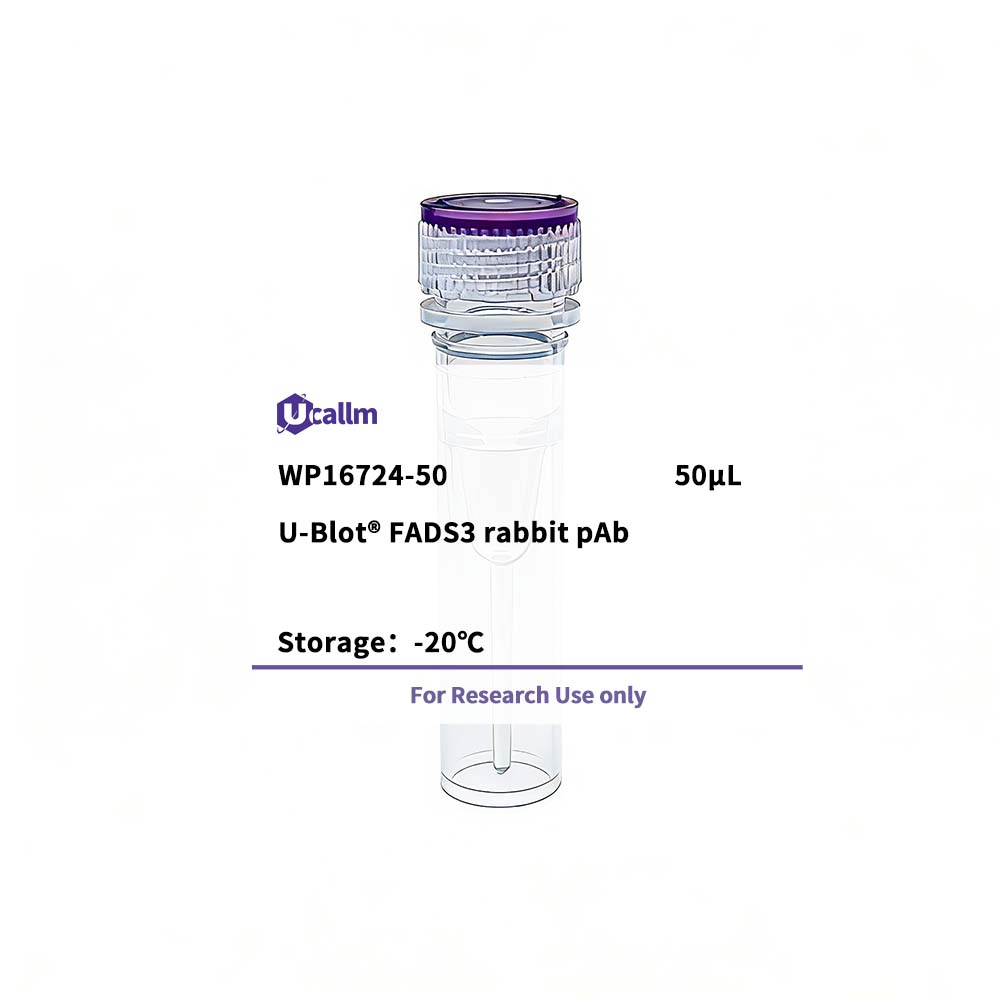
SKU: WP16724 Categories: ,

FADS3 rabbit pAb

Price range: $268.00 through $328.00

SKU: WP16724-100
Enter the quantity you would like, or drag the panel to find the quantity and price that best for you
Bulk QuoteAuthorize OEM & ODM

Product details

Background:

The protein encoded by this gene is a member of the fatty acid desaturase (FADS) gene family. Desaturase enzymes regulate unsaturation of fatty acids through the introduction of double bonds between defined carbons of the fatty acyl chain. FADS family members are considered fusion products composed of an N-terminal cytochrome b5-like domain and a C-terminal multiple membrane-spanning desaturase portion, both of which are characterized by conserved histidine motifs. This gene is clustered with family members FADS1 and FADS2 at 11q12-q13.1; this cluster is thought to have arisen evolutionarily from gene duplication based on its similar exon/intron organization. [provided by RefSeq, Jul 2008],

Specifications

Size50μL/100μL
TargetFADS3
ReactivityHuman, Mouse, Rat
ApplicationsWB
MW(Calculated)49kD
MW(Observed)
Host SpeciesRabbit
IsotypeIgG
Conjugate/ModificationUnmodified
Recommended Dilution RatioWB 1:500-2000
FormulationLiquid in PBS containing 50% glycerol, 0.5% BSA and 0.02% sodium azide.
PurificationThe antibody was affinity-purified from rabbit antiserum by affinity-chromatography using epitope-specific immunogen.
Storage-15°C to -25°C/1 year(Do not lower than -25°C)
Concentration1 mg/ml
ClonalityPolyclonal
Clone Number
ImmunogenSynthesized peptide derived from human FADS3 AA range: 60-110
SpecificityThis antibody detects endogenous levels of FADS3 at Human/Mouse/Rat
Gene NameFADS3 CYB5RP
Protein NameFADS3
Other Name
SpeciesHuman
Gene ID3995
UniprotQ9Y5Q0,
Species.1Mouse
Gene ID.160527
Uniprot.1Q9JJE7,
Species.2Rat
Gene ID.2286922
Uniprot.2Q8K1P9
Cellular LocalizationEndoplasmic reticulum membrane; Multi-pass membrane protein .
Tissue ExpressionHighly expressed in various organs and tissues including liver, kidney, brain, lung, pancreas, testis, ovary and skeletal muscle (at protein level).
Signaling_pathway
Research Areas
FunctionDomain:The histidine box domains may contain the active site and/or be involved in metal ion binding.,similarity:Belongs to the fatty acid desaturase family.,similarity:Contains 1 cytochrome b5 heme-binding domain.,tissue specificity:Has been found in heart, liver, lung, uterus, and brainstem.,
Please login to post questions
Back to Top
Product has been added to your cart

