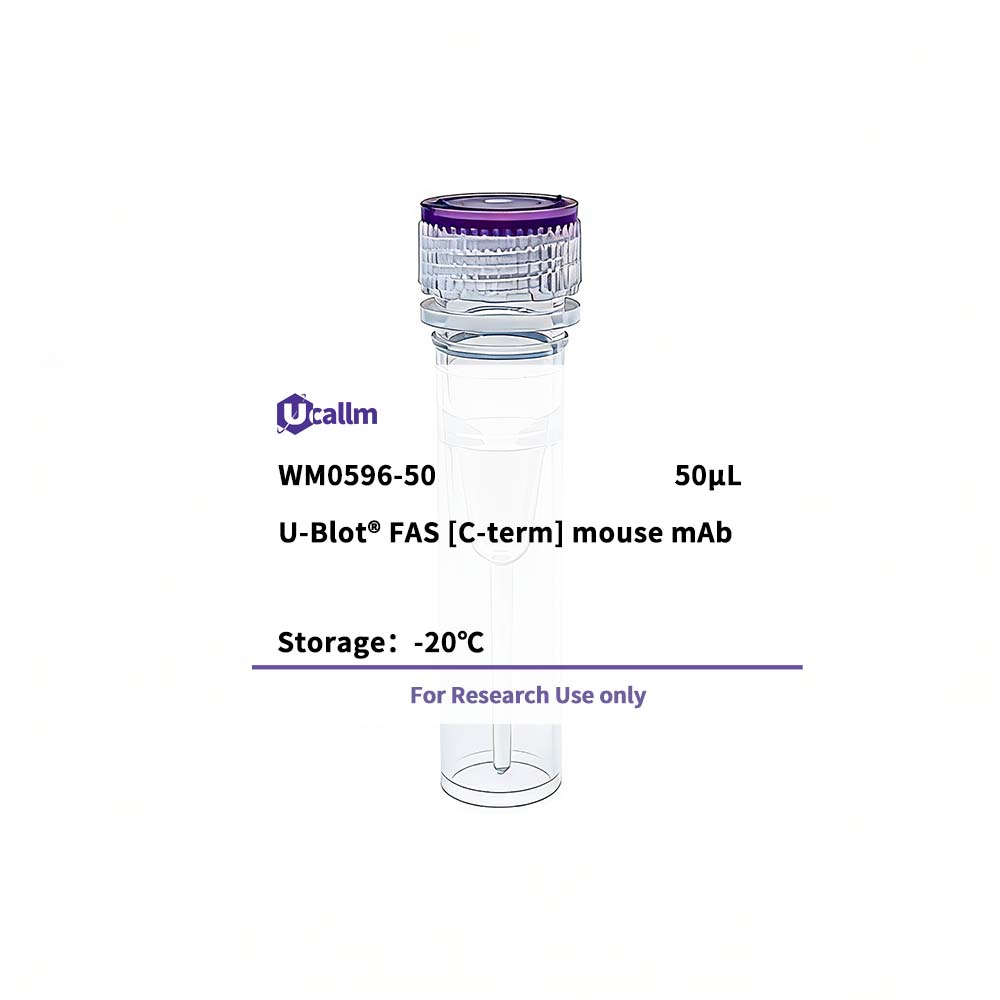
SKU: WM0596 Categories: ,

FAS [C-term] mouse mAb

Price range: $268.00 through $328.00

SKU: WM0596-50
Enter the quantity you would like, or drag the panel to find the quantity and price that best for you
Bulk QuoteAuthorize OEM & ODM

Product details

Background:
The protein encoded by this gene is a member of the TNF-receptor superfamily. This receptor contains a death domain. It has been shown to play a central role in the physiological regulation of programmed cell death, and has been implicated in the pathogenesis of various malignancies and diseases of the immune system. The interaction of this receptor with its ligand allows the formation of a death-inducing signaling complex that includes Fas-associated death domain protein (FADD), caspase 8, and caspase 10. The autoproteolytic processing of the caspases in the complex triggers a downstream caspase cascade, and leads to apoptosis. This receptor has been also shown to activate NF-kappaB, MAPK3/ERK1, and MAPK8/JNK, and is found to be involved in transducing the proliferating signals in normal diploid fibroblast and T cells. Several alternatively spliced transcript variants have been described, s

Specifications

Size50μL/100μL
TargetFAS
ReactivityHuman
ApplicationsWB
MW(Calculated)
MW(Observed)45kD
Host SpeciesMouse
Isotype
Conjugate/ModificationUnmodified
Recommended Dilution RatioWB 1:1000
FormulationLiquid in PBS containing 50% glycerol, 0.5% BSA and 0.02% sodium azide.
PurificationThe antibody was affinity-purified from mouse ascites by affinity-chromatography using epitope-specific immunogen.
Storage-15°C to -25°C/1 year(Do not lower than -25°C)
Concentration
ClonalityMonoclonal
Clone Number6G9
ImmunogenPurified recombinant human Fas (C-terminus) protein fragments expressed in E.coli.
SpecificityThis antibody detects endogenous levels of FAS (C-terminus) and does not cross-react with related proteins.
Gene NameFAS
Protein Name
Other NameALPS 1A; / ALPS1A; / APO 1; / Apo 1 antigen; / APO 1 cell surface antigen; / Apo-1 antigen; / APO1; / Apo1 antigen; / APO1 cell surface antigen; / Apoptosis antigen 1; / Apoptosis mediating surface antigen FAS; / Apoptosis-mediating surface antigen FAS; / APT 1; / APT1; / CD 95; / CD 95 antigen; / CD95; / CD95 antigen; / Delta Fas; / Delta Fas/APO 1/CD95; / Delta Fas/APO1/CD95; / Fas; / TNF receptor superfamily, member 6; / FAS 1; / FAS 827dupA; / Fas AMA; / FAS; / FAS Antigen; / Fas cell surface death receptor; / FAS1; / FASLG receptor; / FASTM; / sFAS; / Surface antigen APO1; / TNF receptor superfamily, member 6; / TNFRSF 6; / TNFRSF6; / TNR6_HUMAN; / Tumor necrosis factor receptor superfamily member 6.
SpeciesHuman
Gene ID355
UniprotP25445,
Species.1Mouse
Gene ID.1
Uniprot.1P25446
Species.2
Gene ID.2
Uniprot.2
Cellular Localization[Isoform 1]: Cell membrane; Single-pass type I membrane protein . Membrane raft .; [Isoform 2]: Secreted.; [Isoform 3]: Secreted.; [Isoform 4]: Secreted.; [Isoform 5]: Secreted.; [Isoform 6]: Secreted.
Tissue ExpressionIsoform 1 and isoform 6 are expressed at equal levels in resting peripheral blood mononuclear cells. After activation there is an increase in isoform 1 and decrease in the levels of isoform 6.
Signaling_pathwayCellular Processes >> Cell growth and death >> Apoptosis;Cellular Processes >> Cell growth and death >> Necroptosis;Cellular Processes >> Cell growth and death >> p53 signaling pathway;Organismal Systems >> Immune system >> Natural killer cell mediated cytotoxicity;Human Diseases >> Cancer: overview >> Pathways in cancer;Human Diseases >> Immune disease >> Autoimmune thyroid disease;Human Diseases >> Immune disease >> Allograft rejection;Human Diseases >> Immune disease >> Graft-versus-host disease;Human Diseases >> Neurodegenerative disease >> Alzheimer disease;Human Diseases >> Neurodegenerative disease >> Pathways of neurodegeneration - multiple diseases;Environmental Information Processing >> Signal transduction >> MAPK signaling pathway;Environmental Information Processing >> Signal transduction >> TNF signaling pathway;Environmental Information Processing >> Signaling molecules and interaction >> Cytokine-cytokine receptor interaction
Research Areas>>Platinum drug resistance; / >>MAPK signaling pathway; / >>Cytokine-cytokine receptor interaction; / >>p53 signaling pathway; / >>Apoptosis; / >>Necroptosis; / >>Natural killer cell mediated cytotoxicity; / >>TNF signaling pathway; / >>Non-alcoholic fatty liver disease; / >>Alcoholic liver disease; / >>Type I diabetes mellitus; / >>Alzheimer disease; / >>Pathways of neurodegeneration - multiple diseases; / >>Pathogenic Escherichia coli infection; / >>Chagas disease; / >>African trypanosomiasis; / >>Hepatitis C; / >>Hepatitis B; / >>Measles; / >>Human cytomegalovirus infection; / >>Influenza A; / >>Human papillomavirus infection; / >>Kaposi sarcoma-associated herpesvirus infection; / >>Herpes simplex virus 1 infection; / >>Epstein-Barr virus infection; / >>Human immunodeficiency virus 1 infection; / >>Pathways in cancer; / >>Proteoglycans in cancer; / >>Autoimmune thyroid disease; / >>Allograft rejection; / >>Graft-versus-host disease; / >>Lipid and atherosclerosis
FunctionDisease:Defects in FAS are the cause of autoimmune lymphoproliferative syndrome type 1A (ALPS1A) [MIM:601859]; also known as Canale-Smith syndrome (CSS). ALPS is a childhood syndrome involving hemolytic anemia and thrombocytopenia with massive lymphadenopathy and splenomegaly.,Domain:Contains a death domain involved in the binding of FADD, and maybe to other cytosolic adapter proteins.,Function:Receptor for TNFSF6/FASLG. The adapter molecule FADD recruits caspase-8 to the activated receptor. The resulting death-inducing signaling complex (DISC) performs caspase-8 proteolytic activation which initiates the subsequent cascade of caspases (aspartate-specific cysteine proteases) mediating apoptosis. FAS-mediated apoptosis may have a role in the induction of peripheral tolerance, in the antigen-stimulated suicide of mature T-cells, or both. The secreted isoforms 2 to 6 block apoptosis (in vitro).,online information:Mutations in TNFRSF6 causing ALPS type Ia,similarity:Contains 1 death domain.,similarity:Contains 3 TNFR-Cys repeats.,subunit:Binds DAXX. Interacts with HIPK3. Part of a complex containing HIPK3 and FADD (By similarity). Binds RIPK1 and FAIM2. Interacts with BRE and FEM1B.,tissue specificity:Isoform 1 and isoform 6 are expressed at equal levels in resting peripheral blood mononuclear cells. After activation there is an increase in isoform 1 and decrease in the levels of isoform 6.,
Please login to post questions
Back to Top
Product has been added to your cart
