

FCER1A rabbit pAb
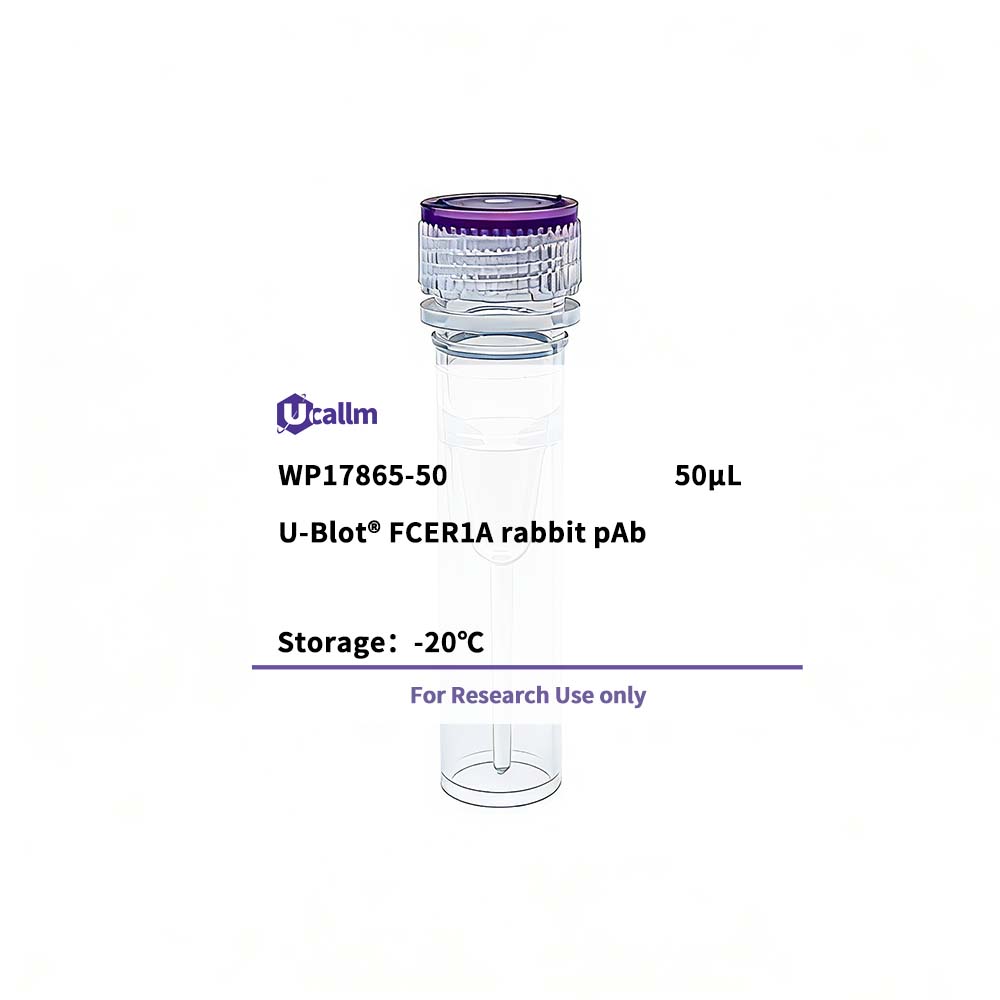
Ucallm_WP17865-50
Price range: $268.00 through $328.00
Product details
Background:
Specifications
| Size | 50μL/100μL |
| Target | FCER1A |
| Reactivity | Human, Mouse, Rat |
| Applications | WB |
| MW(Calculated) | 28kD |
| MW(Observed) | |
| Host Species | Rabbit |
| Isotype | IgG |
| Conjugate/Modification | Unmodified |
| Recommended Dilution Ratio | WB 1:500-2000 |
| Formulation | Liquid in PBS containing 50% glycerol, 0.5% BSA and 0.02% sodium azide. |
| Purification | The antibody was affinity-purified from rabbit antiserum by affinity-chromatography using epitope-specific immunogen. |
| Storage | -15°C to -25°C/1 year(Do not lower than -25°C) |
| Concentration | 1 mg/ml |
| Clonality | Polyclonal |
| Clone Number | |
| Immunogen | Synthesized peptide derived from human FCER1A |
| Specificity | This antibody detects endogenous levels of FCER1A at Human, Mouse,Rat |
| Gene Name | FCER1A FCE1A |
| Protein Name | FCER1A |
| Other Name | High affinity immunoglobulin epsilon receptor subunit alpha; / Fc-epsilon RI-alpha; / FcERI; / IgE Fc receptor subunit alpha |
| Species | Human |
| Gene ID | 2205 |
| Uniprot | P12319, |
| Species.1 | Mouse |
| Gene ID.1 | 14125 |
| Uniprot.1 | P20489, |
| Species.2 | Rat |
| Gene ID.2 | 25047 |
| Uniprot.2 | P12371 |
| Cellular Localization | Cell membrane; Single-pass type I membrane protein. |
| Tissue Expression | Expressed in eosinophils. |
| Signaling_pathway | Organismal Systems >> Immune system >> Fc epsilon RI signaling pathway;Human Diseases >> Immune disease >> Asthma;Environmental Information Processing >> Signal transduction >> Phospholipase D signaling pathway;Environmental Information Processing >> Signal transduction >> Sphingolipid signaling pathway |
| Research Areas | >>Sphingolipid signaling pathway; / >>Phospholipase D signaling pathway; / >>Fc epsilon RI signaling pathway; / >>Asthma |
| Function | High-affinity receptor for immunoglobulin epsilon/IgE. Mediates IgE effector functions in myeloid cells. Upon IgE binding and antigen/allergen cross-linking initiates signaling pathways that lead to myeloid cell activation and differentiation. On mast cells, basophils and eosinophils stimulates the secretion of vasoactive amines, lipid mediators and cytokines that contribute to inflammatory response, tissue remodeling and cytotoxicity against microbes. Triggers the immediate hypersensitivity response to allergens as a host defense mechanism against helminth parasites, pathogenic bacteria and venom toxicity. When dysregulated, it can elicit harmful life-threatening allergic and anaphylactic reactions. |
Please login to post questions
Related products




