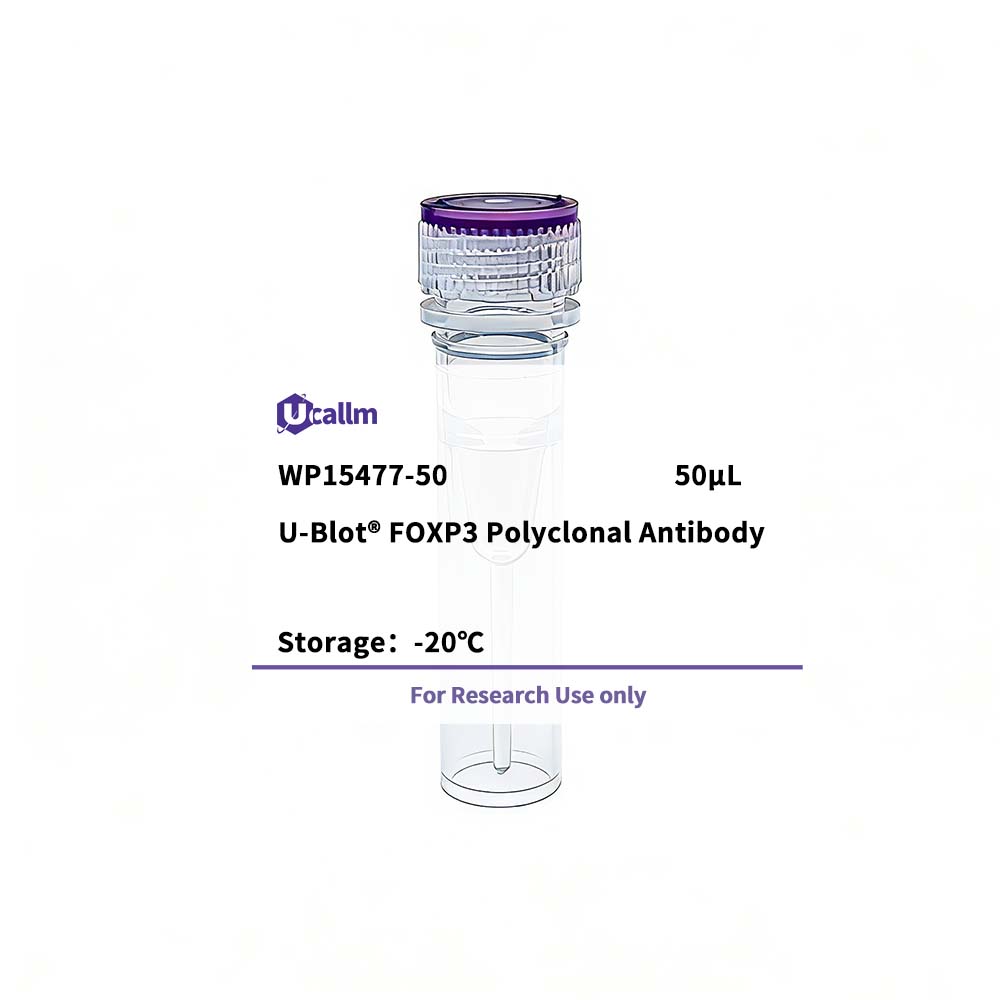
SKU: WP15477 Categories: ,

FOXP3 Polyclonal Antibody

Price range: $268.00 through $328.00

SKU: WP15477-100
Enter the quantity you would like, or drag the panel to find the quantity and price that best for you
Bulk QuoteAuthorize OEM & ODM

Product details

Background:

The protein encoded by this gene is a member of the forkhead/winged-helix family of transcriptional regulators. Defects in this gene are the cause of immunodeficiency polyendocrinopathy, enteropathy, X-linked syndrome (IPEX), also known as X-linked autoimmunity-immunodeficiency syndrome. Alternatively spliced transcript variants encoding different isoforms have been identified. [provided by RefSeq, Jul 2008],

Specifications

Size50μL/100μL
TargetFOXP3
ReactivityHuman, Mouse, Rat, Pig
ApplicationsWB, IHC, IF, ELISA
MW(Calculated)
MW(Observed)47kD
Host SpeciesRabbit
IsotypeIgG
Conjugate/ModificationUnmodified
Recommended Dilution RatioWB 1:500-1:2000; IHC: 1:100-1:300; ELISA 1:20000; IF 1:50-200 / Note: For IHC, we suggest antigen retrieval with TE buffer pH 9.0 (Cat#WT1004)
FormulationLiquid in PBS containing 50% glycerol, 0.5% BSA and 0.02% sodium azide.
PurificationThe antibody was affinity-purified from rabbit antiserum by affinity-chromatography using epitope-specific immunogen.
Storage-15°C to -25°C/1 year(Do not lower than -25°C)
Concentration1 mg/ml
ClonalityPolyclonal
Clone Number
ImmunogenThe antiserum was produced against synthesized peptide derived from the C-terminal region of human FOXP3. AA range:381-430
SpecificityFOXP3 Polyclonal Antibody detects endogenous levels of FOXP3 protein.
Gene NameFOXP3
Protein NameForkhead box protein P3
Other NameFOXP3; / IPEX; / JM2; / Forkhead box protein P3; / Scurfin
SpeciesHuman
Gene ID50943
UniprotQ9BZS1,
Species.1Mouse
Gene ID.120371
Uniprot.1Q99JB6
Species.2
Gene ID.2
Uniprot.2
Cellular LocalizationNucleus . Cytoplasm . Predominantly expressed in the cytoplasm in activated conventional T-cells whereas predominantly expressed in the nucleus in regulatory T-cells (Treg). The 41 kDa form derived by proteolytic processing is found exclusively in the chromatin fraction of activated Treg cells (By similarity). .
Tissue Expression
Signaling_pathwayOrganismal Systems >> Immune system >> Th17 cell differentiation;Human Diseases >> Immune disease >> Inflammatory bowel disease
Research Areas>>Th17 cell differentiation; / >>Inflammatory bowel disease
FunctionDisease:Defects in FOXP3 are the cause of immunodeficiency polyendocrinopathy, enteropathy, X-linked syndrome (IPEX) [MIM:304790]; also known as X-linked autoimmunity-immunodeficiency syndrome. IPEX is characterized by neonatal onset insulin-dependent diabetes mellitus, infections, secretory diarrhea, trombocytopenia, anemia and eczema. It is usually lethal in infancy.,Function:Probable transcription factor. Plays a critical role in the control of immune response.,online information:FOXP3 entry,online information:FOXP3 mutation db,similarity:Contains 1 C2H2-type zinc finger.,similarity:Contains 1 fork-head DNA-binding domain.,
Please login to post questions
Back to Top
Product has been added to your cart
