

FPR1 Polyclonal Antibody
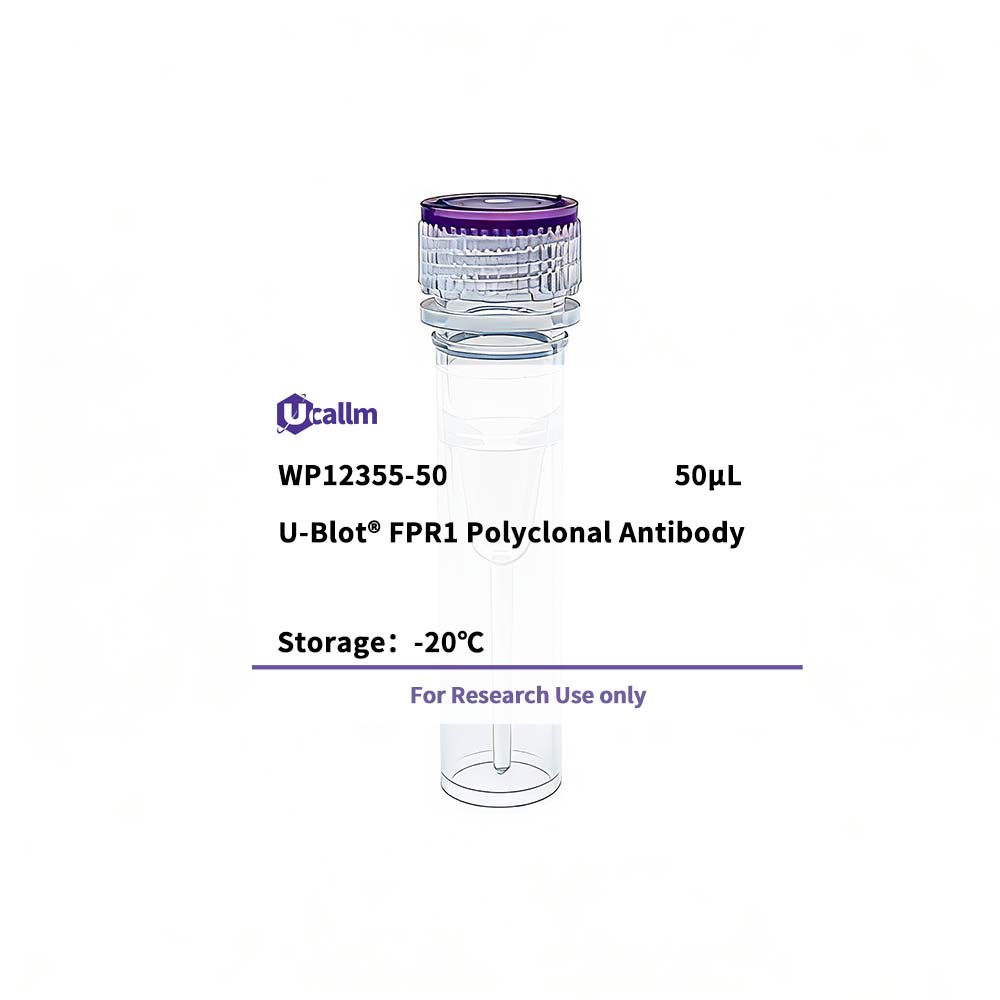
Ucallm_WP12355-50
Price range: $268.00 through $328.00
Product details
Background:
formyl peptide receptor 1(FPR1) Homo sapiens This gene encodes a G protein-coupled receptor of mammalian phagocytic cells that is a member of the G-protein coupled receptor 1 family. The protein mediates the response of phagocytic cells to invasion of the host by microorganisms and is important in host defense and inflammation.[provided by RefSeq, Jul 2010],
Specifications
| Size | 50μL/100μL |
| Target | FPR1 |
| Reactivity | Human, Mouse |
| Applications | WB, IHC, IF, ELISA |
| MW(Calculated) | |
| MW(Observed) | 40kD |
| Host Species | Rabbit |
| Isotype | IgG |
| Conjugate/Modification | Unmodified |
| Recommended Dilution Ratio | WB 1:500-1:2000; IHC 1:100-1:300; IF 1:200-1:1000; ELISA 1:5000; Not yet tested in other applications. / Note: For IHC, we suggest antigen retrieval with TE buffer pH 9.0 (Cat#WT1004) |
| Formulation | Liquid in PBS containing 50% glycerol, 0.5% BSA and 0.02% sodium azide. |
| Purification | The antibody was affinity-purified from rabbit antiserum by affinity-chromatography using epitope-specific immunogen. |
| Storage | -15°C to -25°C/1 year(Do not lower than -25°C) |
| Concentration | 1 mg/ml |
| Clonality | Polyclonal |
| Clone Number | |
| Immunogen | The antiserum was produced against synthesized peptide derived from human FPR1. AA range:155-204 |
| Specificity | FPR1 Polyclonal Antibody detects endogenous levels of FPR1 protein. |
| Gene Name | FPR1 |
| Protein Name | fMet-Leu-Phe receptor |
| Other Name | FPR1; / fMet-Leu-Phe receptor; / fMLP receptor; / N-formyl peptide receptor; / FPR; / N-formylpeptide chemoattractant receptor |
| Species | Human |
| Gene ID | 2357 |
| Uniprot | P21462, |
| Species.1 | Mouse |
| Gene ID.1 | |
| Uniprot.1 | P33766 |
| Species.2 | |
| Gene ID.2 | |
| Uniprot.2 | |
| Cellular Localization | Cell membrane; Multi-pass membrane protein . Internalizes in presence of its ligands, fMLP, TAFA4 and CTSG. . |
| Tissue Expression | Neutrophils. |
| Signaling_pathway | Organismal Systems >> Immune system >> Neutrophil extracellular trap formation;Environmental Information Processing >> Signal transduction >> Rap1 signaling pathway |
| Research Areas | >>Rap1 signaling pathway; / >>Neuroactive ligand-receptor interaction; / >>Neutrophil extracellular trap formation; / >>Staphylococcus aureus infection |
| Function | Function:High affinity receptor for N-formyl-methionyl peptides, which are powerful neutrophils chemotactic factors. Binding of FMLP to the receptor causes activation of neutrophils. This response is mediated via a G-protein that activates a phosphatidylinositol-calcium second messenger system.,PTM:Phosphorylated; which is necessary for desensitization.,similarity:Belongs to the G-protein coupled receptor 1 family.,tissue specificity:Neutrophils., |
Please login to post questions
Related products





