SKU: WP12368 Categories: ,

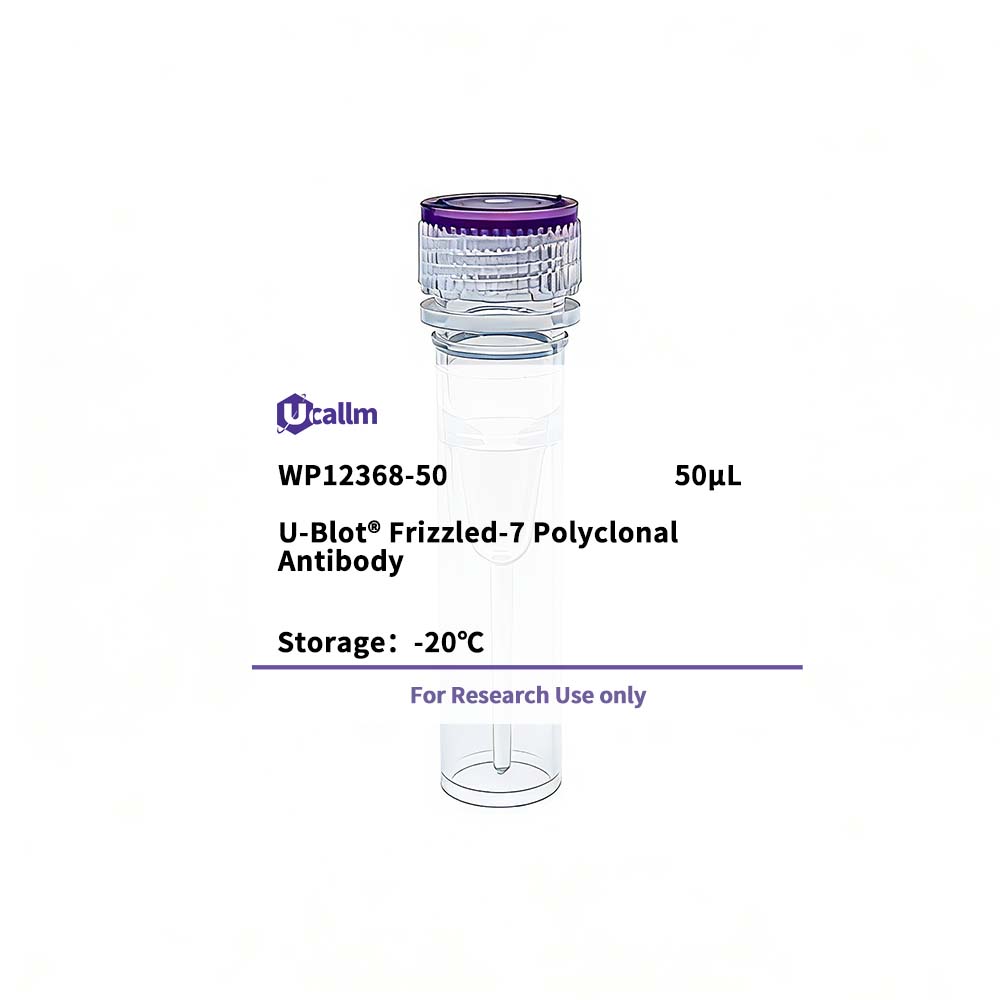
Frizzled-7 Polyclonal Antibody

Price range: $268.00 through $328.00

SKU: WP12368-100
Enter the quantity you would like, or drag the panel to find the quantity and price that best for you
Bulk QuoteAuthorize OEM & ODM

Product details

Background:

frizzled class receptor 7(FZD7) Homo sapiens Members of the 'frizzled' gene family encode 7-transmembrane domain proteins that are receptors for Wnt signaling proteins. The FZD7 protein contains an N-terminal signal sequence, 10 cysteine residues typical of the cysteine-rich extracellular domain of Fz family members, 7 putative transmembrane domains, and an intracellular C-terminal tail with a PDZ domain-binding motif. FZD7 gene expression may downregulate APC function and enhance beta-catenin-mediated signals in poorly differentiated human esophageal carcinomas. [provided by RefSeq, Jul 2008],
Specifications

TargetFrizzled-7
ReactivityHuman, Mouse
ApplicationsWB, FC, IF, ELISA
MW(Calculated)
MW(Observed)64kD
Host SpeciesRabbit
IsotypeIgG
Conjugate/ModificationUnmodified
Modification
Recommended Dilution RatioWB 1:500-2000; Flow Cyt 1:50-200; IF/ICC1:100-500; ELISA 1:5000-20000
FormulationLiquid in PBS containing 50% glycerol, 0.5% BSA and 0.02% sodium azide.
Source
PurificationThe antibody was affinity-purified from rabbit antiserum by affinity-chromatography using epitope-specific immunogen.
Purity
Storage-15°C to -25°C/1 year(Do not lower than -25°C)
Concentration1 mg/ml
ClonalityPolyclonal
Clone Number
ImmunogenThe antiserum was produced against synthesized peptide derived from human FZD7. AA range:45-94
Sequence
SpecificityFrizzled-7 Polyclonal Antibody detects endogenous levels of Frizzled-7 protein.
Gene NameFZD7
Protein NameFrizzled-7
Other NameFZD7; / Frizzled-7; / Fz-7; / hFz7; / FzE3
SpeciesHuman
Gene ID-18324
UniprotO75084,
Species.1Mouse
Gene ID-214369
Uniprot.1Q61090
Species.2
Gene ID-3
Uniprot.2
Organism-4
Gene ID-4
SwissProt-4
Backgroundfrizzled class receptor 7(FZD7) Homo sapiens Members of the ' frizzled' gene family encode 7-transmembrane domain proteins that are receptors for Wnt signaling proteins. The FZD7 protein contains an N-terminal signal sequence, 10 cysteine residues typical of the cysteine-rich extracellular domain of Fz family members, 7 putative transmembrane domains, and an intracellular C-terminal tail with a PDZ domain-binding motif. FZD7 gene expression may downregulate APC function and enhance beta-catenin-mediated signals in poorly differentiated human esophageal carcinomas. [provided by RefSeq, Jul 2008],
Cellular LocalizationCell membrane; Multi-pass membrane protein . Endosome membrane; Multi-pass membrane protein . Associated to the plasma membrane in the presence of FZD7 and phosphatidylinositol 4,5-bisphosphate (PIP2). Localized in recycling endosomes in other conditions. .
Tissue ExpressionHigh expression in adult skeletal muscle and fetal kidney, followed by fetal lung, adult heart, brain, and placenta. Specifically expressed in squamous cell esophageal carcinomas.
Signaling_pathwayCellular Processes >> Cellular community - eukaryotes >> Signaling pathways regulating pluripotency of stem cells;Human Diseases >> Cancer: overview >> Pathways in cancer;Human Diseases >> Cancer: specific types >> Hepatocellular carcinoma;Human Diseases >> Cancer: specific types >> Gastric cancer;Human Diseases >> Cancer: specific types >> Basal cell carcinoma;Human Diseases >> Cancer: specific types >> Breast cancer;Human Diseases >> Neurodegenerative disease >> Alzheimer disease;Human Diseases >> Neurodegenerative disease >> Pathways of neurodegeneration - multiple diseases;Environmental Information Processing >> Signal transduction >> Wnt signaling pathway;Environmental Information Processing >> Signal transduction >> Hippo signaling pathway;Environmental Information Processing >> Signal transduction >> mTOR signaling pathway
Research Areas>>mTOR signaling pathway; / >>Wnt signaling pathway; / >>Hippo signaling pathway; / >>Signaling pathways regulating pluripotency of stem cells; / >>Melanogenesis; / >>Cushing syndrome; / >>Alzheimer disease; / >>Pathways of neurodegeneration - multiple diseases; / >>Human papillomavirus infection; / >>Pathways in cancer; / >>Proteoglycans in cancer; / >>Basal cell carcinoma; / >>Breast cancer; / >>Hepatocellular carcinoma; / >>Gastric cancer
FunctionDomain:Lys-Thr-X-X-X-Trp motif is involved in the activation of the Wnt/beta-catenin signaling pathway.,Domain:The FZ domain is involved in binding with Wnt ligands.,Function:Receptor for Wnt proteins. Most of frizzled receptors are coupled to the beta-catenin canonical signaling pathway, which leads to the activation of disheveled proteins, inhibition of GSK-3 kinase, nuclear accumulation of beta-catenin and activation of Wnt target genes. A second signaling pathway involving PKC and calcium fluxes has been seen for some family members, but it is not yet clear if it represents a distinct pathway or if it can be integrated in the canonical pathway, as PKC seems to be required for Wnt-mediated inactivation of GSK-3 kinase. Both pathways seem to involve interactions with G-proteins. May be involved in transduction and intercellular transmission of polarity information during tissue morphogenesis and/or in differentiated tissues.,similarity:Belongs to the G-protein coupled receptor Fz/Smo family.,similarity:Contains 1 FZ (frizzled) domain.,subunit:Interacts with MAGI3.,tissue specificity:High expression in adult skeletal muscle and fetal kidney, followed by fetal lung, adult heart, brain, and placenta. Specifically expressed in squamous cell esophageal carcinomas.,
RRID
Please login to post questions
Back to Top
Product has been added to your cart