SKU: WM1674 Categories: ,

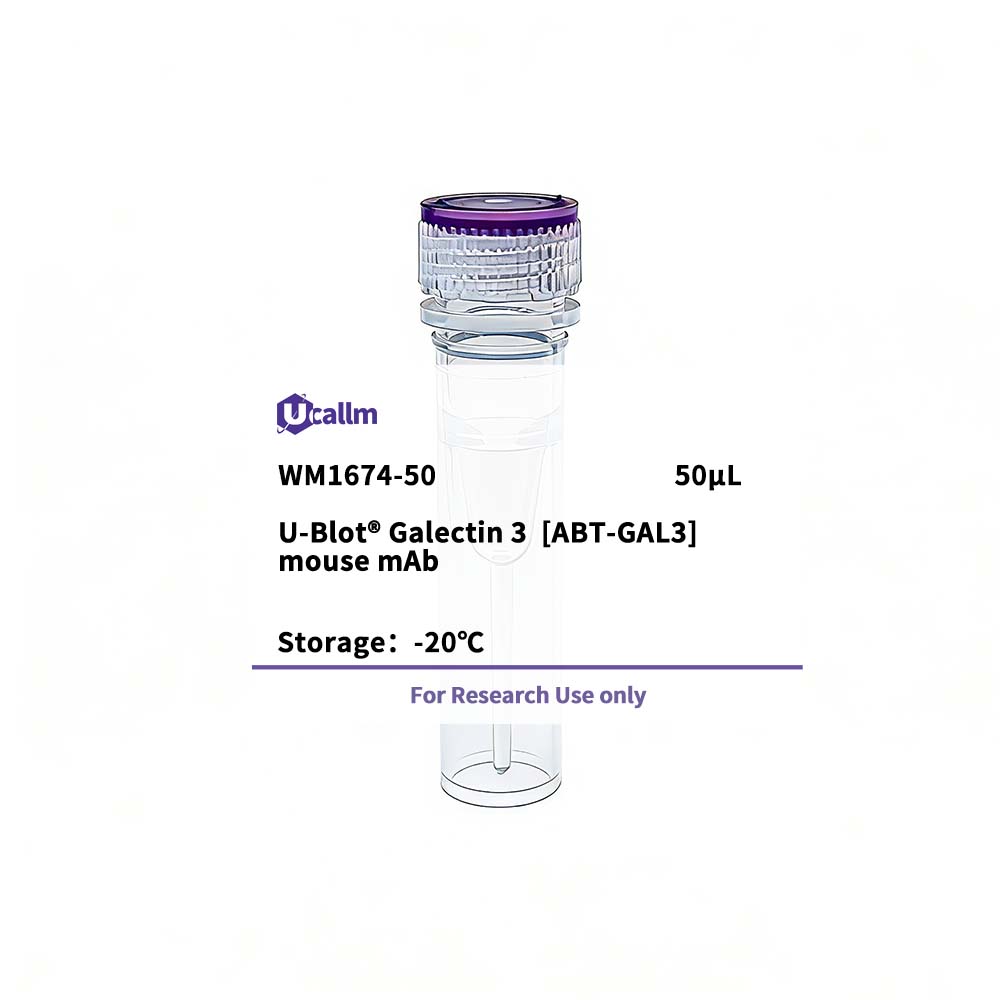
Galectin 3 [ABT-GAL3] mouse mAb

Price range: $268.00 through $328.00

SKU: WM1674-50
Enter the quantity you would like, or drag the panel to find the quantity and price that best for you
Bulk QuoteAuthorize OEM & ODM

Product details

Background:
This gene encodes a member of the galectin family of carbohydrate binding proteins. Members of this protein family have an affinity for beta-galactosides. The encoded protein is characterized by an N-terminal proline-rich tandem repeat domain and a single C-terminal carbohydrate recognition domain. This protein can self-associate through the N-terminal domain allowing it to bind to multivalent saccharide ligands. This protein localizes to the extracellular matrix, the cytoplasm and the nucleus. This protein plays a role in numerous cellular functions including apoptosis, innate immunity, cell adhesion and T-cell regulation. The protein exhibits antimicrobial activity against bacteria and fungi. Alternate splicing results in multiple transcript variants.[provided by RefSeq, Oct 2014],

Specifications

TargetGalectin-3
ReactivityHuman
ApplicationsIHC, ELISA
MW(Calculated)26kD
MW(Observed)33kD
Host SpeciesMouse
IsotypeIgG2b,Kappa
Conjugate/ModificationUnmodified
Modification
Recommended Dilution RatioIHC 1:50-100; ELISA 1:500-5000 / Note: For IHC, we suggest antigen retrieval with TE buffer pH 9.0 (Cat#YS0004)
FormulationPBS, 50% glycerol, 0.05% Proclin 300, 0.05%BSA
Source
PurificationThe antibody was affinity-purified from ascites by affinity-chromatography using specific immunogen.
Purity
Storage-15°C to -25°C/1 year(Do not lower than -25°C)
Concentration
ClonalityMonoclonal
Clone NumberABT-GAL3
ImmunogenSynthesized peptide derived from human Galectin-3 AA range: 150-250
Sequence
SpecificityThe antibody can specifically recognize human Galectin-3 protein.
Gene NameLGALS3 MAC2
Protein NameGalectin 3
Other NameGalectin-3; / Gal-3; / 35 kDa lectin; / Carbohydrate-binding protein 35; / CBP 35; / Galactose-specific lectin 3; / Galactoside-binding protein; / GALBP; / IgE-binding protein; / L-31; / Laminin-binding protein; / Lectin L-29; / Mac-2 antigen
SpeciesHuman
Gene ID-13958
UniprotP17931
Species.1
Gene ID-2
Uniprot.1
Species.2
Gene ID-3
Uniprot.2
Organism-4
Gene ID-4
SwissProt-4
BackgroundThis gene encodes a member of the galectin family of carbohydrate binding proteins. Members of this protein family have an affinity for beta-galactosides. The encoded protein is characterized by an N-terminal proline-rich tandem repeat domain and a single C-terminal carbohydrate recognition domain. This protein can self-associate through the N-terminal domain allowing it to bind to multivalent saccharide ligands. This protein localizes to the extracellular matrix, the cytoplasm and the nucleus. This protein plays a role in numerous cellular functions including apoptosis, innate immunity, cell adhesion and T-cell regulation. The protein exhibits antimicrobial activity against bacteria and fungi. Alternate splicing results in multiple transcript variants.[provided by RefSeq, Oct 2014],
Cellular LocalizationCytoplasmic, Nuclear
Tissue ExpressionA major expression is found in the colonic epithelium. It is also abundant in the activated macrophages. Expressed in fetal membranes.
Signaling_pathway
Research Areas
FunctionFunction:Galactose-specific lectin which binds IgE. May mediate with the alpha-3, beta-1 integrin the stimulation by CSPG4 of endothelial cells migration. Together with DMBT1, required for terminal differentiation of columnar epithelial cells during early embryogenesis.,online information:Galectin-3,similarity:Contains 1 galectin domain.,subcellular location:Cytoplasmic in adenomas and carcinomas. May be secreted by a non-classical secretory pathway and associate with the cell surface.,subunit:Probably forms homo- or heterodimers. Interacts with DMBT1 (By similarity). Forms a complex with the ITGA3, ITGB1 and CSPG4. Interacts with LGALS3BP, LYPD3, CYHR1 and UACA.,tissue specificity:A major expression is found in the colonic epithelium. It is also abundant in the activated macrophages.,
RRID
Please login to post questions
Back to Top
Product has been added to your cart