Product details
Background:
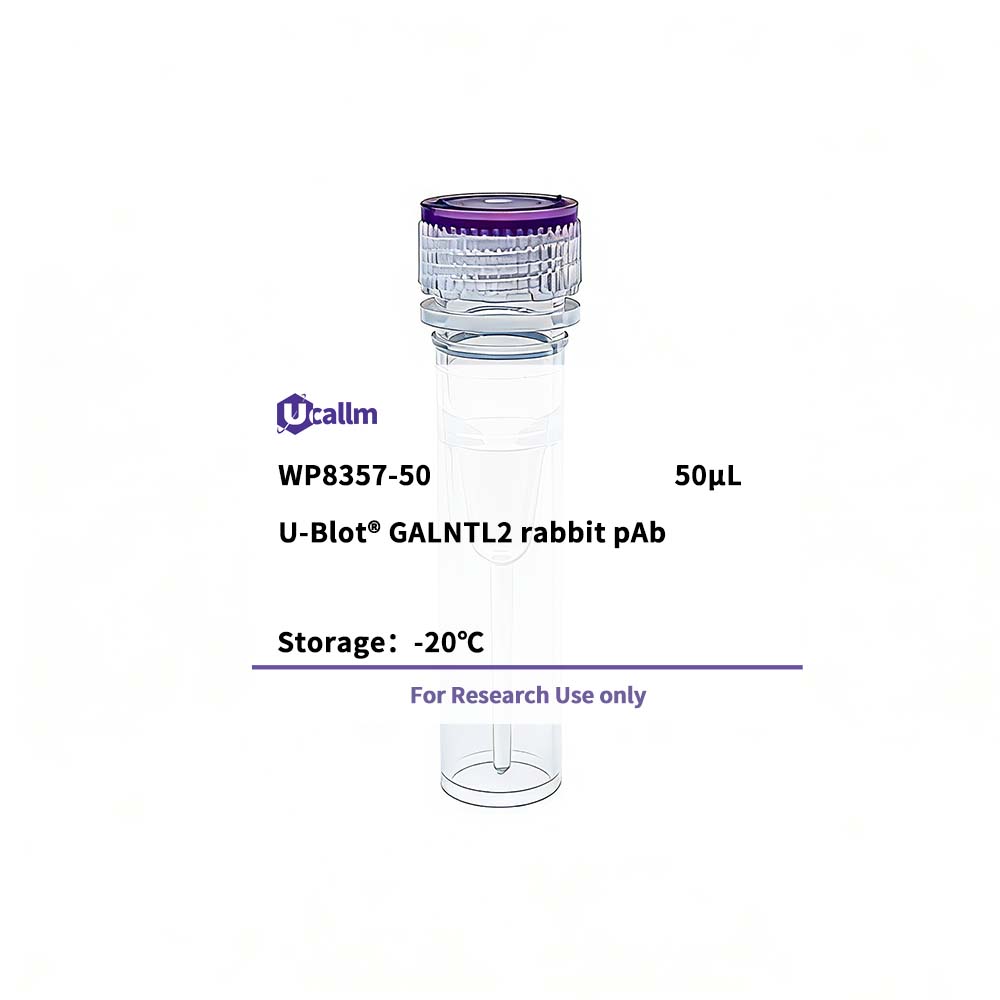
Price range: $268.00 through $328.00
Background:
| Size | 50μL/100μL |
| Target | GALNT15 |
| Reactivity | Human, Mouse |
| Applications | WB |
| MW(Calculated) | 70kD |
| MW(Observed) | |
| Host Species | Rabbit |
| Isotype | IgG |
| Conjugate/Modification | Unmodified |
| Recommended Dilution Ratio | WB 1:500-2000 |
| Formulation | Liquid in PBS containing 50% glycerol, 0.5% BSA and 0.02% sodium azide. |
| Purification | The antibody was affinity-purified from rabbit antiserum by affinity-chromatography using epitope-specific immunogen. |
| Storage | -15°C to -25°C/1 year(Do not lower than -25°C) |
| Concentration | 1 mg/ml |
| Clonality | Polyclonal |
| Clone Number | |
| Immunogen | Synthesized peptide derived from human GALNTL2 |
| Specificity | This antibody detects endogenous levels of GALNTL2 at Human, Mouse |
| Gene Name | GALNTL2 UNQ770/PRO1564 |
| Protein Name | Polypeptide N-acetylgalactosaminyltransferase-like protein 2 (Polypeptide GalNAc transferase-like protein 2) (GalNAc-T-like protein 2) (pp-GaNTase-like protein 2) (Protein-UDP acetylgalactosaminyltransferase-like protein 2) (UDP-GalNAc:polypeptide N-acetylgalactosaminyltransferase-like protein 2) |
| Other Name | |
| Species | Human |
| Gene ID | 117248 |
| Uniprot | Q8N3T1, |
| Species.1 | Mouse |
| Gene ID.1 | 78754 |
| Uniprot.1 | Q9D2N8 |
| Species.2 | |
| Gene ID.2 | |
| Uniprot.2 | |
| Cellular Localization | Golgi apparatus membrane; Single-pass type II membrane protein . |
| Tissue Expression | Widely expressed. Highly expressed in small intestine, placenta, spleen, cerebral cortex and ovary. Expressed at intermediate level in uterus, mammary gland, stomach, cerebellum and whole brain. Weakly expressed in fetal brain, bone marrow, thyroid gland, thymus, heart, skeletal muscle, lung, liver, colon, pancreas, kidney and testis. Not expressed in leukocyte. Expressed in both normal and osteoarthritic cartilage. Expressed at low level in chondrocytes in all zones of both normal and osteoarthritic cartilage. |
| Signaling_pathway | |
| Research Areas | |
| Function | Catalyzes the initial reaction in O-linked oligosaccharide biosynthesis, the transfer of an N-acetyl-D-galactosamine residue to a serine or threonine residue on the protein receptor. Although it displays a much weaker activity toward all substrates tested compared to GALNT2, it is able to transfer up to seven GalNAc residues to the Muc5AC peptide, suggesting that it can fill vicinal Thr/Ser residues in cooperation with other GALNT proteins. Prefers Muc1a as substrate. |