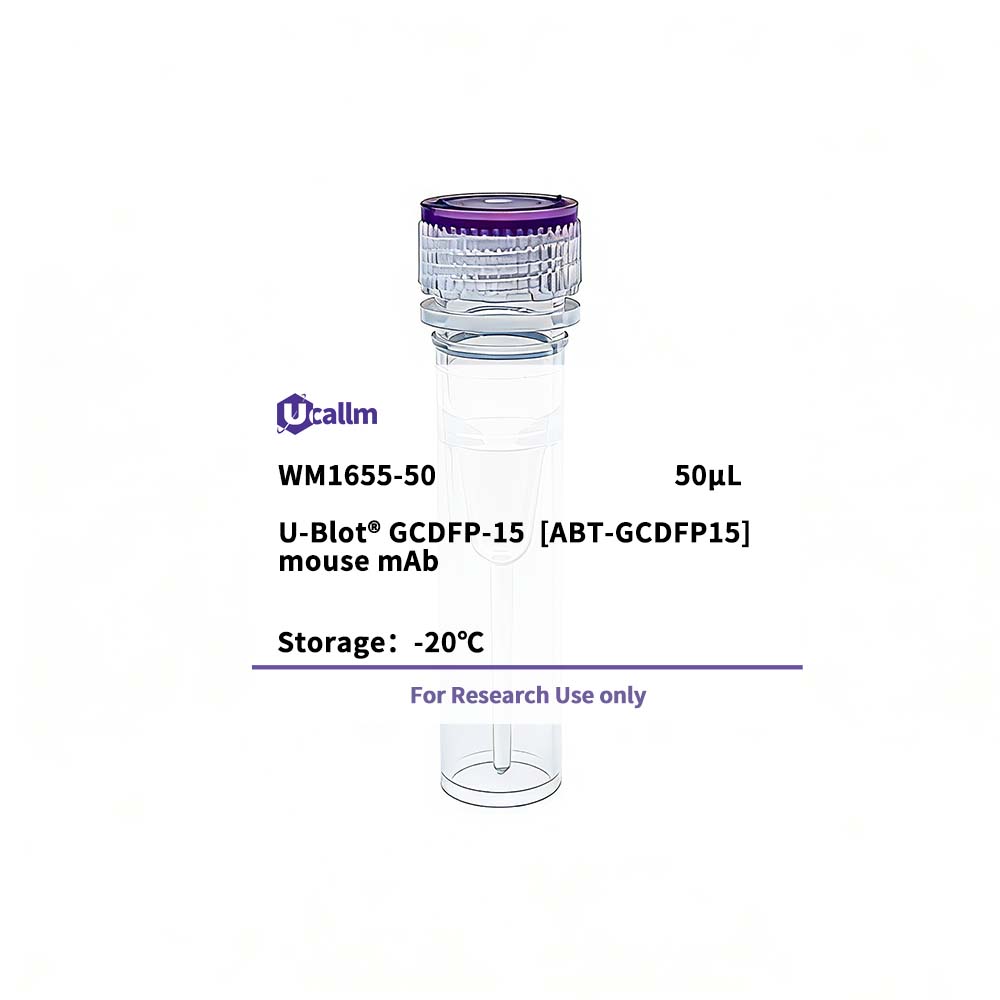
SKU: WM1655 Categories: ,

GCDFP-15 [ABT-GCDFP15] mouse mAb

Price range: $268.00 through $328.00

SKU: WM1655-50
Enter the quantity you would like, or drag the panel to find the quantity and price that best for you
Bulk QuoteAuthorize OEM & ODM

Product details

Background:
induction:By prolactin and androgen; inhibited by estrogen., similarity:Belongs to the PIP family., subunit:Monomer. Interacts with AZGP1., tissue specificity:Expressed in pathological conditions of the mammary gland and in several exocrine tissues, such as the lacrimal, salivary, and sweat glands.,


Specifications

Size50μL/100μL
TargetGCDFP-15
ReactivityHuman
ApplicationsIHC, IF, ELISA
MW(Calculated)17kD
MW(Observed)
Host SpeciesMouse
IsotypeIgG1,Kappa
Conjugate/ModificationUnmodified
Recommended Dilution RatioIHC 1:200-400; IF 1:50-200; ELISA 1:500-5000 / Note: For IHC, we suggest antigen retrieval with TE buffer pH 9.0 (Cat#WT1004)
FormulationPBS, 50% glycerol, 0.05% Proclin 300, 0.05%BSA
PurificationThe antibody was affinity-purified from ascites by affinity-chromatography using specific immunogen.
Storage-15°C to -25°C/1 year(Do not lower than -25°C)
Concentration
ClonalityMonoclonal
Clone NumberRMM-GCDFP15
ImmunogenSynthesized peptide derived from human Gross cystic disease fluid protein-15 (GCDFP-15) AA range: 50-146
SpecificityThe antibody can specifically recognize human GCDFP-15 protein.
Gene NamePIP GCDFP15 GPIP4
Protein NameGross cystic disease fluid protein-15 (GCDFP-15)
Other Name
SpeciesHuman
Gene ID5304
UniprotP12273
Species.1
Gene ID.1
Uniprot.1
Species.2
Gene ID.2
Uniprot.2
Cellular LocalizationCytoplasmic
Tissue ExpressionExpressed in pathological conditions of the mammary gland and in several exocrine tissues, such as the lacrimal, salivary, and sweat glands.
Signaling_pathway
Research Areas
Functioninduction:By prolactin and androgen; inhibited by estrogen.,similarity:Belongs to the PIP family.,subunit:Monomer. Interacts with AZGP1.,tissue specificity:Expressed in pathological conditions of the mammary gland and in several exocrine tissues, such as the lacrimal, salivary, and sweat glands.,
Please login to post questions
Back to Top
Product has been added to your cart