SKU: WP15367 Categories: ,

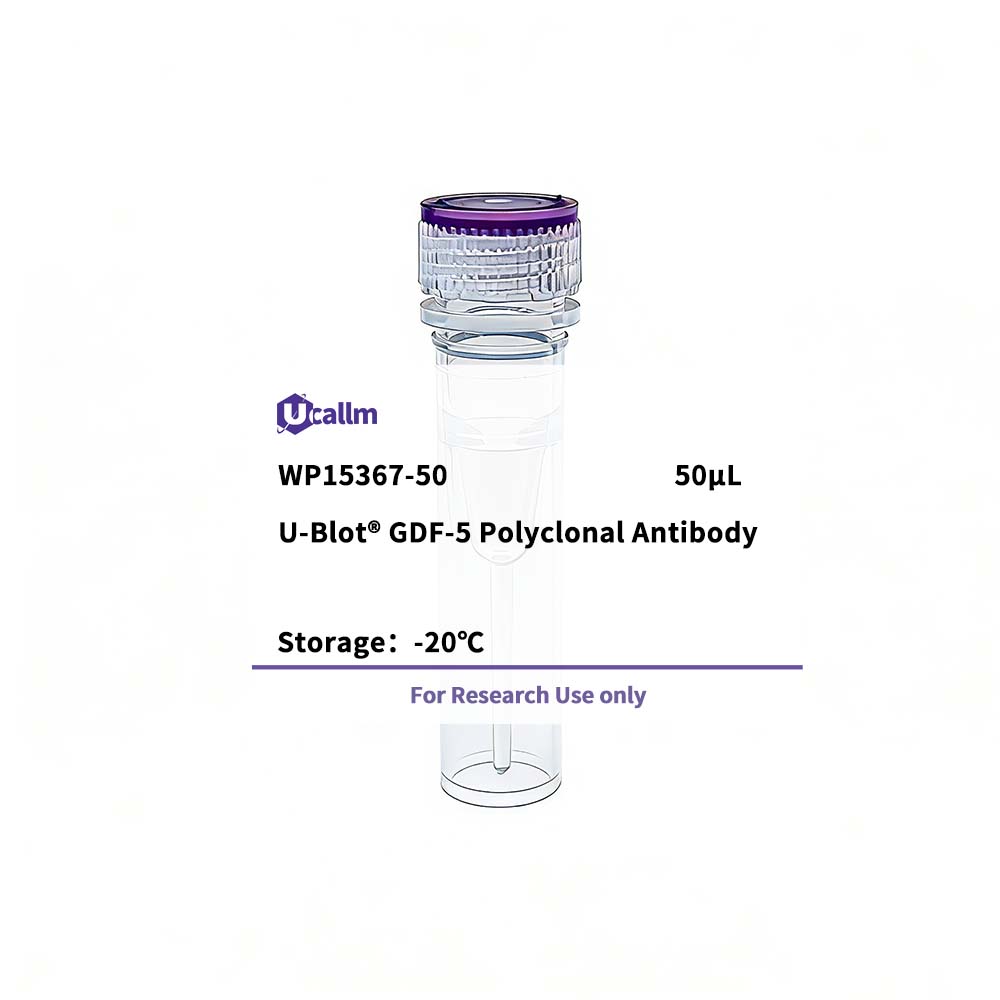
GDF-5 Polyclonal Antibody

Price range: $268.00 through $328.00

SKU: WP15367-100
Enter the quantity you would like, or drag the panel to find the quantity and price that best for you
Bulk QuoteAuthorize OEM & ODM

Product details

Background:

This gene encodes a secreted ligand of the TGF-beta (transforming growth factor-beta) superfamily of proteins. Ligands of this family bind various TGF-beta receptors leading to recruitment and activation of SMAD family transcription factors that regulate gene expression. The encoded preproprotein is proteolytically processed to generate each subunit of the disulfide-linked homodimer. This protein regulates the development of numerous tissue and cell types, including cartilage, joints, brown fat, teeth, and the growth of neuronal axons and dendrites. Mutations in this gene are associated with acromesomelic dysplasia, brachydactyly, chondrodysplasia, multiple synostoses syndrome, proximal symphalangism, and susceptibility to osteoarthritis. [provided by RefSeq, Aug 2016],

Specifications

Size50μL/100μL
TargetGDF-5
ReactivityHuman, Mouse, Rat
ApplicationsWB, IHC, IF, ELISA
MW(Calculated)
MW(Observed)55kD
Host SpeciesRabbit
IsotypeIgG
Conjugate/ModificationUnmodified
Recommended Dilution RatioWB 1:500-1:2000; IHC: 1:100-1:300; ELISA 1:20000; IF 1:50-200 / Note: For IHC, we suggest antigen retrieval with TE buffer pH 9.0 (Cat#WT1004)
FormulationLiquid in PBS containing 50% glycerol, 0.5% BSA and 0.02% sodium azide.
PurificationThe antibody was affinity-purified from rabbit antiserum by affinity-chromatography using epitope-specific immunogen.
Storage-15°C to -25°C/1 year(Do not lower than -25°C)
Concentration1 mg/ml
ClonalityPolyclonal
Clone Number
ImmunogenThe antiserum was produced against synthesized peptide derived from the Internal region of human GDF5. AA range:361-410
SpecificityGDF-5 Polyclonal Antibody detects endogenous levels of GDF-5 protein.
Gene NameGDF5
Protein NameGrowth/differentiation factor 5
Other NameGDF5; / CDMP1; / Growth/differentiation factor 5; / GDF-5; / Cartilage-derived morphogenetic protein 1; / CDMP-1; / Radotermin
SpeciesHuman
Gene ID8200
UniprotP43026,
Species.1Mouse
Gene ID.114563
Uniprot.1P43027
Species.2
Gene ID.2
Uniprot.2
Cellular LocalizationSecreted . Cell membrane .
Tissue ExpressionPredominantly expressed in long bones during embryonic development. Expressed in monocytes (at protein level).
Signaling_pathwayEnvironmental Information Processing >> Signal transduction >> TGF-beta signaling pathway;Environmental Information Processing >> Signal transduction >> Hippo signaling pathway;Environmental Information Processing >> Signaling molecules and interaction >> Cytokine-cytokine receptor interaction
Research Areas>>Cytokine-cytokine receptor interaction; / >>TGF-beta signaling pathway; / >>Hippo signaling pathway
FunctionDisease:Defects in GDF5 are a cause of brachydactyly type A2 (BDA2) [MIM:112600]. Brachydactylies (BDs) are a group of inherited malformations characterized by shortening of the digits due to abnormal development of the phalanges and/or the metacarpals. They have been classified on an anatomic and genetic basis into five groups, A to E, including three subgroups (A1 to A3) that usually manifest as autosomal dominant traits.,Disease:Defects in GDF5 are a cause of symphalangism proximal syndrome (SYM1) [MIM:185800]. SYM1 is characterized by the hereditary absence of the proximal interphalangeal (PIP) joints (Cushing symphalangism). Severity of PIP joint involvement diminishes towards the radial side. Distal interphalangeal joints are less frequently involved and metacarpophalangeal joints are rarely affected whereas carpal bone malformation and fusion are common. In the lower extremities, tarsal bone coalition is common. Conducive hearing loss is seen and is due to fusion of the stapes to the petrous part of the temporal bone.,Disease:Defects in GDF5 are the cause of acromesomelic chondrodysplasia Grebe type (AMDG) [MIM:200700]. Acromesomelic chondrodysplasias are rare hereditary skeletal disorders characterized by short stature, very short limbs, and hand/foot malformations. The severity of limb abnormalities increases from proximal to distal with profoundly affected hands and feet showing brachydactyly and/or rudimentary fingers (knob-like fingers). AMDG is an autosomal recessive form characterized by normal axial skeletons and missing or fused skeletal elements within the hands and feet.,Disease:Defects in GDF5 are the cause of acromesomelic chondrodysplasia Hunter-Thompson type (AMDH) [MIM:201250]. AMDH is an autosomal recessive form of dwarfism. Patients have limb abnormalities, with the middle and distal segments being most affected and the lower limbs more affected than the upper. AMDH is characterized by normal axial skeletons and missing or fused skeletal elements within the hands and feet.,Disease:Defects in GDF5 are the cause of brachydactyly type C (BDC) [MIM:113100]. BDC is an autosomal dominant disorder characterized by an abnormal shortness of the fingers and toes.,Disease:Defects in GDF5 are the cause of Du Pan syndrome [MIM:228900]; also known as fibular hypoplasia and complex brachydactyly. Du Pan syndrome is a rare autosomal recessive condition characterized by absence of the fibulae and severe acromesomelic limb shortening with small, non-functional toes. Although milder, the phenotype resembles the autosomal recessive Hunter-Thompson [MIM:201250] and Grebe types [MIM:200700] of acromesomelic chondrodysplasia.,Disease:Defects in GDF5 are the cause of multiple synostoses syndrome 2 (SYNS2) [MIM:610017]. Multiple synostoses syndrome is an autosomal dominant condition characterized by progressive joint fusions of the fingers, wrists, ankles and cervical spine, characteristic facies and progressive conductive deafness.,Disease:Genetic variations in GDF5 are associated with osteoarthritis susceptibility type 5 (OS5) [MIM:612400]. Osteoarthritis is the most prevalent form of arthritis and a common cause of disability.,Function:Could be involved in bone formation.,online information:GDF5 entry,similarity:Belongs to the TGF-beta family.,subunit:Homodimer; disulfide-linked.,tissue specificity:Predominantly expressed in long bones during embryonic development.,
Please login to post questions
Back to Top
Product has been added to your cart
