

GLUT-1 [ABT-GLUT1] mouse mAb
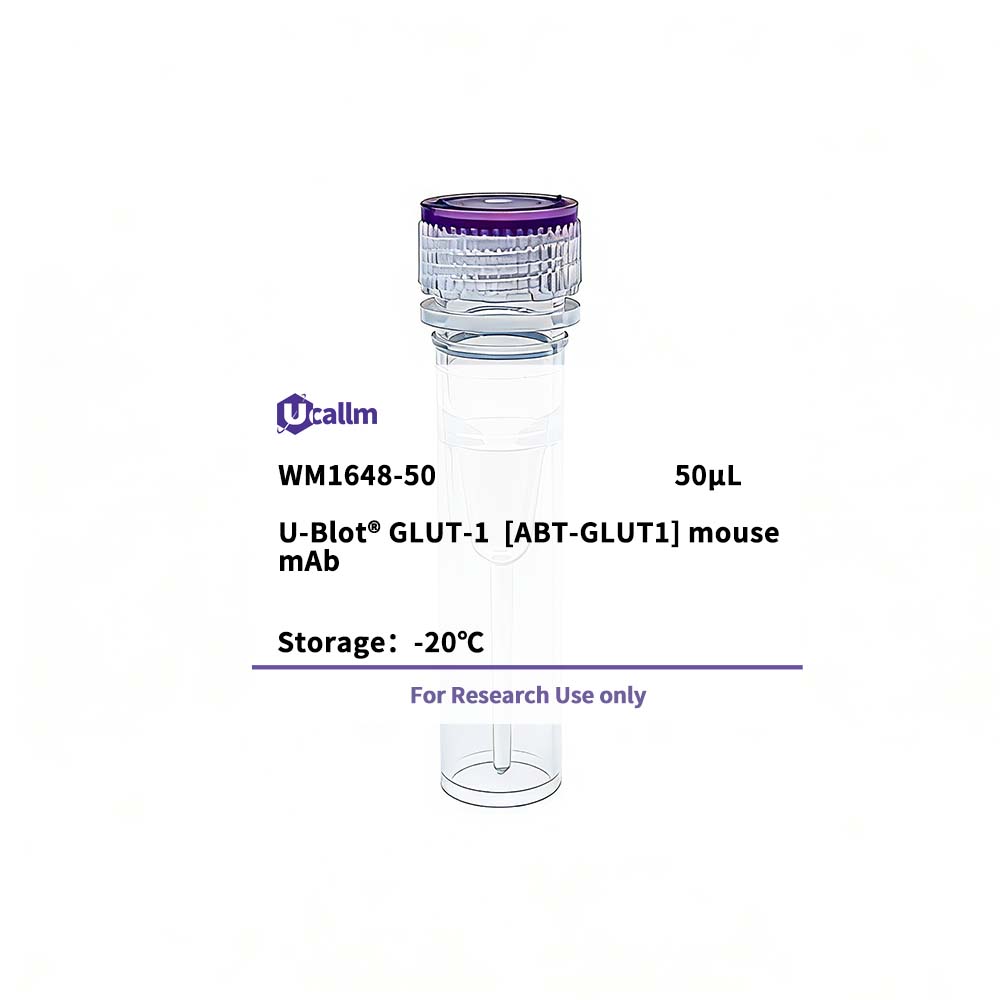
Ucallm_WM1648-50
Price range: $268.00 through $328.00
Product details
Background:
This gene encodes a major glucose transporter in the mammalian blood-brain barrier. The encoded protein is found primarily in the cell membrane and on the cell surface, where it can also function as a receptor for human T-cell leukemia virus (HTLV) I and II. Mutations in this gene have been found in a family with paroxysmal exertion-induced dyskinesia. [provided by RefSeq, Apr 2013],
Specifications
| Size | 50μL/100μL |
| Target | GLUT-1 |
| Reactivity | Human, Mouse, Rat |
| Applications | IHC, IF, ELISA |
| MW(Calculated) | 54kD |
| MW(Observed) | 54kD |
| Host Species | Mouse |
| Isotype | IgG2a,Kappa |
| Conjugate/Modification | Unmodified |
| Recommended Dilution Ratio | IHC 1:200-400; IF 1:50-200; ELISA 1:500-5000 / Note: For IHC, we suggest antigen retrieval with TE buffer pH 9.0 (Cat#WT1004) |
| Formulation | PBS, 50% glycerol, 0.05% Proclin 300, 0.05%BSA |
| Purification | The antibody was affinity-purified from ascites by affinity-chromatography using specific immunogen. |
| Storage | -15°C to -25°C/1 year(Do not lower than -25°C) |
| Concentration | |
| Clonality | Monoclonal |
| Clone Number | RMM-GLUT1 |
| Immunogen | Synthesized peptide derived from human GLUT-1 AA range: 400-492 |
| Specificity | The antibody can specifically recognize human GLUT-1 protein. |
| Gene Name | SLC2A1 GLUT1 |
| Protein Name | Solute carrier family 2, facilitated glucose transporter member 1 (Glucose transporter type 1, erythrocyte/brain) (GLUT-1) (HepG2 glucose transporter) |
| Other Name | |
| Species | Human |
| Gene ID | 6513 |
| Uniprot | P11166 |
| Species.1 | |
| Gene ID.1 | |
| Uniprot.1 | |
| Species.2 | |
| Gene ID.2 | |
| Uniprot.2 | |
| Cellular Localization | Membranous |
| Tissue Expression | Detected in erythrocytes (at protein level). Expressed at variable levels in many human tissues. |
| Signaling_pathway | Organismal Systems >> Endocrine system >> Insulin secretion;Organismal Systems >> Endocrine system >> Glucagon signaling pathway;Organismal Systems >> Endocrine system >> Adipocytokine signaling pathway;Organismal Systems >> Endocrine system >> Thyroid hormone signaling pathway;Human Diseases >> Cancer: overview >> Pathways in cancer;Human Diseases >> Cancer: overview >> Central carbon metabolism in cancer;Human Diseases >> Cancer: specific types >> Renal cell carcinoma;Environmental Information Processing >> Signal transduction >> HIF-1 signaling pathway |
| Research Areas | >>HIF-1 signaling pathway; / >>Insulin secretion; / >>Thyroid hormone signaling pathway; / >>Adipocytokine signaling pathway; / >>Glucagon signaling pathway; / >>Insulin resistance; / >>Bile secretion; / >>Human T-cell leukemia virus 1 infection; / >>Pathways in cancer; / >>Renal cell carcinoma; / >>Central carbon metabolism in cancer; / >>Diabetic cardiomyopathy |
| Function | Disease:Defects in SLC2A1 are the cause of autosomal dominant GLUT1 deficiency syndrome [MIM:606777]; also called blood-brain barrier glucose transport defect. This disease causes a defect in glucose transport across the blood-brain barrier. It is characterized by infantile seizures, delayed development, and acquired microcephaly.,Disease:Defects in SLC2A1 are the cause of dystonia type 18 (DYT18) [MIM:612126]. DYT18 is an exercise-induced paroxysmal dystonia/dyskinesia. Dystonia is defined by the presence of sustained involuntary muscle contraction, often leading to abnormal postures. DYT18 is characterized by attacks of involuntary movements triggered by certain stimuli such as sudden movement or prolonged exercise. In some patients involuntary exertion-induced dystonic, choreoathetotic, and ballistic movements may be associated with macrocytic hemolytic anemia.,Function:Facilitative glucose transporter. This isoform may be responsible for constitutive or basal glucose uptake. Has a very broad substrate specificity; can transport a wide range of aldoses including both pentoses and hexoses.,online information:GLUT1 entry,PTM:Phosphorylated upon DNA damage, probably by ATM or ATR.,similarity:Belongs to the major facilitator superfamily. Sugar transporter (TC 2.A.1.1) family. Glucose transporter subfamily.,subcellular location:Localizes primarily at the cell surface (By similarity). Identified by mass spectrometry in melanosome fractions from stage I to stage IV.,tissue specificity:Expressed at variable levels in many human tissues., |
Please login to post questions
Related products




