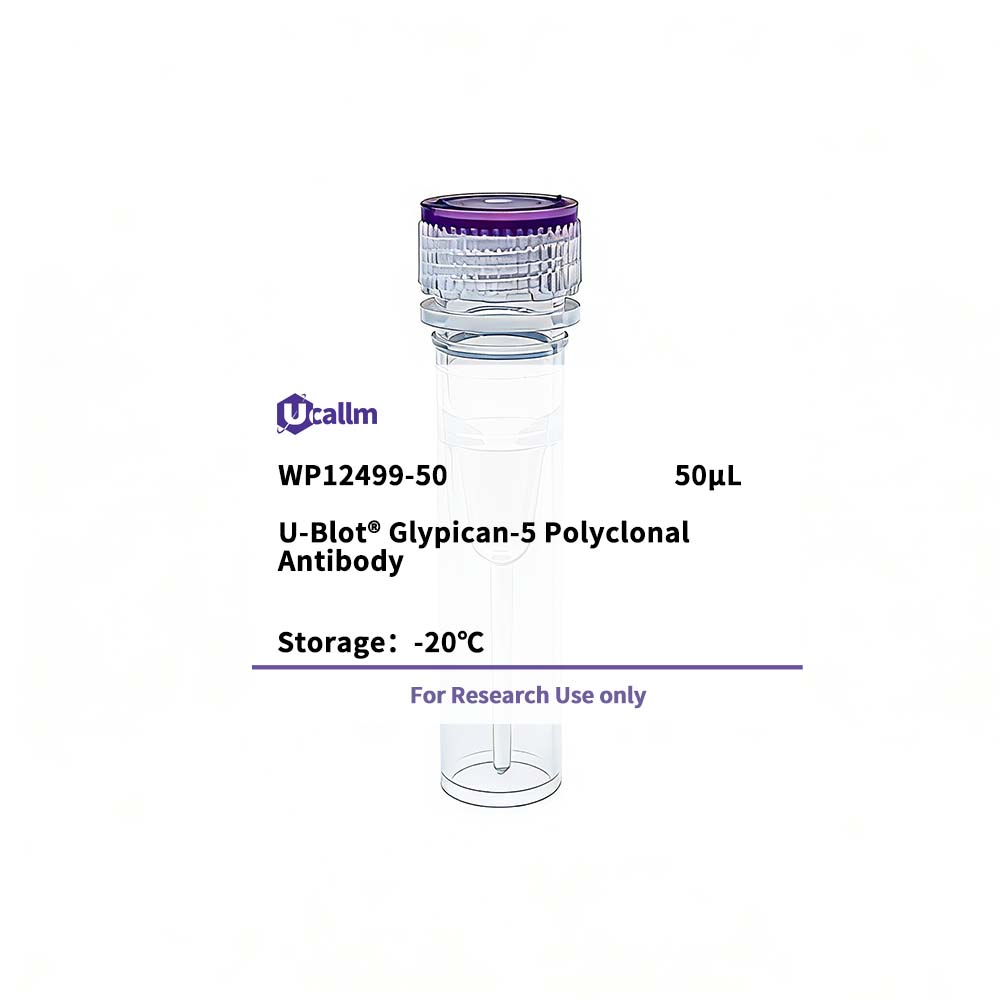
SKU: WP12499 Categories: ,

Glypican-5 Polyclonal Antibody

Price range: $268.00 through $328.00

SKU: WP12499-100
Enter the quantity you would like, or drag the panel to find the quantity and price that best for you
Bulk QuoteAuthorize OEM & ODM

Product details

Background:

Cell surface heparan sulfate proteoglycans are composed of a membrane-associated protein core substituted with a variable number of heparan sulfate chains. Members of the glypican-related integral membrane proteoglycan family (GRIPS) contain a core protein anchored to the cytoplasmic membrane via a glycosyl phosphatidylinositol linkage. These proteins may play a role in the control of cell division and growth regulation. [provided by RefSeq, Jul 2008],

Specifications

Size50μL/100μL
TargetGlypican-5
ReactivityHuman, Mouse, Rat
ApplicationsWB, ELISA
MW(Calculated)
MW(Observed)65kD
Host SpeciesRabbit
IsotypeIgG
Conjugate/ModificationUnmodified
Recommended Dilution RatioWB 1:500-1:2000; ELISA 1:40000; Not yet tested in other applications.
FormulationLiquid in PBS containing 50% glycerol, 0.5% BSA and 0.02% sodium azide.
PurificationThe antibody was affinity-purified from rabbit antiserum by affinity-chromatography using epitope-specific immunogen.
Storage-15°C to -25°C/1 year(Do not lower than -25°C)
Concentration1 mg/ml
ClonalityPolyclonal
Clone Number
ImmunogenSynthesized peptide derived from the Internal region of human Glypican-5.
SpecificityGlypican-5 Polyclonal Antibody detects endogenous levels of Glypican-5 protein.
Gene NameGPC5
Protein NameGlypican-5
Other NameGPC5; / Glypican-5
SpeciesHuman
Gene ID2262
UniprotP78333,
Species.1Mouse
Gene ID.1103978
Uniprot.1Q8CAL5
Species.2
Gene ID.2
Uniprot.2
Cellular LocalizationCell membrane; Lipid-anchor, GPI-anchor; Extracellular side .; [Secreted glypican-5]: Secreted, extracellular space .
Tissue ExpressionIn adult, primarily expressed in the brain. Also detected in fetal brain, lung and liver.
Signaling_pathway
Research Areas
FunctionFunction:Cell surface proteoglycan that bears heparan sulfate.,similarity:Belongs to the glypican family.,tissue specificity:In adult, primarily expressed in the brain. Also detected in fetal brain, lung and liver.,
Please login to post questions
Back to Top
Product has been added to your cart

