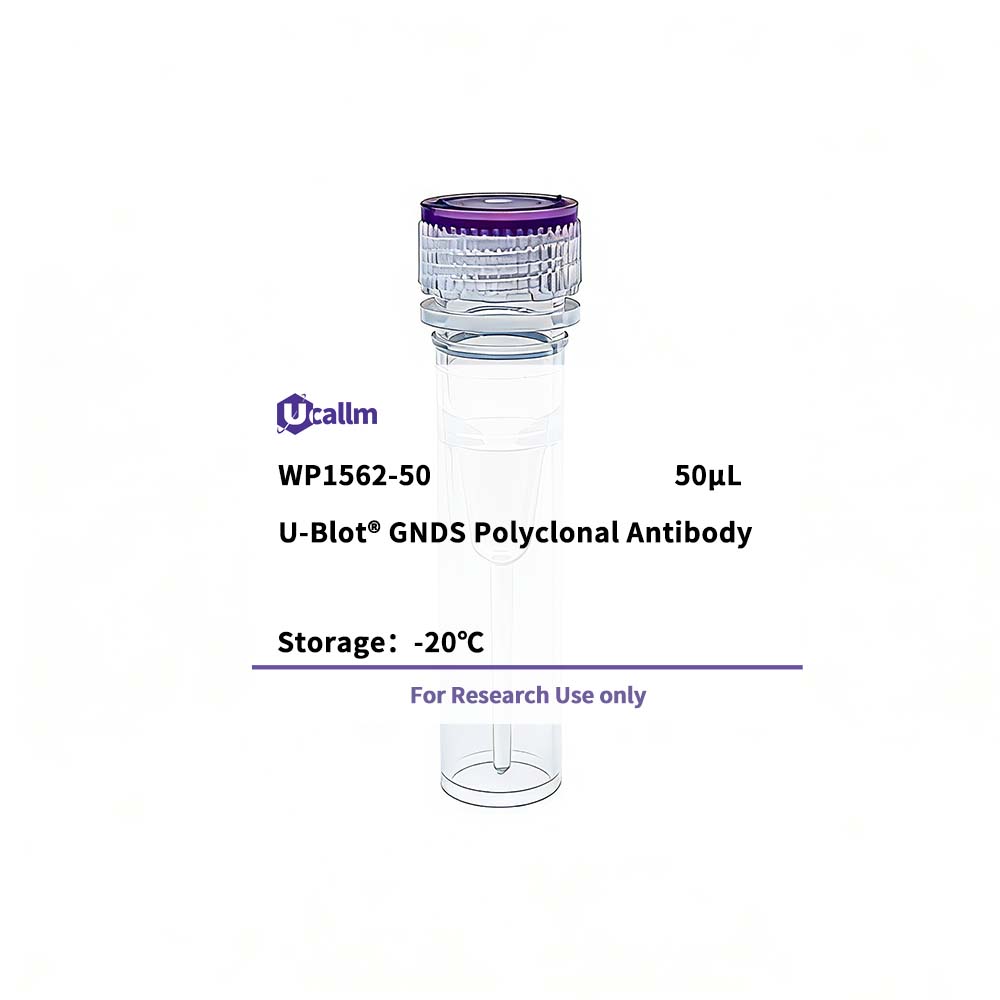
SKU: WP1562 Categories: ,

GNDS Polyclonal Antibody

Price range: $268.00 through $328.00

SKU: WP1562-100
Enter the quantity you would like, or drag the panel to find the quantity and price that best for you
Bulk QuoteAuthorize OEM & ODM

Product details

Background:

Guanine nucleotide dissociation stimulators (GDSs, or exchange factors), such as RALGDS, are effectors of Ras-related GTPases (see MIM 190020) that participate in signaling for a variety of cellular processes.[supplied by OMIM, Nov 2010],

Specifications

Size50μL/100μL
TargetGNDS
ReactivityHuman, Mouse, Rat
ApplicationsWB, ELISA
MW(Calculated)
MW(Observed)100kD
Host SpeciesRabbit
IsotypeIgG
Conjugate/ModificationUnmodified
Recommended Dilution RatioWB 1:500-2000; ELISA 1:5000-20000
FormulationLiquid in PBS containing 50% glycerol,0.5% BSA and 0.02% sodium azide.
PurificationThe antibody was affinity-purified from rabbit antiserum by affinity-chromatography using epitope-specific immunogen.
Storage-15°C to -25°C/1 year(Do not lower than -25°C)
Concentration1 mg/ml
ClonalityPolyclonal
Clone Number
ImmunogenSynthesized peptide derived from human protein . at AA range: 130-210
SpecificityGNDS Polyclonal Antibody detects endogenous levels of protein.
Gene NameRALGDS KIAA1308 RGF
Protein NameRal guanine nucleotide dissociation stimulator (RalGDS) (Ral guanine nucleotide exchange factor) (RalGEF)
Other Name
SpeciesHuman
Gene ID5900
UniprotQ12967,
Species.1Mouse
Gene ID.1
Uniprot.1Q03385,
Species.2Rat
Gene ID.2
Uniprot.2Q03386
Cellular LocalizationCytoplasm . Nucleus . Localizes mainly in the peripheral region of the cytoplasmic membrane in oocytes and in preimplantation embryos until the 8-cell stage. Between the late 1-cell and the early 2-cell stages, nuclear localization becomes stronger. After the 4-cell stage, not detected in the nucleus. .
Tissue ExpressionBrain,Epithelium,Placenta,Primary B-Cells,Spleen,Thalamus,
Signaling_pathwayHuman Diseases >> Cancer: overview >> Pathways in cancer;Human Diseases >> Cancer: specific types >> Colorectal cancer;Human Diseases >> Cancer: specific types >> Pancreatic cancer;Environmental Information Processing >> Signal transduction >> Ras signaling pathway;Environmental Information Processing >> Signal transduction >> Rap1 signaling pathway;Environmental Information Processing >> Signal transduction >> Phospholipase D signaling pathway
Research Areas>>Ras signaling pathway; / >>Rap1 signaling pathway; / >>Phospholipase D signaling pathway; / >>Pathways in cancer; / >>Colorectal cancer; / >>Pancreatic cancer; / >>Choline metabolism in cancer
FunctionDomain:The Ras-associating domain interacts with Ras.,Function:Stimulates the dissociation of GDP from the Ras-related RalA and RalB GTPases which allows GTP binding and activation of the GTPases. Interacts and acts as an effector molecule for R-Ras, H-Ras, K-Ras, and Rap.,similarity:Contains 1 N-terminal Ras-GEF domain.,similarity:Contains 1 Ras-associating domain.,similarity:Contains 1 Ras-GEF domain.,subunit:Interacts with RIT1 and RIT2.,
Please login to post questions
Back to Top
Product has been added to your cart
