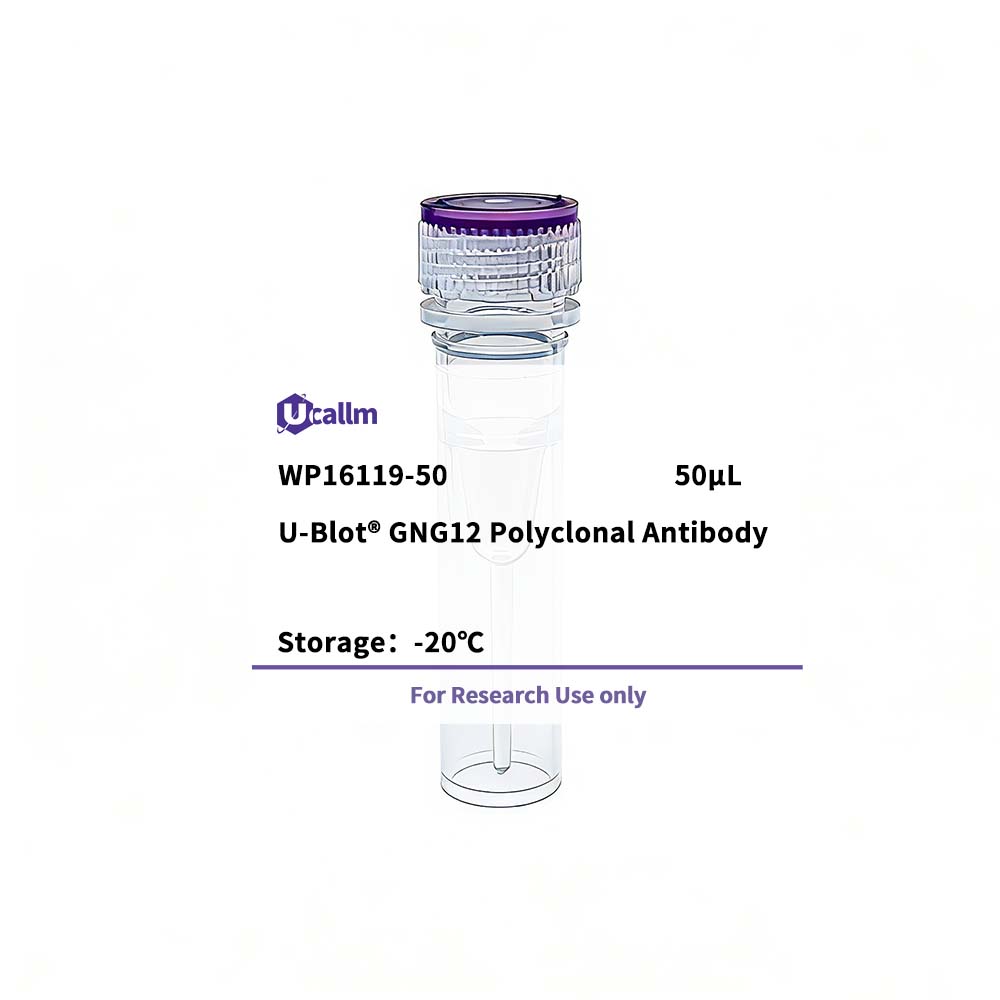
SKU: WP16119 Categories: ,

GNG12 Polyclonal Antibody

Price range: $268.00 through $328.00

SKU: WP16119-100
Enter the quantity you would like, or drag the panel to find the quantity and price that best for you
Bulk QuoteAuthorize OEM & ODM

Product details

Background:

function:Guanine nucleotide-binding proteins (G proteins) are involved as a modulator or transducer in various transmembrane signaling systems. The beta and gamma chains are required for the GTPase activity, for replacement of GDP by GTP, and for G protein-effector interaction., similarity:Belongs to the G protein gamma family., subunit:G proteins are composed of 3 units, alpha, beta and gamma.,


Specifications

Size50μL/100μL
TargetGNG12
ReactivityHuman, Mouse
ApplicationsIHC, ELISA
MW(Calculated)8kD
MW(Observed)
Host SpeciesRabbit
IsotypeIgG
Conjugate/ModificationUnmodified
Recommended Dilution RatioIHC 1:50-200; ELISA(peptide)1:5000-20000 / Note: For IHC, we suggest antigen retrieval with TE buffer pH 9.0 (Cat#WT1004)
FormulationLiquid in PBS containing 50% glycerol, 0.5% BSA and 0.02% sodium azide.
PurificationThe antibody was affinity-purified from rabbit antiserum by affinity-chromatography using epitope-specific immunogen.
Storage-15°C to -25°C/1 year(Do not lower than -25°C)
Concentration1 mg/ml
ClonalityPolyclonal
Clone Number
ImmunogenSynthesized peptide derived from human GNG12 AA range: 1-50
SpecificityThis antibody detects endogenous levels of human GNG12
Gene NameGNG12
Protein NameGNG12
Other NameGuanine nucleotide-binding protein G; / I; / /G; / S; / /G; / O; / subunit gamma-12
SpeciesHuman
Gene ID55970
UniprotQ9UBI6
Species.1
Gene ID.1
Uniprot.1
Species.2
Gene ID.2
Uniprot.2
Cellular LocalizationCell membrane; Lipid-anchor; Cytoplasmic side .
Tissue ExpressionAdrenal gland,Brain,Epithelium,Human small intestine,Melanoma,Uterus,
Signaling_pathwayCellular Processes >> Cell motility >> Regulation of actin cytoskeleton;Organismal Systems >> Immune system >> Chemokine signaling pathway;Organismal Systems >> Endocrine system >> Relaxin signaling pathway;Organismal Systems >> Nervous system >> Glutamatergic synapse;Organismal Systems >> Nervous system >> Cholinergic synapse;Organismal Systems >> Nervous system >> Dopaminergic synapse;Human Diseases >> Cancer: overview >> Pathways in cancer;Environmental Information Processing >> Signal transduction >> MAPK signaling pathway;Environmental Information Processing >> Signal transduction >> Ras signaling pathway;Environmental Information Processing >> Signal transduction >> Apelin signaling pathway;Environmental Information Processing >> Signal transduction >> PI3K-Akt signaling pathway
Research Areas>>MAPK signaling pathway; / >>Ras signaling pathway; / >>Chemokine signaling pathway; / >>PI3K-Akt signaling pathway; / >>Apelin signaling pathway; / >>Circadian entrainment; / >>Retrograde endocannabinoid signaling; / >>Glutamatergic synapse; / >>Cholinergic synapse; / >>Serotonergic synapse; / >>GABAergic synapse; / >>Dopaminergic synapse; / >>Regulation of actin cytoskeleton; / >>Relaxin signaling pathway; / >>Morphine addiction; / >>Alcoholism; / >>Human cytomegalovirus infection; / >>Kaposi sarcoma-associated herpesvirus infection; / >>Human immunodeficiency virus 1 infection; / >>Pathways in cancer
FunctionFunction:Guanine nucleotide-binding proteins (G proteins) are involved as a modulator or transducer in various transmembrane signaling systems. The beta and gamma chains are required for the GTPase activity, for replacement of GDP by GTP, and for G protein-effector interaction.,similarity:Belongs to the G protein gamma family.,subunit:G proteins are composed of 3 units, alpha, beta and gamma.,

Please login to post questions
Back to Top
Product has been added to your cart
