

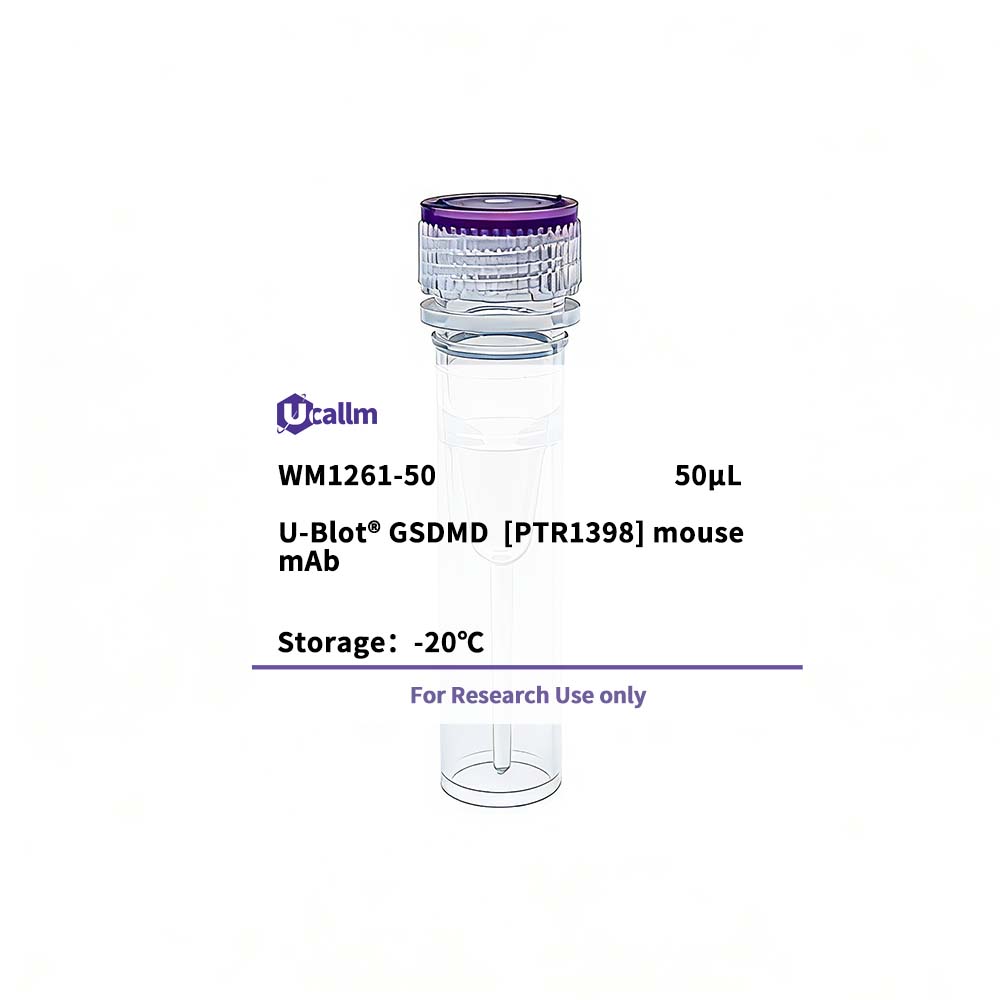
Specifications
| Size | 50μL/100μL |
| Target | GSDMD |
| Reactivity | Human, Mouse, Rat |
| Applications | WB, IF, ELISA |
| MW(Calculated) | 53kD,31kD |
| MW(Observed) | 53kD,31kD |
| Host Species | Mouse |
| Isotype | IgG1,kappa |
| Conjugate/Modification | Unmodified |
| Recommended Dilution Ratio | WB 1:500-2000; IF 1:100-500; ELISA 1:1000-5000; |
| Formulation | PBS, 50% glycerol, 0.05% Proclin 300, 0.05%BSA |
| Purification | The antibody was affinity-purified from ascites by affinity-chromatography using specific immunogen. |
| Storage | -15°C to -25°C/1 year(Do not lower than -25°C) |
| Concentration | |
| Clonality | Monoclonal |
| Clone Number | RMMR1398 |
| Immunogen | AA range: 1-100 |
| Specificity | This antibody detects endogenous levels of GSDMD protein. |
| Gene Name | GSDMD |
| Protein Name | Gasdermin domain-containing protein 1,Gasdermin-D,GSDMD,GSDMD-CT,GSDMD-NT,GSDMD_HUMAN |
| Other Name | |
| Species | Human |
| Gene ID | |
| Uniprot | P57764 |
| Species.1 | |
| Gene ID.1 | |
| Uniprot.1 | |
| Species.2 | |
| Gene ID.2 | |
| Uniprot.2 | |
| Cellular Localization | Cytoplasm |
| Tissue Expression | Expressed in the suprabasal cells of esophagus, as well as in the isthmus/neck, pit, and gland of the stomach, suggesting preferential expression in differentiating cells. |
| Signaling_pathway | |
| Research Areas | >>Neutrophil extracellular trap formation; / >>NOD-like receptor signaling pathway; / >>Salmonella infection |
| Function | Cleavage at Asp-275 by CASP1 (mature and uncleaved precursor forms), CASP4, CASP5 or CASP8 relieves autoinhibition and is sufficient to initiate pyroptosis (PubMed:26375003, PubMed:29898893, PubMed:32109412). Cleavage by CASP1 and CASP4 is not strictly dependent on the consensus cleavage site on GSDMD but depends on an exosite interface on CASP1 that recognizes and binds the Gasdermin-D, C-terminal (GSDMD-CT) part (PubMed:32109412). Cleavage by CASP8 takes place following inactivation of MAP3K7/TAK1 by Yersinia toxin YopJ (By similarity). Cleavage at Asp-87 by CASP3 or CAPS7 inactivates the ability to mediate pyroptosis (PubMed:28392147, PubMed:28045099). |





