



H-FABP mouse mAb
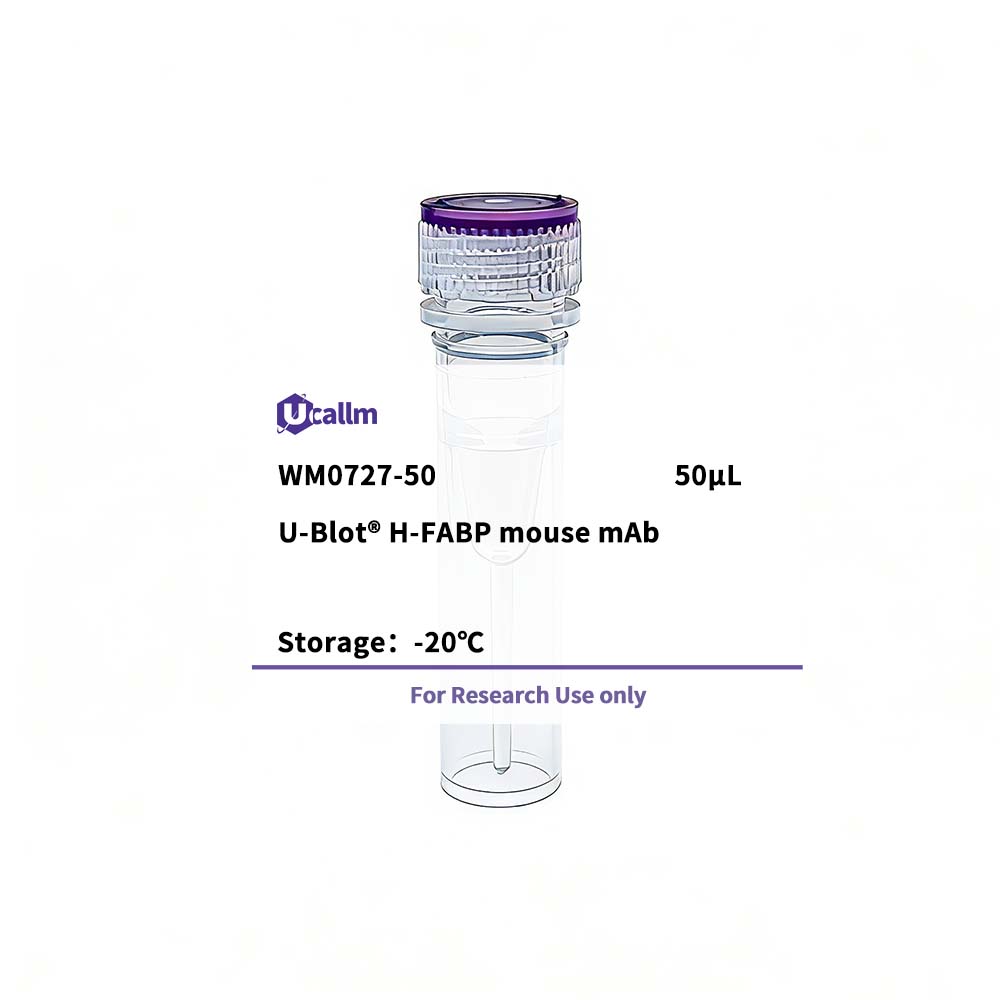
Ucallm_WM0727-50
Price range: $268.00 through $328.00
Product details
Background:
The intracellular fatty acid-binding proteins (FABPs) belongs to a multigene family. FABPs are divided into at least three distinct types, namely the hepatic-, intestinal- and cardiac-type. They form 14-15 kDa proteins and are thought to participate in the uptake, intracellular metabolism and/or transport of long-chain fatty acids. They may also be responsible in the modulation of cell growth and proliferation. Fatty acid-binding protein 3 gene contains four exons and its function is to arrest growth of mammary epithelial cells. This gene is a candidate tumor suppressor gene for human breast cancer. Alternative splicing results in multiple transcript variants. [provided by RefSeq, Mar 2016],
Specifications
| Size | 50μL/100μL |
| Target | H-FABP |
| Reactivity | Human(predicted:Mouse |
| Applications | sELISA, Detector |
| MW(Calculated) | |
| MW(Observed) | |
| Host Species | Mouse |
| Isotype | |
| Conjugate/Modification | Unmodified |
| Recommended Dilution Ratio | ELISA 1:10000-20000 |
| Formulation | Liquid in PBS containing 50% glycerol, 0.5% BSA and 0.02% sodium azide. |
| Purification | The antibody was affinity-purified from mouse ascites by affinity-chromatography using epitope-specific immunogen. |
| Storage | -15°C to -25°C/1 year(Do not lower than -25°C) |
| Concentration | |
| Clonality | Monoclonal |
| Clone Number | 14F9 |
| Immunogen | Purified recombinant H-FABP protein expressed in E.coli |
| Specificity | |
| Gene Name | fabp3 |
| Protein Name | |
| Other Name | 422 protein; / Cardiac Fatty Acid Binding Protein; / FABP 11; / FABP 3; / FABP11; / FABP3; / FABPH_HUMAN; / fatty acid binding protein 11; / Fatty acid binding protein 3; / Fatty acid binding protein 3 muscle and heart; / Fatty acid binding protein 3 muscle and heart mammary derived growth inhibitor; / Fatty acid binding protein 3 muscle; / Fatty acid binding protein 3, muscle and heart; / mammary derived growth inhibitor; / Fatty acid binding protein 3, muscle; / Fatty acid binding protein heart; / Fatty acid binding protein, heart; / Fatty acid binding protein, muscle and heart; / Fatty acid binding protein, skeletal muscle; / Fatty acid-binding protein 3; / Fatty acid-binding protein; / H FABP; / H-FABP; / heart; / Heart type fatty acid binding protein; / Heart-type fatty acid-binding protein; / M FABP; / M-FABP; / mammary derived growth inhibitor; / Mammary-derived growth inhibitor; / MDGI; / Muscle fatty acid binding protein; / Muscle fatty acid-binding protein; / mylein protein P2 homolog; / O FABP; / OTTHUMP00000003898; / P2 adopocyte protein. |
| Species | Human |
| Gene ID | 2170 |
| Uniprot | P05413, |
| Species.1 | Mouse |
| Gene ID.1 | |
| Uniprot.1 | P11404 |
| Species.2 | |
| Gene ID.2 | |
| Uniprot.2 | |
| Cellular Localization | Cytoplasm. |
| Tissue Expression | Fetal brain cortex,Heart,Liver,Mammary gland,Skeletal muscle, |
| Signaling_pathway | Organismal Systems >> Endocrine system >> PPAR signaling pathway |
| Research Areas | >>PPAR signaling pathway |
| Function | Domain:Forms a beta-barrel structure that accommodates the hydrophobic ligand in its interior.,Function:FABP are thought to play a role in the intracellular transport of long-chain fatty acids and their acyl-CoA esters.,similarity:Belongs to the calycin superfamily. Fatty-acid binding protein (FABP) family., |
Please login to post questions
Related products





