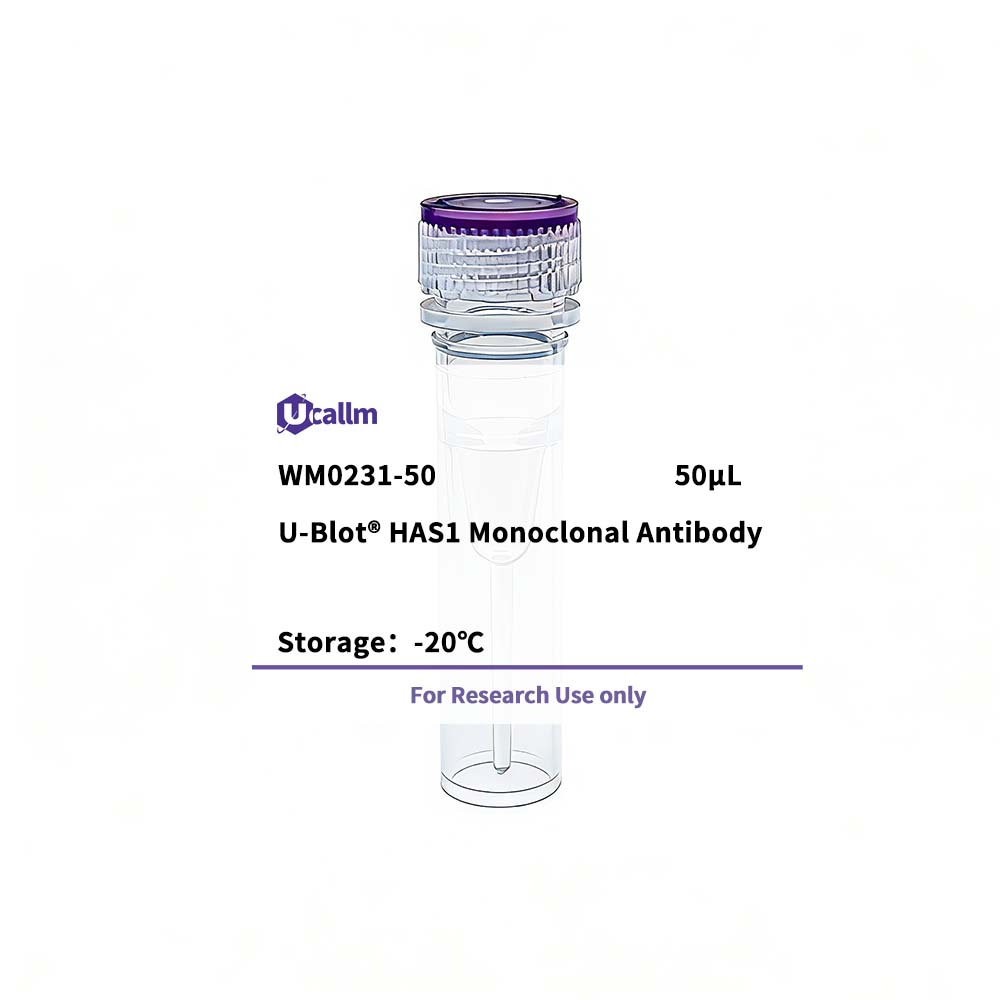
SKU: WM0231 Categories: ,

HAS1 Monoclonal Antibody

Price range: $268.00 through $328.00

SKU: WM0231-50
Enter the quantity you would like, or drag the panel to find the quantity and price that best for you
Bulk QuoteAuthorize OEM & ODM

Product details

Background:
Hyaluronan or hyaluronic acid (HA) is a high molecular weight unbranched polysaccharide synthesized by a wide variety of organisms from bacteria to mammals, and is a constituent of the extracellular matrix. It consists of alternating glucuronic acid and N-acetylglucosamine residues that are linked by beta-1-3 and beta-1-4 glycosidic bonds. HA is synthesized by membrane-bound synthase at the inner surface of the plasma membrane, and the chains are extruded through pore-like structures into the extracellular space. It serves a variety of functions, including space filling, lubrication of joints, and provision of a matrix through which cells can migrate. HA is actively produced during wound healing and tissue repair to provide a framework for ingrowth of blood vessels and fibroblasts. Changes in the serum concentration of HA are associated with inflammatory and degenerative arthropathies such as rheuma

Specifications

Size50μL/100μL
TargetHAS1
ReactivityHuman
ApplicationsWB, IF, ELISA
MW(Calculated)65kD
MW(Observed)
Host SpeciesMouse
Isotype
Conjugate/ModificationUnmodified
Recommended Dilution RatioWB 1:500-1:2000; IF 1:200-1:1000; ELISA 1:10000; Not yet tested in other applications.
FormulationLiquid in PBS containing 50% glycerol, 0.5% BSA and 0.02% sodium azide.
PurificationAffinity purification
Storage-15°C to -25°C/1 year(Do not lower than -25°C)
Concentration
ClonalityMonoclonal
Clone Number6H5
ImmunogenPurified recombinant fragment of human HAS1 expressed in E. Coli.
SpecificityHAS1 Monoclonal Antibody detects endogenous levels of HAS1 protein.
Gene NameHAS1
Protein NameHyaluronan synthase 1
Other Name
SpeciesHuman
Gene ID3036
UniprotQ8IYH3
Species.1
Gene ID.1
Uniprot.1
Species.2
Gene ID.2
Uniprot.2
Cellular Localizationcytoplasm,plasma membrane,integral component of plasma membrane,integral component of membrane,
Tissue ExpressionFetal brain,Lymph node,Ovary,
Signaling_pathway
Research Areas
FunctionCatalytic activity:UDP-alpha-D-glucuronate + N-acetyl-beta-D-glucosaminyl-(1->4)-beta-D-glucuronosyl-(1->3)-(nascent hyaluronan) = UDP + beta-D-glucuronosyl-(1->3)-N-acetyl-beta-D-glucosaminyl-(1->4)-beta-D-glucuronosyl-(1->3)-(nascent hyaluronan).,Catalytic activity:UDP-alpha-N-acetyl-D-glucosamine + beta-D-glucuronosyl-(1->3)-N-acetyl-beta-D-glucosaminyl-(1->4)-(nascent hyaluronan) = UDP + N-acetyl-beta-D-glucosaminyl-(1->4)-beta-D-glucuronosyl-(1->3)-N-acetyl-beta-D-glucosaminyl-(1->4)-(nascent hyaluronan).,cofactor:Magnesium.,Function:Plays a role in hyaluronan/hyaluronic acid (HA) synthesis. Also able to catalyze the synthesis of chito-oligosaccharide depending on the substrate.,online information:GlycoGene database,pathway:Glycan biosynthesis; hyaluronan biosynthesis.,similarity:Belongs to the nodC/HAS family.,tissue specificity:Highly expressed in ovary followed by spleen, thymus, prostate, testes and large intestine. Weakly expressed in small intestine.,
Please login to post questions
Back to Top
Product has been added to your cart
