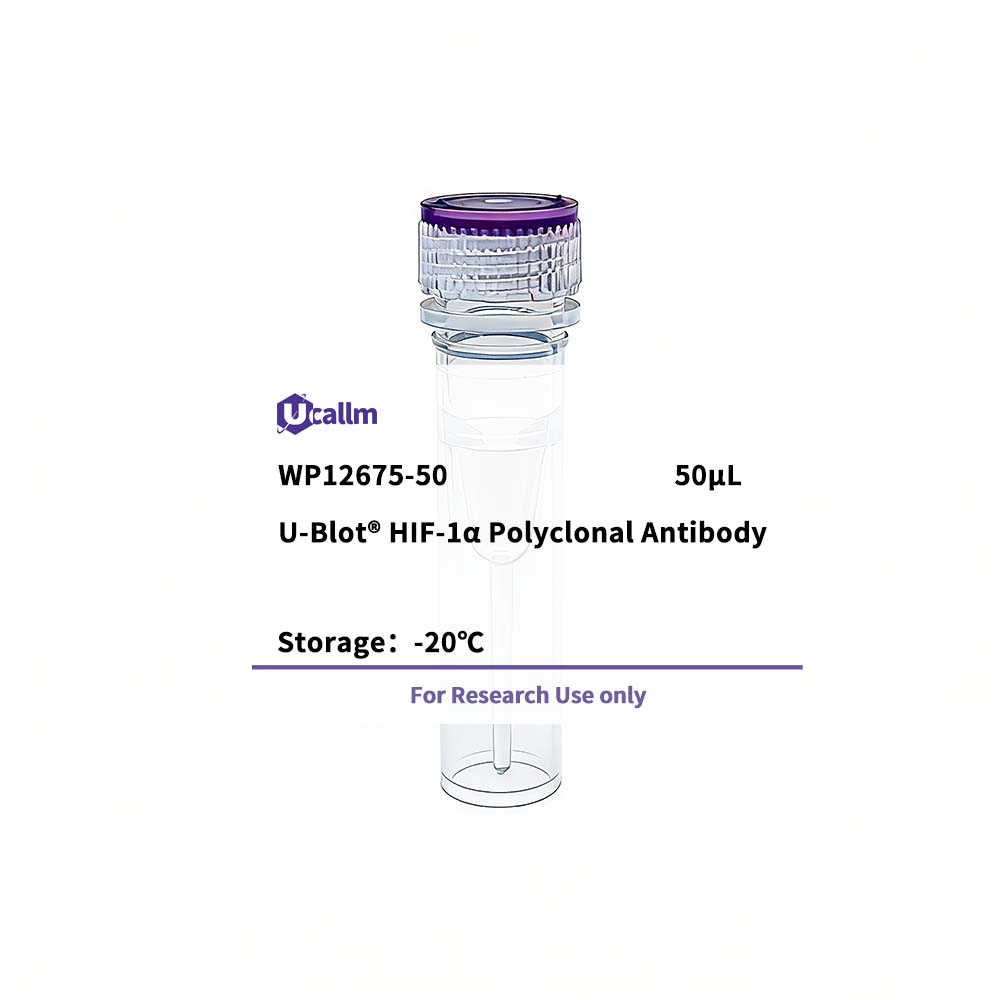
SKU: WP12675 Categories: ,

HIF-1α Polyclonal Antibody

Price range: $268.00 through $328.00

SKU: WP12675-100
Enter the quantity you would like, or drag the panel to find the quantity and price that best for you
Bulk QuoteAuthorize OEM & ODM

Product details

Background:

hypoxia inducible factor 1 alpha subunit(HIF1A) Homo sapiens This gene encodes the alpha subunit of transcription factor hypoxia-inducible factor-1 (HIF-1), which is a heterodimer composed of an alpha and a beta subunit. HIF-1 functions as a master regulator of cellular and systemic homeostatic response to hypoxia by activating transcription of many genes, including those involved in energy metabolism, angiogenesis, apoptosis, and other genes whose protein products increase oxygen delivery or facilitate metabolic adaptation to hypoxia. HIF-1 thus plays an essential role in embryonic vascularization, tumor angiogenesis and pathophysiology of ischemic disease. Alternatively spliced transcript variants encoding different isoforms have been identified for this gene. [provided by RefSeq, Jul 2011],

Specifications

Size50μL/100μL
TargetHIF-1α
ReactivityHuman, Mouse, Rat
ApplicationsIF, WB, IHC, IP, ELISA
MW(Calculated)
MW(Observed)92-130kD
Host SpeciesRabbit
IsotypeIgG
Conjugate/ModificationUnmodified
Recommended Dilution RatioIF 1:50-200; WB 1:500-1:2000; IP 1:200; IHC 1:100-1:300; ELISA 1:40000; Not yet tested in other applications; / Note: For IHC, we suggest antigen retrieval with TE buffer pH 9.0 (Cat#WT1004)
FormulationLiquid in PBS containing 50% glycerol, 0.5% BSA and 0.02% sodium azide.
PurificationThe antibody was affinity-purified from rabbit antiserum by affinity-chromatography using epitope-specific immunogen.
Storage-15°C to -25°C/1 year(Do not lower than -25°C)
Concentration1 mg/ml
ClonalityPolyclonal
Clone Number
ImmunogenThe antiserum was produced against synthesized peptide derived from human HIF-1alpha. AA range:328-377
SpecificityHIF-1α Polyclonal Antibody detects endogenous levels of HIF-1α protein.
Gene NameHIF1A
Protein NameHypoxia-inducible factor 1-alpha
Other NameHIF1A; / BHLHE78; / MOP1; / PASD8; / Hypoxia-inducible factor 1-alpha; / HIF-1-alpha; / HIF1-alpha; / ARNT-interacting protein; / Basic-helix-loop-helix-PAS protein MOP1; / Class E basic helix-loop-helix protein 78; / bHLHe78; / Member of PAS protein 1; / PAS doma
SpeciesHuman
Gene ID3091
UniprotQ16665,
Species.1Mouse
Gene ID.115251
Uniprot.1Q61221,
Species.2Rat
Gene ID.229560
Uniprot.2O35800
Cellular LocalizationCytoplasm . Nucleus . Nucleus speckle . Colocalizes with HIF3A in the nucleus and speckles (By similarity). Cytoplasmic in normoxia, nuclear translocation in response to hypoxia (PubMed:9822602). .
Tissue ExpressionExpressed in most tissues with highest levels in kidney and heart. Overexpressed in the majority of common human cancers and their metastases, due to the presence of intratumoral hypoxia and as a result of mutations in genes encoding oncoproteins and tumor suppressors. A higher level expression seen in pituitary tumors as compared to the pituitary gland.
Signaling_pathwayCellular Processes >> Transport and catabolism >> Autophagy - animal;Cellular Processes >> Transport and catabolism >> Mitophagy - animal;Organismal Systems >> Immune system >> Th17 cell differentiation;Organismal Systems >> Endocrine system >> Thyroid hormone signaling pathway;Human Diseases >> Cancer: overview >> Pathways in cancer;Human Diseases >> Cancer: overview >> Central carbon metabolism in cancer;Human Diseases >> Cancer: overview >> PD-L1 expression and PD-1 checkpoint pathway in cancer;Human Diseases >> Cancer: specific types >> Renal cell carcinoma;Environmental Information Processing >> Signal transduction >> HIF-1 signaling pathway
Research Areas>>HIF-1 signaling pathway; / >>Mitophagy - animal; / >>Autophagy - animal; / >>Th17 cell differentiation; / >>Thyroid hormone signaling pathway; / >>Kaposi sarcoma-associated herpesvirus infection; / >>Pathways in cancer; / >>Proteoglycans in cancer; / >>Chemical carcinogenesis - reactive oxygen species; / >>Renal cell carcinoma; / >>Central carbon metabolism in cancer; / >>Choline metabolism in cancer; / >>PD-L1 expression and PD-1 checkpoint pathway in cancer
FunctionDomain:Contains two independent C-terminal transactivation domains, NTAD and CTAD, which function synergistically. Their transcriptional activity is repressed by an intervening inhibitory domain (ID).,Function:Functions as a master transcriptional regulator of the adaptive response to hypoxia. Under hypoxic conditions activates the transcription of over 40 genes, including, erythropoietin, glucose transporters, glycolytic enzymes, vascular endothelial growth factor, and other genes whose protein products increase oxygen delivery or facilitate metabolic adaptation to hypoxia. Plays an essential role in embryonic vascularization, tumor angiogenesis and pathophysiology of ischemic disease. Binds to core DNA sequence 5'-[AG]CGTG-3' within the hypoxia response element (HRE) of target gene promoters. Activation requires recruitment of transcriptional coactivators such as CREBPB and EP300. Activity is enhanced by interaction with both, NCOA1 or NCOA2. Interaction with redox regulatory protein APEX seems to activate CTAD and potentiates activation by NCOA1 and CREBBP.,induction:Under reduced oxygen tension. Induced also by various receptor-mediated factors such as growth factors, cytokines, and circulatory factors such as PDGF, EGF FGF-2 FGF-2 IGF-2, TGF-1 beta, HGF, TNF alpha, IL-1 beta, angiotensin-2 and thrombin. However, this induction is less intense than that stimulated by hypoxia.,online information:Hypoxia inducible factor entry,PTM:In normoxia, is hydroxylated on Asn-803 by HIF1AN, thus abrogating interaction with CREBBP and EP300 and preventing transcriptional activation. This hydroxylation is inhibited by the Cu/Zn-chelator, Clioquinol.,PTM:In normoxia, is hydroxylated on Pro-402 and Pro-564 in the oxygen-dependent degradation domain (ODD) by EGLN1/PHD1 and EGLN2/PHD2. EGLN3/PHD3 has also been shown to hydroxylate Pro-564. The hydroxylated prolines promote interaction with VHL, initiating rapid ubiquitination and subsequent proteasomal degradation. Under hypoxia, proline hydroxylation is impaired and ubiquitination is attenuated, resulting in stabilization.,PTM:Requires phosphorylation for DNA-binding.,PTM:S-nitrosylation of Cys-800 may be responsible for increased recruitment of p300 coactivator necessary for transcriptional activity of HIF-1 complex.,PTM:Sumoylated; by SUMO1 under hypoxia. Sumoylation is enhanced through interaction with RWDD3. Desumoylation by SENP1 leads to increased HIF1A stability and transriptional activity.,PTM:The iron and 2-oxoglutarate dependent 3-hydroxylation of asparagine is (S) stereospecific within HIF CTAD domains.,PTM:Ubiquitinated; in normoxia, following hydroxylation and interaction with VHL. Lys-532 appears to be the principal site of ubiquitination. Clioquinol, the Cu/Zn-chelator, inhibits ubiquitination through preventing hydroxylation at Asn-803.,similarity:Contains 1 basic helix-loop-helix (bHLH) domain.,similarity:Contains 1 PAC (PAS-associated C-terminal) domain.,similarity:Contains 2 PAS (PER-ARNT-SIM) domains.,subcellular location:Cytoplasmic in normoxia, nuclear translocation in response to hypoxia. Colocalizes with SUMO1 in the nucleus, under hypoxia.,subunit:Interacts with the HIF1A beta/ARNT subunit; heterodimerization is required for DNA binding. Interacts with COPS5; the interaction increases the transcriptional activity of HIF1A through increased stability (By similarity). Interacts with CREBBP and EP300 (via TAZ-type 1 domains). Interacts with NCOA1, NCOA2, APEX and HSP90. Interacts (hydroxylated within the ODD domain) with VHLL (via beta domain); the interaction, leads to polyubiquitination and subsequent HIF1A proteasomal degradation. During hypoxia, sumoylated HIF1A also binds VHL; the interaction promotes the ubiquitination of HIF1A. Interacts with SENP1; the interaction desumoylates HIF1A resulting in stabilization and activation of transcription. Interacts (Via the ODD domain) with ARD1A; the interaction appears not to acetylate HIF1A nor have any affect on protein stability, during hypoxia. Interacts with RWDD3; the interaction enhances HIF1A sumoylation. Interacts with TSGA10.,tissue specificity:Expressed in most tissues with highest levels in kidney and heart. Overexpressed in the majority of common human cancers and their metastases, due to the presence of intratumoral hypoxia and as a result of mutations in genes encoding oncoproteins and tumor suppressors.,
Please login to post questions
Back to Top
Product has been added to your cart


